

Introduction to PPC Marketing
What Is PPC In Digital Marketing?
PPC stands for pay-per-click advertising. In digital marketing, PPC is a way for businesses to show their ads online and pay only when someone clicks on the ad.
This method lets companies control their ad spend and target the right people. Paid search advertising is a main part of search engine marketing (SEM), and Google Ads is the most popular platform. Microsoft Ads (Bing Ads) is another option for reaching people online.
PPC is different from SEO. With PPC, you pay for clicks, while SEO focuses on getting free traffic. PPC vs SEO is about speed and control. PPC brings instant traffic, while SEO takes time but may cost less in the long run. Both strategies are important in a good digital marketing strategy.
How PPC Works: Keyword Bidding and the Ad Auction
A PPC campaign starts with keyword bidding. Advertisers choose keywords related to their business and set a cost per click (CPC) bid. When a user searches for a keyword, an ad auction happens. The search engine decides which ads to show based on the bid, the ad’s relevance, and something called Quality Score. Quality Score measures your ad copy, landing page optimization, and how likely people are to click (CTR).
Here are key parts of the PPC process:
- Selecting keywords, including negative keywords to block unwanted searches
- Writing good ad copy to attract clicks
- Improving landing pages to boost the conversion rate
- Using ad extensions or assets for more information
Smart Bidding and AI-powered bidding help automate this process. Performance Max campaigns use advanced tools to get better results and higher return on ad spend (ROAS).
Key Benefits of PPC Management for Small Businesses
PPC for small business helps even the smallest company compete. It is flexible and fits any PPC budget. You can track how much you spend and see your impression share, which tells you how often your ads show up.
PPC management includes:
- Adjusting bids for better results
- Testing ad copy and landing pages
- Using remarketing or retargeting to reach past visitors
- Including first-party data to find the best audience
- Exploring display advertising and social media advertising for more reach
With the right strategy, PPC campaigns deliver quick results, more clicks, and more sales.
How PPC Works
The Basics of Pay-Per-Click Advertising
Pay-per-click (PPC) advertising is a core part of digital marketing. It means you pay a fee each time your ad gets a click. Paid search advertising is the most common form. Google Ads and Microsoft Ads (Bing Ads) are top PPC platforms. Your PPC campaign starts when you choose keywords related to your product or service. This is known as keyword bidding. Search engines use an ad auction when someone searches for your keyword. Your ad may show up if your bid and ad quality meet the requirements.
Your ad’s placement depends on the bid amount and something called Quality Score. Quality Score measures your ad’s relevance, landing page quality, and click-through rate (CTR). Higher Quality Scores lower your cost per click (CPC) and can boost your impression share. This helps your digital marketing strategy reach the right audience.
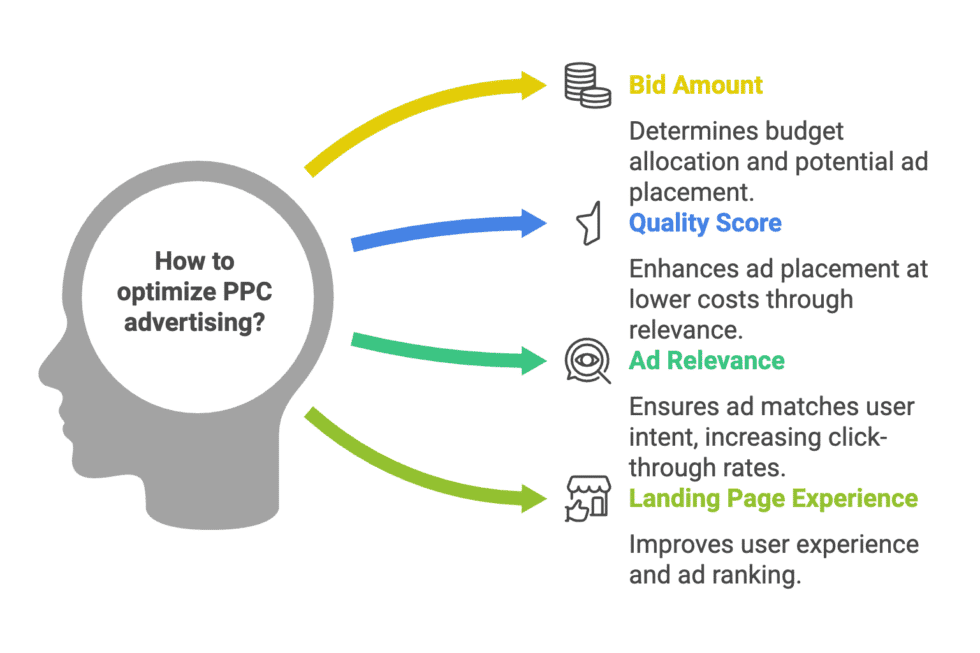
Ad Auctions and Keyword Bidding
In search engine marketing (SEM), keyword bidding is important. You pick keywords and set a maximum amount you want to spend per click. That is your PPC budget. During an ad auction, Google Ads or Microsoft Ads compare all bids. They also look at Quality Score and other factors. The best ads with the highest scores and smart bidding strategies get top spots.
AI-powered bidding, like Smart Bidding and Performance Max campaigns, can help improve results. These use first-party data to adjust bids automatically. This saves time and makes your PPC management easier. Good use of negative keywords keeps your ads from showing for the wrong searches. This can improve conversion rates and return on ad spend (ROAS).
Improving PPC Performance
Good PPC campaigns use strong ad copy and effective landing page optimization. Ad copy should match the keywords and grab attention. Landing pages must be clear and make it easy for customers to take action. Ad extensions, also called ad assets, add extra info to your ads. These can increase CTR and help your ad stand out.
You can run remarketing or retargeting ads to reach people who visited your site before. Display advertising and social media advertising offer more ways to get clicks. PPC for small business is very helpful because you can set your ad spend and grow as you see results. Tracking metrics like impression share, conversion rate, and ROAS helps you measure success and improve future campaigns.
Types of PPC Ads — Which Format Fits Which Goal
Search Ads: Paid Search Advertising and SEM
Search ads are the most common type of PPC ad. They show up at the top of search engine results when someone enters a keyword. With search engine marketing (SEM), you use keyword bidding to choose which searches show your ad. Google Ads and Microsoft Ads (Bing Ads) are big platforms for these. Paid search advertising works well if you want to reach people searching for your product now. These ads are based on cost per click (CPC). The higher your Quality Score and ad copy relevance, the less you pay for each click. Your goal with search ads is often to get more sales or leads. PPC vs SEO is important here—SEO is unpaid, but PPC brings instant traffic.
PPC management for search ads means picking the right keywords and using negative keywords to block unwanted searches. Ad auction systems decide whose ad gets shown. To improve your conversion rate, keep your landing page simple and clear. Good landing page optimization boosts your return on ad spend (ROAS). Many small businesses use PPC for small business growth because of the control it offers over ad spend.
Display, Social, and Remarketing Ads
Display ads appear on websites, apps, and YouTube. These use images or videos instead of just text. Display advertising is best for building brand awareness and reaching a wide audience. Social media advertising on platforms like Facebook and Instagram lets you target users by age, location, or interests. Social ads are great if your goal is engagement or building a following.
Remarketing (also called retargeting) helps you reach users who visited your site but didn’t buy. You can remind them to come back with special offers. This format is good for increasing conversion rate and moving leads closer to a sale. Both social and remarketing ads benefit from first-party data. AI-powered bidding and Performance Max campaigns can also help automate your bids for better results.
Comparing Formats: Which Ad Type for Which Goal?
Here is a simple table to compare PPC formats:
| PPC Format | Best Use | Key Platforms |
|---|---|---|
| Search Ads | Lead generation, sales | Google Ads, Bing Ads |
| Display Ads | Brand awareness | Google, YouTube |
| Social Ads | Engagement, audience building | Facebook, Instagram |
| Remarketing Ads | Re-engagement, conversions | Google, Facebook |
Choose the ad format that matches your digital marketing strategy and budget. Always track click-through rate (CTR), impression share, and ad extensions / assets. This will help you get the most from your PPC campaign.
PPC Platforms — Where You Should Actually Run Your Ads
Search Engines: Google Ads and Microsoft Ads
Search engines are the main home for pay-per-click advertising. Google Ads leads the way in search engine marketing (SEM). When businesses ask, “What Is PPC In Digital Marketing?”, Google Ads is often the answer. You can use keyword bidding to show ads when people search for what you offer. Google uses an ad auction and Quality Score to decide which ads show and how much you pay. Microsoft Ads, sometimes called Bing Ads, is another platform. It lets you reach people searching on Bing and Yahoo. Both platforms show your ads above or next to organic results. Paid search advertising helps you get in front of people looking for your products now.
PPC vs SEO is often a big question. Paid search gives you instant results, while SEO takes time. Google Ads and Microsoft Ads let you control your PPC budget. You can test ad copy, use negative keywords, and improve your conversion rate. You track cost per click (CPC), click-through rate (CTR), and return on ad spend (ROAS) to see success. Both platforms offer ad extensions or assets to make your ads stand out. You can use Smart Bidding or Performance Max campaigns for AI-powered bidding.
Social Media and Display Advertising
Social media advertising is another strong PPC channel. Facebook, Instagram, LinkedIn, and Twitter let you target people by age, interest, or job. This helps you reach new customers. You pay when users click or see your ad. Social platforms use first-party data to target the right audience. Display advertising shows your ads as banners or videos on other websites. Google Display Network and Microsoft display ads can help you get more impression share.
Both social and display ads allow for remarketing or retargeting. This means you show ads to people who visited your site but did not buy. These platforms let you test new ad copy and landing page optimization ideas to boost conversion rates. You can control your ad spend and track which channels drive sales. PPC for small business works well here as budgets can be set small and adjusted as you grow.
Choosing the Right PPC Platform
The best PPC platform depends on your digital marketing strategy and goals. Google Ads works well for search intent and high-volume keywords. Microsoft Ads can be cheaper and still reach many users. Social media platforms are good for brand building or reaching special groups. Display ads boost brand awareness and help with retargeting.
Choose platforms that support your PPC management needs. Test different ads, use negative keywords, and watch your ROAS. Use ad extensions, PPC campaign types, and AI-powered bidding tools. Review performance data and keep improving your strategy to grow your business with pay-per-click advertising.
Components of a Successful PPC Campaign
Choosing the Right Keywords and Bidding
Keyword bidding is very important in pay-per-click advertising. Picking the right keywords makes sure your ads show up to the right people. Use tools to find words that match what you sell or offer. Think about using both broad and long-tail keywords in your PPC campaign. This helps reach more people with search engine marketing (SEM).
Negative keywords help block your ads from showing for unrelated searches. This saves ad spend by reducing waste. Google Ads and Microsoft Ads (Bing Ads) both let you set negative keywords. Smart bidding tools, including AI-powered bidding and Performance Max campaigns, can help get more out of every cost per click (CPC). They adjust bids based on what works, boosting your conversion rate and return on ad spend (ROAS).
Creating Effective Ads and Landing Pages
Your ad copy should be clear, short, and catchy. Good ads answer the question: What Is PPC In Digital Marketing? They show the benefit of your offer. Use ad extensions or assets like call buttons or site links to make your ads stand out. This can increase your click-through rate (CTR) and impression share. Test different ad copy to see what works best.
Landing page optimization is key for higher conversions. The page should match the ad content and have a simple design. Make sure the landing page loads fast and is easy to use. This helps turn visitors into customers and helps improve your Quality Score in Google Ads. A high Quality Score can lower your CPC and increase ad placements in the ad auction.
Managing, Measuring, and Refining Your Campaign
PPC management is ongoing. Track how your PPC campaign is doing using first-party data and analytics. Watch metrics like ad spend, ROAS, and conversion rate. Adjust your PPC budget based on results. Try remarketing or retargeting to reach people who visited your site but did not buy. Use social media advertising and display advertising to reach even more people.
Regularly update your keyword list and ad copy. Remove keywords with poor results and add new ones as trends change. Keep improving your digital marketing strategy to get better results in paid search advertising. PPC for small business works best with careful planning and smart management.
How Much Does PPC Cost? (Real Numbers, Not Estimates)
Key Factors That Affect PPC Costs
The cost of pay-per-click advertising depends on many things. The biggest factor is keyword bidding. Some keywords, like “digital marketing strategy” or “Google Ads management,” cost more because many businesses want them. When you start a PPC campaign, you join an ad auction. You set your max bid for each click, known as cost per click (CPC). Your ad’s Quality Score also matters. Quality Score looks at your ad copy, CTR, landing page optimization, and how relevant your keywords are. Search engines, like Google and Microsoft Ads (Bing Ads), use this score to lower costs for better ads.
PPC for small business often means lower budgets. But even with a small PPC budget, targeting the right keywords and using negative keywords can help save money. Choosing long-tail keywords or niche terms lowers your average CPC. Paid search advertising costs go up for competitive industries, but smart PPC management can keep spending under control.
Real-World PPC Costs by Platform
Google Ads is the leading platform for PPC in digital marketing. The average CPC on Google Ads ranges from $1 to $2 for search network ads. On the display network, it is often under $1. Social media advertising platforms like Facebook or Instagram usually have lower CPCs, from $0.50 to $1.50. Microsoft Ads (Bing Ads) generally cost 20-30% less than Google Ads.
Here is a simple table of average CPC rates:
| Platform | Search CPC | Display CPC |
|---|---|---|
| Google Ads | $1.00 – $2.00 | $0.50 – $1.00 |
| Microsoft Ads | $0.80 – $1.60 | $0.30 – $0.80 |
| Facebook Ads | $0.50 – $1.50 | N/A |
These values show real numbers, but costs change by industry, keyword, and targeting.
How to Control and Optimize Your PPC Spend
You can control PPC costs with smart tactics. Use ad extensions to boost click-through rate (CTR) and improve Quality Score. Set a daily or monthly ad spend to match your PPC budget. Try AI-powered bidding, like Smart Bidding or Performance Max campaigns, to help maximize return on ad spend (ROAS). Remarketing and retargeting can lower costs by showing ads to people who visited your site before.
Check your impression share to see how often your ads show up. Use first-party data to shape your targeting. Regularly update your keywords, refine ad copy, and test landing page changes for better conversion rate. Good PPC management keeps costs low and results high in search engine marketing (SEM).
PPC in 2026-27— How AI and Automation Are Changing Everything
Smarter Keyword Bidding and Ad Auctions
AI is making keyword bidding much easier and smarter in PPC campaign management. With tools like Smart Bidding in Google Ads and Microsoft Ads (Bing Ads), advertisers let AI set bids to get the best cost per click (CPC). It looks at things like user search history, device, and even first-party data to decide when to raise or lower bids during an ad auction. This means your paid search advertising budget is used in the best way possible.
AI also affects Quality Score and ad copy. By reading lots of past data, AI helps you write better ad copy that matches what users want. It can even spot negative keywords you should block, saving your PPC budget from wasted clicks. This helps boost click-through rate (CTR) and get more conversions.
Advanced Targeting and Personalization
AI changes how we do PPC for small business by finding the best audience for every ad. With machine learning, ads show to users who are more likely to click and buy. Performance Max campaigns are a good example, using many types of data to reach shoppers across search engine marketing (SEM), social media advertising, and display advertising.
Remarketing and retargeting also get a boost from automation. AI tracks who visited your site and shows them your ads later, bringing them back for another chance to convert. You can even use ad extensions or assets to add more info to your ads and stand out in search results, winning more impression share.
Better Results Tracking and Budget Control
AI tools watch your PPC campaign and help with landing page optimization in real time. They measure return on ad spend (ROAS) and adjust targeting or ad spend to get the best value. You can see which ads, keywords, and devices work best and move your PPC budget to what delivers the highest conversion rate.
AI and automation also help compare PPC vs SEO. While SEO takes time, AI-powered paid search brings fast data that helps change your digital marketing strategy quickly. With these new tools, PPC management becomes simpler and results more predictable.
PPC vs SEO: Understanding the Differences
What Is PPC In Digital Marketing?
PPC, or pay-per-click advertising, is a core part of search engine marketing (SEM). With PPC, businesses pay a fee each time someone clicks on their ad. This is different from organic results, which are earned through search engine optimization (SEO). Google Ads and Microsoft Ads (Bing Ads) are common platforms for paid search advertising. PPC campaigns use keyword bidding, ad auctions, and focus on metrics like cost per click (CPC) and click-through rate (CTR). The goal is to drive targeted traffic fast and improve return on ad spend (ROAS).
How PPC and SEO Work
SEO involves optimizing web pages so they appear higher in unpaid search results. It is a long-term digital marketing strategy. SEO relies on content, links, and landing page optimization to increase visibility. In contrast, PPC uses paid placements. Advertisers set a PPC budget, select keywords, and write ad copy. Tools like negative keywords and ad extensions help control who sees the ads. Quality Score and ad auction play a big role in PPC success. SEO requires ongoing updates, while PPC can provide instant results with a higher conversion rate if managed well.
| Feature | PPC Advertising | SEO |
|---|---|---|
| Placement | Paid ads (top of page) | Organic listings |
| Cost | Pay per click (CPC) | No direct cost per click |
| Speed | Immediate visibility | Takes time to rank |
| Control | Full control (budget, ad copy, targeting) | Less control, relies on search engine rules |
| Data | First-party data, fast insights | Slower feedback |
When to Use Each Strategy
PPC for small business is great for quick leads and sales. It works well for remarketing, Performance Max campaigns, and social media advertising. Display advertising also helps reach new audiences fast. For long-term growth, SEO is key. Combining PPC management and SEO can be powerful. Use PPC for time-sensitive promotions or to test new products. Rely on SEO for steady traffic and trust. Both strategies benefit from landing page optimization, first-party data, and smart bidding. AI-powered bidding helps make the most of your ad spend and impression share.
Advanced PPC Strategies
Smart Keyword Bidding and Ad Auction Tactics
In PPC marketing, smart keyword bidding is key. Understanding What Is PPC In Digital Marketing can help set better bids. Advertisers use search engine marketing (SEM) tools to pick keywords with the best cost per click (CPC). High-intent keywords can drive more clicks and boost your return on ad spend (ROAS). Adjusting bids for specific devices or locations can improve your PPC campaign results. Google Ads and Microsoft Ads (Bing Ads) both offer options to fine-tune keyword bids.
Winning the ad auction means paying attention to Quality Score. Google measures ad relevance, CTR, and landing page quality. Higher Quality Scores lead to lower costs and better ad placement. Use ad extensions or assets to show more details, like phone numbers or links, on your ads. This can boost your impression share and click-through rate (CTR).
Advanced Ad Copy and Audience Targeting
Effective ad copy makes your paid search advertising stand out. Use clear, strong words that match what the searcher wants. Include keywords in your ads to raise Quality Score. Try A/B testing different headlines and descriptions to find the best performers. Good ad copy, paired with optimized landing pages, can raise your conversion rate.
PPC management often means targeting the right audience. Use negative keywords to stop your ads showing for unwanted searches. Remarketing or retargeting lets you show ads to people who have visited your site before. Social media advertising and display advertising offer more ways to reach shoppers on platforms like Facebook or Instagram. Performance Max campaigns use AI-powered bidding to help get the most from your PPC budget.
Maximizing Results with Data and Optimization
Landing page optimization is vital for driving more conversions. Pages must load fast and match the ad’s promise. Use first-party data from your website to build better PPC campaigns. Look at which keywords and ads lead to sales, then adjust your ad spend for those that work.
PPC for small business means careful management to get the best results. Track your impression share to see how often your ads show compared to others. Use tools in Google Ads and Microsoft Ads to see what’s working and what needs fixing. Making small changes each week can steadily improve your PPC campaign outcomes, helping you win in paid search advertising versus SEO.
PPC Management Best Practices
Setting Up Strong PPC Campaigns
A good PPC campaign starts with careful planning. First, choose the right keywords. Use tools to find words people search for. Focus on terms that match your business and goals. This is called keyword bidding. Make sure to include negative keywords. These words stop your ads from showing up in search results that do not help your business.
Pick between different types of paid search advertising. Google Ads and Microsoft Ads (Bing Ads) are popular. Set your cost per click (CPC) based on your budget. For PPC for small business, control your ad spend closely. Try using ad extensions or assets to make your ads stand out. Ad extensions add more info to your ads, like phone numbers or links.
Optimizing for Quality and Results
PPC management means improving your ads over time. Quality Score is important. It measures how relevant your ad, keywords, and landing pages are. A higher score can lower your CPC. Write clear ad copy that matches your keywords. Good ad copy helps your click-through rate (CTR) and conversion rate.
Landing page optimization is key. Your landing page should be easy to use and match your ad message. This helps turn visitors into customers. Use first-party data to target the right audience. Remarketing or retargeting can show your ad again to people who have visited your site before. This often increases sales.
Using Tools and Tracking Success
Digital marketing strategy should mix PPC with other tools. Try Performance Max campaigns or AI-powered bidding (Smart Bidding) for better results. Use social media advertising and display advertising to reach more people. Keep track of your impression share, which shows how often your ads are seen compared to others.
Always watch your PPC budget and ad spend. Check your return on ad spend (ROAS) to make sure your campaigns are working. Compare PPC vs SEO to see which brings more results for your business. Track results with tools like Google Ads reports. Use this data to make smart changes to your search engine marketing (SEM) plan.
Conclusion: The Future of PPC in Digital Marketing
PPC’s Growing Role in Digital Marketing Strategy
PPC, or pay-per-click advertising, is becoming more important for businesses of all sizes. As online competition grows, using paid search advertising can help brands stand out. Google Ads and Microsoft Ads (Bing Ads) are leading platforms for running a PPC campaign. These tools let companies use keyword bidding, negative keywords, and ad extensions to reach the right people. PPC for small business is especially useful because it allows businesses to control their PPC budget and target specific customers.
PPC vs SEO is a common topic in digital marketing strategy. While SEO focuses on organic growth, PPC delivers instant traffic and measurable results. Many companies use both strategies together for best results. Search engine marketing (SEM) blends these approaches, improving online visibility and driving more clicks. With tools like ad auction, Quality Score, and CPC, advertisers can manage campaigns and get the best return on ad spend (ROAS).
Key Trends Shaping PPC’s Future
AI-powered bidding and Smart Bidding are changing how PPC management works. These tools use first-party data to make smarter decisions in real time. Performance Max campaigns help advertisers reach audiences across many Google channels with one simple setup. This saves time and helps improve click-through rate (CTR) and conversion rate. Display advertising and social media advertising are also important. They allow brands to run remarketing or retargeting campaigns, bringing back visitors who did not convert the first time.
Ad copy and landing page optimization remain important for success. Well-written ad copy improves CTR, while landing page changes boost conversion rate. Ad extensions or assets make ads more helpful and engaging. Impression share is another key metric, showing how often your ads appear compared to competitors. Using negative keywords helps block unwanted clicks and saves ad spend.
Building Success With PPC
For the future, businesses should focus on:
- Using first-party data for better targeting.
- Testing different ad copy and landing pages.
- Tracking metrics like CTR, CPC, and ROAS.
- Managing PPC budget carefully.
Here is a simple table of important PPC elements:
| Element | Purpose |
|---|---|
| Keyword bidding | Targets the right search terms |
| Quality Score | Lowers CPC, improves ad position |
| Negative keywords | Blocks unwanted clicks |
| Ad extensions/assets | Adds info, improves engagement |
| Remarketing/Retargeting | Re-engages visitors |
| Smart Bidding | Automates and improves bid strategy |
PPC will keep changing as new tools and features come out. Staying updated and testing new ideas will help drive better results in every PPC campaign.
FAQ
What is PPC in digital marketing?
PPC stands for pay-per-click advertising, a digital marketing model where businesses pay only when someone clicks on their online ads. It allows control over ad spend and targeting, with popular platforms like Google Ads and Microsoft Ads.
How does PPC differ from SEO?
PPC involves paying for clicks to gain instant traffic, offering full control over budget and targeting. SEO focuses on organic, unpaid traffic growth that takes longer but may cost less over time. Both are important in a digital marketing strategy.
How does PPC work?
PPC works through keyword bidding and ad auctions. Advertisers select keywords and set a maximum cost per click (CPC). When users search, an auction decides which ads show based on bids, ad relevance, and Quality Score.
What is Quality Score in PPC?
Quality Score measures ad copy relevance, landing page quality, and click-through rate (CTR). Higher scores reduce CPC and improve ad placement in auctions.
What are negative keywords?
Negative keywords block ads from showing on irrelevant searches, saving ad spend and improving conversion rates.
What are ad extensions or assets?
Ad extensions add extra information like call buttons or site links to ads, increasing engagement and click-through rates.
What is Smart Bidding and AI-powered bidding?
These are automated bidding strategies using AI to optimize bids in real-time based on data like user behavior and device, improving cost efficiency and campaign results.
What are the key benefits of PPC for small businesses?
PPC is flexible, fits any budget, allows tracking of spend and impression share, and helps small businesses compete by delivering quick results, more clicks, and sales.
What types of PPC ads are there?
Common types include search ads (for lead generation and sales), display ads (for brand awareness), social ads (for engagement and audience building), and remarketing ads (to re-engage past visitors).
Which platforms support PPC advertising?
Google Ads and Microsoft Ads (Bing Ads) are primary platforms for search advertising. Social media platforms like Facebook and Instagram support social ads, and Google Display Network supports display ads.
How do ad auctions work in PPC?
During an auction, search engines compare bids and Quality Scores of competing ads. The highest scoring ads with the best bids and relevance win top placements.
How can PPC performance be improved?
By selecting relevant keywords, writing strong ad copy, optimizing landing pages for conversions, using negative keywords, utilizing ad extensions, and employing AI-powered bidding tools.
What is remarketing or retargeting in PPC?
Remarketing targets users who previously visited a website but didn’t convert, showing them ads to encourage return visits and increase conversions.
How do you control and optimize PPC spend?
Set daily or monthly budgets, use ad extensions to boost CTR, apply AI bidding strategies, track impression share, and continuously refine keywords, ad copy, and landing pages.
What factors affect PPC costs?
Keyword competition, bid amounts, Quality Score, and ad relevance all influence costs. Competitive keywords cost more per click, while higher Quality Scores can lower CPC.
What are typical PPC costs on different platforms?
Average CPCs are roughly $1-$2 for Google search ads, under $1 for Google display ads, $0.80-$1.60 for Microsoft search ads, and $0.50-$1.50 for Facebook ads, though costs vary by industry and targeting.
How do you choose the right PPC platform?
Based on marketing goals: Google Ads for search intent and volume, Microsoft Ads for cost savings, social platforms for audience targeting, and display networks for brand awareness.
What are the essential elements of a successful PPC campaign?
Keyword bidding, Quality Score optimization, use of negative keywords, engaging ad extensions, remarketing, and smart bidding automation.
How does AI impact PPC management?
AI automates bid adjustments, improves ad copy relevance, identifies negative keywords, enhances targeting, and helps optimize budget allocation for better ROI.
When should businesses use PPC versus SEO?
Use PPC for immediate traffic, quick leads, and time-sensitive promotions. Use SEO for long-term organic growth and steady traffic. Combining both often yields the best results.
What metrics are important to track in PPC campaigns?
Cost per click (CPC), click-through rate (CTR), return on ad spend (ROAS), impression share, and conversion rate.
How important is landing page optimization in PPC?
Very important; landing pages must be relevant, fast-loading, and easy to use to increase conversion rates and improve Quality Score.
What role does first-party data play in PPC?
It helps refine audience targeting, improve bidding strategies, and boost campaign effectiveness by using insights from your own customers.
How can small businesses benefit from PPC?
By setting manageable budgets, targeting the right audience, leveraging remarketing, and scaling campaigns based on measurable results.
What are Performance Max campaigns?
Google’s AI-driven campaigns that use machine learning to optimize bids and ad placements across multiple channels for better overall performance.
Why are negative keywords important?
They prevent ads from appearing in irrelevant searches, reducing wasted spend and improving return on investment.
What is impression share?
A metric showing how often your ads appear compared to total available impressions, helping measure visibility against competitors.
How do ad extensions improve PPC ads?
They add additional clickable information, making ads more useful and increasing the likelihood of user engagement.
What is the relationship between Quality Score and CPC?
Higher Quality Scores typically lower the cost per click and improve ad position in auctions.
How can remarketing increase conversions?
By reminding previous visitors about your offerings, increasing the chances they return and complete a purchase.
What strategies help improve PPC click-through rates?
Using clear, relevant ad copy with keywords, employing ad extensions, targeting the right audience, and testing different ad versions.
How does PPC fit into an overall digital marketing strategy?
PPC provides quick, targeted traffic and measurable results, complementing SEO and other marketing efforts for balanced growth.
What future trends are shaping PPC?
Increased use of AI-powered bidding, cross-channel campaigns like Performance Max, enhanced personalization, and improved automation tools.
How often should PPC campaigns be managed and updated?
Regularly; updating keywords, testing ad copy, refining targeting, and analyzing performance data is essential for ongoing success.