

What each term means and why the distinction matters
Search Engine Optimization (SEO): What It Is
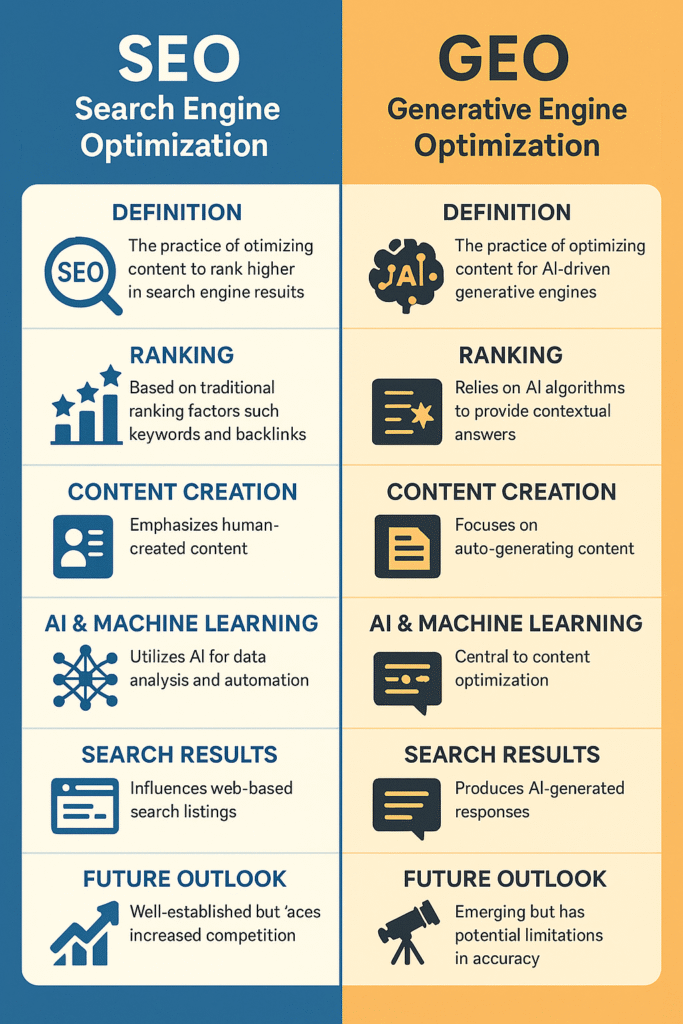
Search Engine Optimization (SEO) is a way to help people find your website on search engines like Google and Bing. It uses keywords, clear writing, and links from other sites to boost your place on search results. SEO also uses structured data so search engines understand your content better. The goal is to get your website to show up higher on the page when someone searches for something you offer. SEO uses tools like EEAT (Experience, Expertise, Authoritativeness, Trustworthiness) to show that your site is safe and smart.
SEO has clear success signals. You can measure clicks, how long people stay, and if they click other pages. These are called visibility metrics. SEO is important because it brings visitors to your site and helps your brand grow over time.
Generative Engine Optimization (GEO): What Makes It Different
Generative engine optimization (GEO) is new. It helps content show up in answers made by AI. These answers come from large language models like Google SGE and BingChat. Instead of just showing a list of links, AI search gives people direct answers. GEO means making AI-ready content that can be found, cited, and trusted by AI tools.
GEO uses techniques like structured data for AI, answer engine optimization (AEO), and content summarization signals. Adding expert quotes, facts, and clear sections helps AI “see” your information. GEO also uses AI visibility metrics—like how often your content is cited or shown in AI responses. GEO is about getting your words in the answers, not just the link list.
Why the Distinction Between SEO vs GEO Matters
The difference between Search Engine Optimization vs Generative Engine Optimization matters because the way people search is changing. AI-first search is growing. People ask questions using conversational search. They want fast, clear answers. GEO focuses on being the content AI uses for those answers through large language model optimization (LLMO). SEO still matters for regular searches, but GEO puts your brand in the new AI spotlight.
This means you need both. Mixing SEO with GEO helps your content rank in lists and get cited in AI results. Using both keeps your brand visible, trusted, and up-to-date. As Google generative results and AI search optimization grow, blending both strategies ensures you stay ahead.
How search behavior and platforms are changing
The Shift from Traditional Search to AI-Driven Search
People used to search by typing keywords into engines like Google. Search Engine Optimization (SEO) helped websites show up in those results. But now, things are changing fast. New tools use generative engine optimization (GEO) and large language model optimization (LLMO) to help content appear in AI-created answers. AI-first search platforms, such as Google SGE and BingChat, now give users direct answers instead of only showing website links. This means users get information faster, and brands need to change how their content is found.
With AI search optimization and answer engine optimization (AEO), engines summarize and pull information from many sites. They use structured data for AI and content summarization signals to decide what to show. Instead of people clicking links, AI often uses content that is clear, well-structured, and easy to cite. This makes it important to focus on making AI-ready content.
New Metrics and Content Needs for AI Platforms
AI platforms care about more than just keywords. They use EEAT (Experience, Expertise, Authoritativeness, Trustworthiness) to judge if content is trustworthy. This changes what counts as “good” content. AI visibility metrics now look at things like being cited in Google generative results or linked in conversational search optimization. It is not only about page visits but also about whether AI models find and use your content.
To meet these new needs, content should include:
- Clear headers and lists
- Direct answers to common questions
- Easy-to-find facts and sources
- Proper use of schema and structured data for AI
A table can help compare old and new metrics:
| Metric | Old SEO Approach | GEO/AI Approach |
|---|---|---|
| Keyword Ranking | High importance | Lower importance |
| Click-Through Rate | Core metric | Less relevant |
| AI Citations | Not tracked | High importance |
| EEAT | Growing factor | Essential for AI |
| Structured Data | Helpful | Required for best results |
The Changing Role of Content for Search
SEO vs GEO is now a daily challenge for brands and publishers. Sites must create content that both humans and AI can use. AI platforms want up-to-date facts, clear answers, and trusted sources. They also need summaries and answers in formats AI understands, like FAQs and bullet lists.
Generative engine optimization (GEO) means focusing on how AI finds and cites information. AI search optimization looks for content summarization signals—like TL;DRs, expert quotes, and clear data. Sites should track AI visibility metrics, such as citation in Google generative results, to know if their content is working. Brands that adapt to this new world will stay visible and trusted as search platforms keep changing.
Core technical differences: indexing vs retrieval & summarization
How SEO Indexes and Ranks Content
Search Engine Optimization (SEO) works with search engines that use indexing and ranking. Search engines like Google crawl web pages and save them in a huge index. When a user types a question, the engine looks for the best matches in this index. Ranking is based on keywords, backlinks, structured data, and EEAT (Experience, Expertise, Authoritativeness, Trustworthiness). Sites use SEO strategies like meta tags, sitemaps, and schema markup to help engines find and list their content. Here, visibility depends on where your page shows up in the search results.
SEO uses structured data for AI and classic web search, so a clear page layout and reliable sources count. The focus is on attracting human visitors who click links, read information, and interact with sites. Visibility is measured by clicks, impressions, and positions in search engine results pages (SERPs). This is called traditional search engine optimization.
How GEO Summarizes and Cites Content
Generative engine optimization (GEO) is different. GEO works with AI-driven engines like Google SGE and BingChat, which use large language models (LLMs). LLMs do not just list web pages. Instead, they read lots of sources, retrieve pieces of information, and generate direct answers for users in a conversational way. They use techniques like answer engine optimization (AEO) and large language model optimization (LLMO). GEO focuses on making content easy for AI to read, understand, and cite.
These AI-first search engines look for clear, direct, and well-structured content. AI-ready content includes short summaries, lists, bullet points, and clear citations or attributions to sources. GEO helps ensure your content is picked up and referenced by AI when providing answers. Instead of tracking clicks, GEO uses metrics like AI citations and attribution, visibility in AI answers, and content summarization signals.
Comparing SEO vs GEO: A Technical Table
| Feature | SEO (Index & Rank) | GEO (Retrieve & Summarize) |
|---|---|---|
| Indexing Method | Crawling & Storing | AI Retrieval & Summarization |
| Visibility Goal | SERP Rankings | AI Citations in Answers |
| Content Format | Web Pages | Lists, Summaries, FAQs |
| Optimization | Keywords, EEAT | AI-ready, Structured for LLMs |
| Metrics | Clicks, Impressions | AI Citations, Summarization |
SEO vs GEO shows a big shift: classic search wants to rank pages, but generative engines want to pull answers and quote sources. For AI search optimization, focus on conversational search optimization and content that is structured for both people and AI.
Content strategy: writing for blue links and AI answers
Writing for Search Engine Optimization (SEO): Blue Links
Search Engine Optimization (SEO) helps content appear in search engines like Google and Bing. To get blue links, writers focus on keywords, headings, and clear page structure. SEO uses targeted keywords so search engines can understand what a page is about. Using strong titles and headings makes it easier for people and machines to find the main points.
SEO also relies on backlinks from other trusted sites. These links build authority and improve rankings in search results. Using EEAT (Experience, Expertise, Authoritativeness, Trustworthiness) helps content rank higher. Pages need to be easy to read and answer common questions. Lists, tables, and short paragraphs help with this. SEO success is tracked using metrics like clicks, bounce rates, and time on page.
Optimizing for Generative Engines: GEO, AEO, and LLMO
Generative engine optimization (GEO) and answer engine optimization (AEO) focus on AI-first search. Modern AI search engines like Google SGE and BingChat use large language models to answer questions directly. Instead of showing just blue links, these tools summarize information from many sites.
To help AI select content, writers need structured data for AI. This means using clear bullet points, tables, and FAQ sections. Adding in-line citations and attribution signals tells the AI where facts come from. Content summarization signals, such as TL;DR sections, help AI understand the main ideas fast. AI-ready content also includes up-to-date facts, statistics, and expert quotes. GEO and AEO track success with new AI visibility metrics, like being cited or mentioned in AI-generated answers.
Balancing SEO vs GEO: Best Practices
Writers now need to blend SEO and GEO methods. Traditional SEO still matters for blue links, but GEO brings new needs. The best content strategy uses both approaches. For SEO, focus on keywords, links, and EEAT. For GEO and AEO, add structured lists, expert attributions, and clear answer formats.
A table can help compare the approach:
| Strategy | Focus | Key Tactics |
|---|---|---|
| SEO | Blue links, clicks | Keywords, links, EEAT |
| GEO/AEO/LLMO | AI citations, answers | Structure, attributions, TL;DR |
This balance ensures content is visible in blue links and AI answers, and adapts to how search is changing.
On‑page and markup tactics for GEO
Structuring AI-Ready Content for Generative Engines
Creating content for generative engine optimization (GEO) is different from classic Search Engine Optimization (SEO). In GEO, information must be clear, accurate, and easy for AI tools to use. This is important for AI search optimization and large language model optimization (LLMO). Using short sentences, simple words, and clear headlines helps AI models like those in Google SGE or other AI-first search tools find answers quickly. Use bullet points and numbered lists for facts or step-by-step guides. These structures help answer engine optimization (AEO) by making content easy for AI to cite and summarize.
Content should also include summary sections, such as TL;DRs or quick FAQs. These signals help AI models pick up key information faster. Organizing content with bolded main ideas, subheadings, and clear question-answer pairs improves conversational search optimization. This can lead to better AI visibility metrics and more citations in generative search results.
Boosting Credibility with Markup and EEAT
Markup adds signals for both users and AI tools. Adding schema markup, like FAQ or HowTo schema, helps AI engines understand page structure. This is important for AI citations and attribution. Clearly mark author names, dates, and sources in your content. These trust signals support EEAT (Experience, Expertise, Authoritativeness, Trustworthiness), which both SEO and GEO value. Use in-line citations and expert quotes for strong authority. Linking to reputable sources strengthens content for both Search Engine Optimization vs Generative engine optimization.
Include structured data for AI, such as organization, person, or event schema. This helps Google SGE and other generative search tools recognize your brand. Use meta tags that state the purpose and summary of each page. These markup tactics increase the chance of your content appearing in AI-generated answers.
Tracking GEO Success and Optimization Signals
To check if your GEO tactics work, measure AI visibility metrics like citations in AI results and brand mentions. Set up reports to track when your content is referenced by large language models. Compare these with classic SEO metrics, such as clicks and rankings, to see the balance of success in SEO vs GEO.
Also, keep your content up-to-date and relevant. Refresh summaries, update lists, and add recent expert quotes. This lets AI models see that your site provides current, trustworthy information. Using both Search Engine Optimization (SEO) and generative engine optimization (GEO) tactics together helps brands stay visible in today’s evolving search landscape.
Measurement and KPIs: how to track GEO success
Key Metrics for GEO Success
Tracking generative engine optimization (GEO) means using new metrics, not just the old Search Engine Optimization (SEO) ones. GEO looks at how often AI tools, like Google SGE or large language models, cite or use your content. These AI visibility metrics are different from simple click data. You need to count how many times your brand or article is mentioned in AI-generated answers. Table 1 shows some important metrics:
| Metric | Description |
|---|---|
| AI Citations/Attributions | Number of times AI references your content |
| Brand Mentions in AI | How often your name shows up in AI answers |
| Structured Data for AI Usage | Did your structured data help AI use your content? |
| EEAT Signals | Authority and trust signals detected by AI |
| Content Summarization Count | Number of times your info is summarized in AI |
Tracking Tools and Methods
To measure SEO vs GEO, use special tools along with classic analytics. Google Search Console tracks SEO clicks, but GEO needs more. You might use brand monitoring platforms that spot mentions in Google generative results or AI answers. Some tools also scan answer engine optimization (AEO) wins, like getting featured in FAQs or lists in AI search. Watching structured data for AI, like schema markup, helps you see if AI uses your information. Tracking large language model optimization (LLMO) is about seeing if your content is quoted in ChatGPT or similar tools.
Make lists of target keywords and check if AI search optimization engines show your content for those topics. Save examples of when your content is cited by AI. Keep a record of any conversational search optimization wins, such as when your answers appear in AI chats.
Analyzing and Improving GEO Performance
After collecting GEO data, compare it with old SEO numbers. If organic clicks drop but AI mentions rise, it means your AI-ready content strategy is working. Also, check if your EEAT signals, like expertise and trust, are strong in AI responses. Summarization signals, like clear TL;DRs, can help boost your mentions in AI answers.
Focus on updating content and adding facts, lists, and summaries. This helps with both GEO and AEO, making your content easier for AI engines to use and reference. Use structured content and schema to increase AI citations and attribution in the new world of AI-first search.
Link building, citations, and authority in the GEO era
How Link Building Changes from SEO to GEO
In Search Engine Optimization (SEO), link building means getting other websites to link to yours. These links act like votes that tell search engines your site is trustworthy. In the world of generative engine optimization (GEO), the focus shifts. Now, it is not just about who links to you. It’s about how AI sees and uses your content. AI search optimization in tools like Google SGE or BingChat values clear sources and useful information. For GEO, it is important to use structured data for AI and show strong content summarization signals. This helps large language models understand and cite your work.
In GEO, citations are more than just links. Generative engines need to trust your facts. Adding original research, expert quotes, and clear data points boosts your authority. Using EEAT (Experience, Expertise, Authoritativeness, Trustworthiness) is key for both SEO and GEO. But for GEO, transparency and clarity make your content AI-ready.
Citations and Attribution for AI-driven Search
Traditional SEO links help with rankings, but GEO relies on citations in a new way. AI models look for stated sources and clear attribution in content. Answer engine optimization (AEO) and large language model optimization (LLMO) both need well-cited facts. This means including the names of experts, organizations, and even direct quotes. Using structured lists, tables, and bullet points makes it easier for conversational search optimization tools to find and use your information.
AI search optimization means your content must be easy to parse for machines. Google generative results often favor content that is neatly organized and full of trustworthy signals. Adding schema markup and structured data helps AI engines know what to show in their answers. This increases the chance your brand or site will be referenced in AI results.
Measuring Authority and AI Visibility Metrics
In the SEO vs GEO era, measuring success is also changing. SEO uses traffic and click-through rates. GEO uses AI visibility metrics. These include how often your brand appears in AI-generated answers. You can track mentions of your site or experts in Google SGE, BingChat, and other AI-first search platforms.
Table: Key Metrics for SEO vs GEO
| Metric Type | SEO Focus | GEO Focus |
|---|---|---|
| Backlinks | Yes | Sometimes |
| Click-Through Rate | High | Less important |
| AI Citations/Attribution | Low | High |
| Brand Mentions in AI | Not Tracked | Essential |
| Structured Data Use | Helpful | Critical |
To win in both SEO and GEO, build quality links, provide strong citations, and use structure. AI-ready content and clear authority signals will help your content get noticed by both traditional search engines and generative AI platforms.
Practical roadmap: transitioning an existing SEO program to include GEO
Assessing Your Current SEO Program
Start by taking stock of your existing Search Engine Optimization (SEO) efforts. Review your keyword strategies, backlink profiles, and on-page SEO elements. Check if your content already follows EEAT (Experience, Expertise, Authoritativeness, Trustworthiness) guidelines. Identify areas where your website performs well in traditional search engine rankings, like Google. Compare your current SEO tactics against the needs of generative engine optimization (GEO).
Next, look for gaps. Does your content include clear sources for facts or statistics? Are you using structured data, like schema markup, that helps AI engines understand your content? Make a list of what you need to add or adjust to support both SEO and GEO goals. Understanding the overlap between SEO vs GEO is key before moving forward.
Integrating GEO Tactics Into Existing Workflows
Begin optimizing for AI-first search and large language model optimization (LLMO) by updating your content formats. Add summaries at the top or bottom of articles for content summarization signals. Use clear headings, bullet points, and lists to help with answer engine optimization (AEO) and conversational search optimization. Make sure facts, quotes, and data points are properly cited so AI search like Google SGE can attribute your brand in its generative results.
Update structured data for AI and include schema for articles, FAQs, and authors. This helps search engines and AI models better parse your information. Also, review and refresh old content to make it AI-ready, focusing on clarity and simplifying complex ideas. Whenever possible, add expert quotes or unique insights for better AI citations and attribution in generative search results.
Measuring and Monitoring Success
Switch your success tracking from clicks alone to also include AI visibility metrics. Track how often your content appears as a citation in Google generative results or other AI search engines. Set up tools that monitor brand mentions in AI summaries and conversational answers.
Create a table to compare old and new metrics:
| Metric Type | SEO (Traditional) | GEO (AI-Driven) |
|---|---|---|
| Click-Through Rate | Yes | Sometimes |
| Bounce Rate | Yes | No |
| AI Citations/Attribution | No | Yes |
| EEAT Signals | Yes | Critical |
| Structured Data Usage | Sometimes | Always |
Use both sets of metrics to guide future improvements. Regularly review results to keep your content ahead in both Search Engine Optimization vs Generative landscapes.
Privacy, ethics, and brand safety when AI cites your content
How AI Search Impacts Privacy and Brand Safety
With Search Engine Optimization vs Generative approaches, AI tools now pull from many online sources. Generative engine optimization (GEO) and answer engine optimization (AEO) help content appear in AI search results, like Google SGE or Bing Chat. But when AI search optimization uses your content, privacy and brand safety become concerns. Large language models may summarize or quote your work, sometimes without proper AI citations and attribution. This means your brand could be linked to answers you didn’t write. Your content may appear out of context or lack the structure you intended. It’s important to use structured data for AI, so content stays linked to your brand. Following EEAT (Experience, Expertise, Authoritativeness, Trustworthiness) helps protect your reputation in an AI-first search world.
A table like this can help track your content’s use across platforms:
| Platform | Citation Method | Brand Mentioned | Context Accurate? |
|---|---|---|---|
| Google SGE | Direct Quote | Yes | Yes |
| Bing Chat | Paraphrase | No | Somewhat |
| Reddit Answers | Link | Yes | No |
Ethical Concerns in AI-Driven Content Discovery
With SEO vs GEO, ethical concerns rise as AI pulls from many sites. AI-ready content may be reused by others or changed by the AI’s summarization process. Sometimes, these changes can affect how people view your brand. For example, AI summarization signals might make your message shorter, but less clear. Ensuring your content has clear citations, accurate data, and visible EEAT signals keeps your brand safe. Brands should check AI visibility metrics to see how and where their content is used in AI-driven results.
Here are some best practices for ethical AI search optimization:
- Add author names and credentials for credibility
- Use facts and cite sources in each section
- Add structured lists and FAQs for conversational search optimization
- Set up alerts for brand mentions in Google generative results
Managing Attribution and Control
Brands worry about losing control when AI uses their content in conversational search or large language model optimization (LLMO). It’s important to monitor where your content appears, who is quoting it, and in what context. Add content summarization signals and schema markup to guide AI in proper use. By tracking AI citations and attribution, brands can respond when content is misused or misunderstood. Managing both Search Engine Optimization (SEO) and generative engine optimization (GEO) is key to maintaining control and safety in this new search era.
Case studies and proven tactics
Real-world examples: SEO vs GEO in action
Many brands are now testing both Search Engine Optimization (SEO) and Generative Engine Optimization (GEO). For example, a news publisher used SEO to target Google search rankings with keyword-focused articles. At the same time, they also applied generative engine optimization (GEO) by adding clear headlines, TL;DR summaries, and in-line citations to make their stories easy for large language models like Google SGE to cite. The result: their stories showed up in both regular search results and Google generative results. This increased their AI visibility metrics and extended their reach to new AI-first search users.
Another case: a tech blog optimized for answer engine optimization (AEO) by structuring their content into question-and-answer formats and using lists. They tracked AI citations and attribution in BingChat. Their content appeared in AI-generated responses, boosting site impressions even when click-throughs fell. This proves how AEO, LLMO, and conversational search optimization can bring value as AI search grows.
Proven tactics for AI-ready content
- Use structured data for AI: Mark up articles with schema for facts and authors. This helps AI systems understand your content and gives it EEAT signals (Experience, Expertise, Authoritativeness, Trustworthiness).
- Create content summarization signals: Write TL;DR sections and clear summaries. These help large language models pick out key facts for citation and response.
- Focus on conversational search optimization: Write in direct, simple language. Use FAQs and lists to answer common questions clearly. This makes content easy for AI to parse and cite.
- Track new AI visibility metrics: Monitor impressions, AI citations, and attribution, not just clicks. These show if your content is referenced in AI answers.
Comparing results: SEO vs GEO
A table can show how tactics impact results:
| Tactic | SEO Result | GEO Result |
|---|---|---|
| Keyword optimization | Higher search rank | Low LLM citations |
| Structured data for AI | Rich results | More AI citations |
| Summarization signals | No effect | Boosts AI citations |
| FAQ/list formatting | Better snippet chance | Boosts answer inclusion |
| Expert quotes/E-E-A-T signals | Higher trust signals | Authority in AI answers |
These case studies show that using both Search Engine Optimization vs Generative tactics brings better results in both spaces. Brands that blend SEO, GEO, and AEO will lead in the new world of AI-first search.
Tools, checklists and resources
Essential Tools for SEO vs GEO
When working with Search Engine Optimization (SEO) and Generative Engine Optimization (GEO), the right tools make a big difference. For SEO, use platforms like Google Search Console, SEMrush, and Ahrefs. These help you track keywords, measure traffic, and spot problems. For GEO, try Jasper, Surfer AI, and Content at Scale. These tools help you prepare AI-ready content, check for structured data for AI, and watch how content is cited in Google SGE or other AI-first search tools.
Large language model optimization (LLMO) tools can show how your content is used in AI-generated answers. Look for platforms that track AI citations and attribution. These help you see where your content appears in AI results. You can also use schema markup tools to make your content easier for conversational search optimization.
Checklists for AI Search Optimization
A checklist can help you make sure your content fits both SEO and GEO needs. Here are some key points:
- Use clear headlines and summaries (content summarization signals).
- Add structured lists, FAQs, and schema markup for AI parsing.
- Show expertise, experience, authoritativeness, and trust (EEAT).
- Include sources and expert quotes for AI citations and attribution.
- Update your content to stay AI-ready.
For answer engine optimization (AEO), always use simple, direct language. Break down information into steps or tips. Make sure your content is easy to quote or cite in AI-generated results.
Resources to Improve AI Search Visibility
Many resources can guide you in the Search Engine Optimization vs Generative world. Google Search Central gives tips on SEO basics. For GEO, Jasper and other AI platforms offer guides on optimizing for Google generative results and BingChat. Look for blogs and videos about generative engine optimization (GEO), answer engine optimization (AEO), and AI search optimization.
Use AI visibility metrics tools to track where your content appears in AI answers. Some analytics platforms now track AI impressions, so you can see which pages are cited by AIs. There are also online courses on structured data for AI, writing with EEAT, and conversational search optimization. These help you stay ahead as AI-first search becomes more common.
FAQs people actually search for
What is the difference between Search Engine Optimization (SEO) and Generative Engine Optimization (GEO)?
SEO is about helping websites appear higher in regular search results. It uses things like keywords, links, and good content. GEO focuses on getting content picked up and cited by AI tools, like Google SGE and BingChat. GEO pays attention to AI search optimization, answer engine optimization (AEO), and large language model optimization (LLMO). SEO wants clicks to your website, but GEO wants your content shown in AI answers. GEO uses strong facts, clear structure, and EEAT signals so AI trusts your information.
How do you optimize content for AI-first search and Google generative results?
To show up in AI-first search, start by making your content clear and trustworthy. Use structured data for AI, like headings, lists, and tables, which help AI models understand your information. Add citations, statistics, and expert quotes to boost your chances of being picked as an AI citation. Focus on content summarization signals, such as TL;DR sections and bullet points. These features make your content easier for AI to summarize and display. Always keep your data up to date to match what users are searching for in conversational search optimization.
| SEO Focus | GEO Focus |
|---|---|
| Keywords | AI citations and attribution |
| Backlinks | Answer engine optimization (AEO) |
| Meta descriptions | Content summarization signals |
| High click rates | AI-ready content and EEAT |
What metrics and strategies should you watch for in GEO vs SEO?
For SEO, look at metrics like clicks, bounce rate, and rank. GEO requires tracking AI visibility metrics, such as how often your content is cited by AI or appears in Google generative results. Watch for brand mentions in AI answers and measure your authority through AI-ready content. Mixing structured data, expert commentary, and clear answers helps with both SEO and GEO. Updating your strategy to include both methods can increase your site’s visibility in both regular and AI-first search results.ude schema for articles, FAQs, and authors. This helps search engines and AI models better parse your information. Also, review and refresh old content to make it AI-ready, focusing on clarity and simplifying complex ideas. Whenever possible, add expert quotes or unique insights for better AI citations and attribution in generative search results.
Measuring and Monitoring Success
Switch your success tracking from clicks alone to also include AI visibility metrics. Track how often your content appears as a citation in Google generative results or other AI search engines. Set up tools that monitor brand mentions in AI summaries and conversational answers.
Create a table to compare old and new metrics:
| Metric Type | SEO (Traditional) | GEO (AI-Driven) |
|---|---|---|
| Click-Through Rate | Yes | Sometimes |
| Bounce Rate | Yes | No |
| AI Citations/Attribution | No | Yes |
| EEAT Signals | Yes | Critical |
| Structured Data Usage | Sometimes | Always |
Use both sets of metrics to guide future improvements. Regularly review results to keep your content ahead in both Search Engine Optimization vs Generative landscapes.
Privacy, ethics, and brand safety when AI cites your content
How AI Search Impacts Privacy and Brand Safety
With Search Engine Optimization vs Generative approaches, AI tools now pull from many online sources. Generative engine optimization (GEO) and answer engine optimization (AEO) help content appear in AI search results, like Google SGE or Bing Chat. But when AI search optimization uses your content, privacy and brand safety become concerns. Large language models may summarize or quote your work, sometimes without proper AI citations and attribution. This means your brand could be linked to answers you didn’t write. Your content may appear out of context or lack the structure you intended. It’s important to use structured data for AI, so content stays linked to your brand. Following EEAT (Experience, Expertise, Authoritativeness, Trustworthiness) helps protect your reputation in an AI-first search world.
A table like this can help track your content’s use across platforms:
| Platform | Citation Method | Brand Mentioned | Context Accurate? |
|---|---|---|---|
| Google SGE | Direct Quote | Yes | Yes |
| Bing Chat | Paraphrase | No | Somewhat |
| Reddit Answers | Link | Yes | No |
Ethical Concerns in AI-Driven Content Discovery
With SEO vs GEO, ethical concerns rise as AI pulls from many sites. AI-ready content may be reused by others or changed by the AI’s summarization process. Sometimes, these changes can affect how people view your brand. For example, AI summarization signals might make your message shorter, but less clear. Ensuring your content has clear citations, accurate data, and visible EEAT signals keeps your brand safe. Brands should check AI visibility metrics to see how and where their content is used in AI-driven results.
Here are some best practices for ethical AI search optimization:
- Add author names and credentials for credibility
- Use facts and cite sources in each section
- Add structured lists and FAQs for conversational search optimization
- Set up alerts for brand mentions in Google generative results
Managing Attribution and Control
Brands worry about losing control when AI uses their content in conversational search or large language model optimization (LLMO). It’s important to monitor where your content appears, who is quoting it, and in what context. Add content summarization signals and schema markup to guide AI in proper use. By tracking AI citations and attribution, brands can respond when content is misused or misunderstood. Managing both Search Engine Optimization (SEO) and generative engine optimization (GEO) is key to maintaining control and safety in this new search era.
Case studies and proven tactics
Real-world examples: SEO vs GEO in action
Many brands are now testing both Search Engine Optimization (SEO) and Generative Engine Optimization (GEO). For example, a news publisher used SEO to target Google search rankings with keyword-focused articles. At the same time, they also applied generative engine optimization (GEO) by adding clear headlines, TL;DR summaries, and in-line citations to make their stories easy for large language models like Google SGE to cite. The result: their stories showed up in both regular search results and Google generative results. This increased their AI visibility metrics and extended their reach to new AI-first search users.
Another case: a tech blog optimized for answer engine optimization (AEO) by structuring their content into question-and-answer formats and using lists. They tracked AI citations and attribution in BingChat. Their content appeared in AI-generated responses, boosting site impressions even when click-throughs fell. This proves how AEO, LLMO, and conversational search optimization can bring value as AI search grows.
Proven tactics for AI-ready content
- Use structured data for AI: Mark up articles with schema for facts and authors. This helps AI systems understand your content and gives it EEAT signals (Experience, Expertise, Authoritativeness, Trustworthiness).
- Create content summarization signals: Write TL;DR sections and clear summaries. These help large language models pick out key facts for citation and response.
- Focus on conversational search optimization: Write in direct, simple language. Use FAQs and lists to answer common questions clearly. This makes content easy for AI to parse and cite.
- Track new AI visibility metrics: Monitor impressions, AI citations, and attribution, not just clicks. These show if your content is referenced in AI answers.
Comparing results: SEO vs GEO
A table can show how tactics impact results:
| Tactic | SEO Result | GEO Result |
|---|---|---|
| Keyword optimization | Higher search rank | Low LLM citations |
| Structured data for AI | Rich results | More AI citations |
| Summarization signals | No effect | Boosts AI citations |
| FAQ/list formatting | Better snippet chance | Boosts answer inclusion |
| Expert quotes/E-E-A-T signals | Higher trust signals | Authority in AI answers |
These case studies show that using both Search Engine Optimization vs Generative tactics brings better results in both spaces. Brands that blend SEO, GEO, and AEO will lead in the new world of AI-first search.
Tools, checklists and resources
Essential Tools for SEO vs GEO
When working with Search Engine Optimization (SEO) and Generative Engine Optimization (GEO), the right tools make a big difference. For SEO, use platforms like Google Search Console, SEMrush, and Ahrefs. These help you track keywords, measure traffic, and spot problems. For GEO, try Jasper, Surfer AI, and Content at Scale. These tools help you prepare AI-ready content, check for structured data for AI, and watch how content is cited in Google SGE or other AI-first search tools.
Large language model optimization (LLMO) tools can show how your content is used in AI-generated answers. Look for platforms that track AI citations and attribution. These help you see where your content appears in AI results. You can also use schema markup tools to make your content easier for conversational search optimization.
Checklists for AI Search Optimization
A checklist can help you make sure your content fits both SEO and GEO needs. Here are some key points:
- Use clear headlines and summaries (content summarization signals).
- Add structured lists, FAQs, and schema markup for AI parsing.
- Show expertise, experience, authoritativeness, and trust (EEAT).
- Include sources and expert quotes for AI citations and attribution.
- Update your content to stay AI-ready.
For answer engine optimization (AEO), always use simple, direct language. Break down information into steps or tips. Make sure your content is easy to quote or cite in AI-generated results.
Resources to Improve AI Search Visibility
Many resources can guide you in the Search Engine Optimization vs Generative world. Google Search Central gives tips on SEO basics. For GEO, Jasper and other AI platforms offer guides on optimizing for Google generative results and BingChat. Look for blogs and videos about generative engine optimization (GEO), answer engine optimization (AEO), and AI search optimization.
Use AI visibility metrics tools to track where your content appears in AI answers. Some analytics platforms now track AI impressions, so you can see which pages are cited by AIs. There are also online courses on structured data for AI, writing with EEAT, and conversational search optimization. These help you stay ahead as AI-first search becomes more common.
FAQs people actually search for
What is the difference between Search Engine Optimization (SEO) and Generative Engine Optimization (GEO)?
SEO is about helping websites appear higher in regular search results. It uses things like keywords, links, and good content. GEO focuses on getting content picked up and cited by AI tools, like Google SGE and BingChat. GEO pays attention to AI search optimization, answer engine optimization (AEO), and large language model optimization (LLMO). SEO wants clicks to your website, but GEO wants your content shown in AI answers. GEO uses strong facts, clear structure, and EEAT signals so AI trusts your information.
How do you optimize content for AI-first search and Google generative results?
To show up in AI-first search, start by making your content clear and trustworthy. Use structured data for AI, like headings, lists, and tables, which help AI models understand your information. Add citations, statistics, and expert quotes to boost your chances of being picked as an AI citation. Focus on content summarization signals, such as TL;DR sections and bullet points. These features make your content easier for AI to summarize and display. Always keep your data up to date to match what users are searching for in conversational search optimization.
| SEO Focus | GEO Focus |
|---|---|
| Keywords | AI citations and attribution |
| Backlinks | Answer engine optimization (AEO) |
| Meta descriptions | Content summarization signals |
| High click rates | AI-ready content and EEAT |
What metrics and strategies should you watch for in GEO vs SEO?
For SEO, look at metrics like clicks, bounce rate, and rank. GEO requires tracking AI visibility metrics, such as how often your content is cited by AI or appears in Google generative results. Watch for brand mentions in AI answers and measure your authority through AI-ready content. Mixing structured data, expert commentary, and clear answers helps with both SEO and GEO. Updating your strategy to include both methods can increase your site’s visibility in both regular and AI-first search results.arch Engine Optimization Still Matters
Search engine optimization has been the backbone of digital marketing for years. SEO helps your content show up in the top results when people use a search engine. It includes using the right keywords, building links from other reputable sites, and making sure your website is easy to navigate. These steps increase the chances that users will click through to your site and learn about your business.
SEO is measurable. You can track clicks, impressions, and user behavior. Success is clear when your site moves up in rankings and attracts more visitors. For many, these benefits make SEO the go-to choice for improving website visibility.
The Rise of Generative Engine Optimization
Generative engine optimization is changing how websites get noticed. GEO focuses on helping AI-powered search tools, like Google’s generative search or BingChat, find and use your content directly in their answers. This means your content needs to be clear, structured, and backed by sources. The goal is not just to be found, but to be cited as a trusted source by AI.
GEO uses new metrics. Instead of counting clicks, you look at how often your content appears in AI-generated responses. As generative search engines grow, GEO will become more important for maintaining visibility online.