

Imagine you are given four keyword options:
A. Shoes
B. Running shoes
C. Sports footwear
D. Best waterproof running shoes for women with flat feet
Which answer should you choose?
Option D is the clearest example of a long-tail keyword.
It names a product, feature, audience, and specific need. The searcher is not browsing the general subject of footwear. They know what kind of shoe they want and which problem it must solve.
That direct answer is useful, but it leaves an important question open. Why is option D a long-tail keyword? Is it only because it contains more words?
No.
Long-tail keywords are often longer than broad keywords, but word count is not the real definition. A phrase belongs to the long tail because it receives relatively low demand compared with broader searches in the same topic. It also tends to reveal a more focused purpose.
That difference matters for SEO.
A broad query can attract a large audience, but its meaning may be unclear. A specific query may attract fewer people, yet those visitors often have a better-defined problem. That gives you a clearer opportunity to create the right page, answer the right question, and attract the right audience.
This guide answers which of these is an example of a long-tail keyword and explains how to identify, research, evaluate, organise, use, and measure specific search queries.
It also corrects several common myths. Not every long phrase is a valuable keyword. Not every low-volume query is easy to rank for. Not every specific term needs its own page. And long-tail keywords do not automatically produce sales.
The real value comes from understanding the person behind the search.
Which of These Is an Example of a Long-Tail Keyword? The Direct Answer
A long-tail keyword usually describes a narrow subject, problem, audience, or desired outcome.
Compare “running shoes” with “best waterproof running shoes for women with flat feet.”
The first phrase defines a product category. It does not tell us whether the person wants road shoes, trail shoes, racing shoes, affordable shoes, wide shoes, or injury support.
The second phrase provides far more context. The person wants running shoes. They need waterproofing. They are shopping for women’s footwear. They also need a design suitable for flat feet.
A useful page can now respond with relevant recommendations, fitting advice, support features, waterproofing standards, and possible limitations.
That is the power of specificity.
A Quick Multiple-Choice Example
Consider another set of options:
A. Marketing
B. Digital marketing
C. SEO services
D. Affordable local SEO services for dental clinics in Manchester
Option D is the strongest long-tail example.
“Marketing” covers an enormous subject. The user could be looking for a course, definition, strategy, agency, book, job, or software tool.
“Digital marketing” narrows the field but still leaves many possible goals.
“SEO services” introduces a service, yet the searcher’s location, industry, budget, and exact needs remain unclear.
“Affordable local SEO services for dental clinics in Manchester” defines the service, pricing concern, target industry, and location.
A provider serving dentists in Manchester could create a focused commercial page for that need. A general marketing article would not satisfy the search nearly as well.
Why the Other Options Are Head, Mid-Tail, or Branded Keywords
A head keyword is a broad, popular term that represents a large subject or category. Examples include “insurance,” “laptops,” “marketing,” “dentist,” and “coffee.”
A mid-tail keyword is more focused than a head term but still serves a fairly wide audience. Examples include “business insurance,” “gaming laptop,” “local dentist,” and “organic coffee beans.”
A branded keyword contains the name of a company, platform, service, or product. It may be broad or specific.
“Nike” is a broad branded search.
“Nike running shoes” is more focused.
“Nike waterproof trail running shoes for women size 8” is far more specific.
Adding a brand name does not automatically make a phrase long-tail. The important questions are how frequently it is searched, how narrow its meaning is, and what the searcher expects to find.
The Five-Second Specificity Test
When you need to identify the correct option quickly, look for the phrase that reveals the most useful context:
- It names a clear product, service, topic, or problem.
- It includes an audience, feature, location, budget, use case, or desired result.
- Its purpose is easier to understand than the broader alternatives.
- A general category page would probably feel too vague.
- It is likely to receive less demand than its broader parent topic.
This test helps you recognise a likely long-tail phrase. It should not replace proper research, but it works well for quizzes, basic comparisons, and early keyword screening.
What Is a Long-Tail Keyword in SEO?
If someone asks what is a long-tail keyword, a reliable definition is:
A long-tail keyword is a relatively low-demand search query that usually expresses a focused need, question, audience, product requirement, or search purpose.
The word “long” refers to the extended tail of a search demand curve. It does not refer only to the number of words.
A small number of broad queries receive very high demand. These terms sit near the head of the curve.
A much larger number of individual queries receive lower demand. Together, these less popular searches form the long tail.
Many of these phrases contain four, five, six, or more words. People often need extra language to describe precise situations. Still, length is a common characteristic rather than a strict rule.
The Technical Definition: A Query in the Long Tail of Search Demand
Think about all the searches made within one product category.
A large number of people may search for “laptops.”
Smaller groups may search for “gaming laptops,” “student laptops,” or “business laptops.”
Fewer people may search for “lightweight student laptop with long battery life under £700.”
An even smaller group may search for “lightweight student laptop under £700 for architecture software.”
Each step introduces more detail. The likely number of searches falls, while the searcher’s needs become easier to understand.
There is no fixed monthly number that separates a head term from a long-tail term.
A phrase receiving 200 monthly searches could be a major keyword in a narrow B2B market. The same number could represent a tiny variation in consumer electronics.
This is why search volume should be judged in context.
The useful comparison is between the phrase and the wider topic around it. Ask how its demand, audience, and intent compare with the broader searches that lead to it.
Why Long-Tail Search Queries Tend to Be More Specific
People often begin with broad searches when they are learning.
Someone planning to buy a coffee machine might start with “coffee machines.”
After reading a few guides, they may search “espresso machine for small kitchen.”
Later, they may search “quiet stainless steel espresso machine under £500.”
The final long-tail search query contains several constraints. The machine must fit a small kitchen. It should operate quietly. The preferred material is stainless steel. The buyer also has a budget.
The searcher has moved from exploration to evaluation.
This progression is common across many industries. People learn the category, recognise their needs, and then search with greater precision.
That greater precision gives content creators a clearer brief. Instead of writing another general guide to coffee machines, they can address size, noise, material, price, and buyer expectations.
Long-Tail Keyword Characteristics at a Glance
Most long-tail keywords in SEO share several traits.
They usually receive lower individual demand than broad category terms. They often describe a narrow audience or problem. Their meaning tends to be clearer. They may have lower organic competition. They can also attract visitors who are more relevant to a specific page.
These traits are common, but none of them is guaranteed.
A detailed phrase may still be highly competitive. A low-volume term may attract powerful brands. A specific query may have weak commercial value. A long phrase may also be popular enough to function like a head term.
Good keyword research looks at the complete opportunity.
How Many Words Is a Long-Tail Keyword?
The question how many words is a long-tail keyword appears in many SEO discussions.
A common answer is three or more words. Some marketers use four or five words as their starting point.
Those rules can help with basic filtering. They do not provide a complete definition.
The number of words cannot tell you how much demand exists. It cannot reveal whether the intent is clear. It cannot show which pages rank or how strong the competition is.
Why Three to Five Words Is Only a Rule of Thumb
Longer searches are often more specific because extra words introduce context.
“Chair” is broad.
“Office chair” is more focused.
“Ergonomic office chair” adds a feature.
“Ergonomic office chair for tall person” adds an audience requirement.
“Ergonomic office chair for tall person under £300” adds a budget.
This progression makes the word-count guideline feel convincing. More words often create a smaller and more defined audience.
But the pattern is not universal.
A five-word phrase may become highly popular during a major event, product launch, sports tournament, or breaking news story.
A one-word term may have very little demand because it belongs to a small technical niche.
Word count is best used as a clue, not a verdict.
Examples That Break the Word-Count Rule
Consider the phrase “iPhone 18 release date.”
It contains four words. During the period surrounding a major launch, it could receive substantial demand. Its length does not automatically place it in the long tail.
Now consider an obscure one-word scientific, legal, industrial, or medical term. It may receive very little demand. Within a wider subject, it could sit in the long tail despite being short.
A second example is “mesothelioma lawyer near me.”
The phrase is narrow and contains several words, but legal leads in that field can be highly valuable. Strong law firms and lead-generation websites may compete heavily for it.
The phrase may be long-tail in terms of relative demand, yet extremely difficult to rank for.
These examples show why length, competition, and demand must be evaluated separately.
The Better Test: Relative Demand, Specificity, and SERP Intent
When learning how to identify a long-tail keyword, use three questions.
How popular is the phrase compared with its broader topic?
How clearly does the phrase describe the user’s need?
What type of pages appear in the search results?
The final question reveals the dominant intent.
Tutorials suggest informational intent.
Product and category pages suggest transactional intent.
Comparison articles suggest commercial investigation.
Maps and local listings suggest local service intent.
Login pages and official product resources suggest navigational intent.
A keyword may look attractive in a spreadsheet but fail when you examine the search results. The existing SERP may favour a page type you cannot offer. It may also reveal that Google treats the phrase as part of a broader subject.
Long-Tail vs. Short-Tail vs. Mid-Tail Keywords
Understanding long-tail vs short-tail keywords becomes easier when you treat them as points on a spectrum.
Broad queries reach larger audiences but reveal less information. Specific queries reach smaller audiences but reveal more about what those people need.
The middle of the spectrum contains useful terms that are neither extremely broad nor highly narrow.
| Keyword type | Example | Relative demand | Intent clarity | Common competition pattern | Suitable page type |
|---|---|---|---|---|---|
| Short-tail or head term | Coffee | High | Low | Often strong | Pillar guide or broad category |
| Mid-tail | Organic coffee beans | Moderate | Medium | Moderate to strong | Category page or focused guide |
| Long-tail | Best low-acid organic coffee beans for cold brew | Lower | High | Often lower, but not always | Detailed guide or filtered category |
| Local long-tail | Organic coffee shop open Sunday in Leeds | Lower and local | Very high | Depends on the local market | Store or local landing page |
| Question-based long-tail | Why do organic coffee beans taste bitter in cold brew? | Lower and problem-specific | Very high | Depends on topical authority | Tutorial or troubleshooting article |
Head Keywords and Short-Tail Keywords
Head terms describe broad subjects.
Examples include “insurance,” “recipes,” “mortgage,” “SEO,” and “furniture.”
Their traffic potential can be attractive, but their meaning is often unclear.
Someone searching for “insurance” could want a definition, company, price comparison, policy, job, legal answer, login page, or market report.
A single page cannot satisfy every interpretation equally well.
Head terms also tend to attract large organisations. Established brands, government sites, major publishers, comparison platforms, marketplaces, and specialist companies may all compete.
That does not make head keywords useless.
They are valuable for building main categories, pillar pages, navigation, and long-term subject authority. They are simply difficult starting points for many new or specialised websites.
Mid-Tail Keywords: The Overlooked Middle
A mid-tail keyword narrows the topic without defining every condition.
“Insurance” is broad.
“Business insurance” is more focused.
“Business insurance for restaurants” adds an industry.
“Business insurance for small restaurants with delivery drivers” describes a narrower risk profile and becomes a stronger long-tail candidate.
Mid-tail terms often work well for category pages, service pages, and central guides.
They give a site structure. A broad pillar can introduce the main subject. Mid-tail pages can cover major subcategories. Long-tail pages and sections can answer detailed questions.
A strategy built only around very narrow terms may become fragmented. Mid-tail pages connect the small opportunities to a larger content system.
One Seed Keyword Transformed Across the Full Spectrum
Start with “laptop.”
“Gaming laptop” adds a use case.
“Gaming laptop under £1,000” adds a budget.
“Gaming laptop under £1,000 with 32GB RAM” adds a technical requirement.
“Quiet gaming laptop under £1,000 with 32GB RAM for university” adds noise and audience context.
Each modifier reduces the number of suitable products.
At the same time, it becomes easier to understand the user’s expectations.
This is the central trade-off. The potential audience gets smaller, but relevance can improve.
How Keyword Specificity Reveals Search Intent
Search intent is the purpose behind a query.
A person may want to learn, reach a known resource, compare solutions, or complete an action.
A keyword becomes useful when you understand that purpose and can create a page that satisfies it.
The Anatomy of a Specific Search Phrase
Consider “best accounting software for self-employed plumbers in the UK.”
“Accounting software” is the subject.
“Best” suggests evaluation and comparison.
“Self-employed” identifies the business structure.
“Plumbers” defines the profession.
“UK” creates country-specific requirements involving currency, tax practices, and business rules.
The phrase tells you what a strong page should discuss.
A general accounting software article might compare popular platforms. A focused page should address mobile invoicing, expense capture, mileage, job records, tax reporting, bank feeds, and usability for a one-person trade business.
The keyword already contains the beginning of a content brief.
This is keyword specificity in practice. The phrase narrows the answer, audience, examples, and likely page format.
Common Keyword Modifiers and What They Signal
Keyword modifiers change or narrow a broad term.
Words such as “best,” “top,” “reviews,” “comparison,” and “versus” often suggest evaluation.
Words such as “buy,” “order,” “book,” “download,” and “subscribe” suggest action.
“How,” “why,” “what,” and “guide” often introduce an educational need.
“Near me,” a city name, or a neighbourhood suggests local intent.
“Cheap,” “affordable,” and “under £500” introduce budget limits.
“For beginners,” “for seniors,” and “for startups” define an audience.
“Today,” “24-hour,” and “emergency” suggest urgency.
These modifiers help separate broad topics from buyer intent keywords, local service searches, and detailed informational questions.
They also show why search intent matters more than raw length. Two phrases may contain the same number of words but represent very different stages of the customer journey.
Specific Does Not Always Mean Transactional
“Why does my lower back hurt after sitting for 30 minutes?” is highly specific.
The person is looking for information about a symptom. The right page should provide careful educational guidance, explain possible causes, describe warning signs, and recommend professional evaluation where appropriate.
“Best ergonomic office chair for lower back pain under £300” is commercial. The searcher wants to evaluate products.
“Buy adjustable ergonomic chair with lumbar support and next-day delivery” is transactional. The person appears ready to act.
The level of detail is similar, but the expected page changes.
A detailed informational query should not be forced into a sales page. A product query should not be buried inside a general educational essay.
Matching the format to the purpose is one of the most important parts of SEO.
Long-Tail Keyword Examples by Search Intent
Useful long-tail keyword examples show what the searcher expects, not just how many words appear in the phrase.
| Intent or industry | Long-tail example | Likely expectation | Best page format |
|---|---|---|---|
| Informational | How to remove coffee stains from a wool carpet | Safe, practical instructions | Step-by-step guide |
| Navigational | Where is the conversion report in Google Analytics? | Access to a known feature | Help article |
| Commercial | Best project management software for a five-person design agency | Comparison and evaluation | Commercial comparison guide |
| Transactional | Buy oak dining table for six with next-day delivery | Available products and delivery details | Product or category page |
| Local service | Emergency boiler repair in South Manchester on Sunday | An available local provider | Local service page |
| Ecommerce | Waterproof school backpack for 13-inch laptop under £50 | A filtered product selection | Product collection |
| B2B | Payroll software for UK construction firms using subcontractors | Specialist software options | Industry solution page |
| Education | Fractions worksheets for Year 5 pupils using visual examples | Printable learning resources | Resource page |
| SaaS support | How to connect Shopify orders to Xero without duplicate invoices | Product-specific instructions | Integration tutorial |
| Professional service | Fixed-fee trademark registration for UK startups | Scope, cost, process, and contact option | Commercial landing page |
Informational and Navigational Long-Tail Examples
Informational queries ask for knowledge.
“How to clean a silver necklace without damaging gemstones” is informational.
“Why does my WordPress website load slowly on mobile data?” is also informational.
These searches often appear as question keywords. They can become useful tutorials, FAQ answers, support pages, videos, or detailed guides.
A strong response should answer the main question early. It should then explain the process, limitations, risks, and common follow-up concerns.
Navigational searches help users reach a specific company, tool, product, report, or feature.
“Semrush login” is navigational but broad.
“How to open the position tracking report in Semrush” is more specific.
Navigational long-tail terms are useful for software documentation, customer education, troubleshooting, integrations, and onboarding.
The reader usually wants a direct route and clear steps. They do not need a long introduction to the history of the platform.
Commercial and Transactional Long-Tail Examples
Commercial searches happen when people compare options.
Examples include “Ahrefs vs Semrush for a small local SEO agency,” “best standing desk for tall person under £400,” and “top payroll software for restaurants with hourly staff.”
These searches can become high-converting keywords because the user has defined the problem and started evaluating solutions.
That does not guarantee a sale.
The offer still needs to fit the need. The page must be trustworthy. Pricing, proof, availability, delivery, design, and usability all influence conversion.
Transactional searches show a stronger desire to act.
“Book an MOT test in Birmingham tomorrow morning” is clearer than “MOT test.”
“Download an editable restaurant cleaning checklist” is clearer than “cleaning checklist.”
The landing page should make the desired action obvious and easy to complete.
Local, Question-Based, Conversational, and Voice Search Examples
Many conversational keywords sound like natural speech.
“Where can I find a dog-friendly café with outdoor seating near me?”
“Which electrician can install a home EV charger in Bristol?”
“What is the best quiet hotel near Manchester Airport for an early flight?”
These phrases may also function as voice search keywords because spoken requests often contain complete sentences and extra context.
Not every voice search is long-tail. People can speak short commands. Not every long-tail term comes from voice input either.
The connection comes from natural phrasing. Spoken queries often include location, urgency, audience, timing, and conditions that would be omitted from a shorter typed search.
Long-Tail Keyword Examples Across Industries
The structure of a long-tail phrase changes by industry.
A clothing shopper may care about size, material, colour, fit, and delivery.
A software buyer may care about integrations, team size, security, and workflow.
A local-service customer may care about location, urgency, qualification, and availability.
Ecommerce and Product Long-Tail Keywords
Ecommerce searches often include product attributes.
A buyer may specify size, colour, material, model, compatibility, age, condition, price, delivery speed, or use case.
“Phone case” is broad.
“Clear phone case” adds appearance.
“Shockproof clear phone case for iPhone 18 Pro” adds protection and compatibility.
“Shockproof clear iPhone 18 Pro case with camera cover and next-day delivery” adds another feature and delivery requirement.
A relevant ecommerce page should display compatible products and confirm the requested features.
Sending that visitor to a general phone-accessories page creates unnecessary work. They must filter through irrelevant products to find what they need.
There is a technical risk here.
Online stores can generate thousands of URLs through filters for colour, size, price, brand, material, and availability. Not every combination deserves to appear in search results.
Indexing every possible filter can create thin, repetitive pages. A better approach identifies combinations with genuine demand, stable inventory, distinct usefulness, and enough content to support the page.
Local Business and Professional Service Keywords
Local searches become specific through place, urgency, service type, property type, or customer situation.
“Lawyer” is broad.
“Employment lawyer for unfair dismissal claim in Glasgow” is focused.
“Web designer” is broad.
“Affordable WordPress web design company for charities in Arlington” defines the platform, service, budget concern, audience, and location.
A useful local page should contain more than a city name.
It should explain the service, process, service area, common problems, relevant experience, pricing approach, proof, availability, and next step.
Creating near-identical pages for hundreds of locations rarely creates strong value. Each location page needs a real reason to exist.
The business should serve the area. The content should reflect local conditions or evidence. The page should help someone decide whether the provider is suitable.
B2B, SaaS, Education, and Publishing Keywords
B2B searches often include industry, company size, workflow, regulation, integration, or business model.
“CRM software” is broad.
“CRM software for nonprofit fundraising teams using Microsoft 365” is specific.
The phrase suggests that the page should discuss donor management, campaign tracking, volunteer access, reporting, email integration, permissions, and compatibility with the organisation’s existing tools.
SaaS companies can target detailed integration and troubleshooting queries.
Education publishers can focus on subject, year group, ability level, teaching method, and resource format.
“How to teach fractions” is broad.
“How to teach equivalent fractions to struggling Year 5 pupils using visual models” describes a much clearer classroom need.
The audience is smaller, but the writer has a stronger chance of producing a complete and memorable answer.
How to Identify a True Long-Tail Keyword
Finding a long phrase is easy.
Finding a useful keyword opportunity requires evidence.
A phrase should represent a real audience need. It should fit a recognisable intent. It should lead to a page you can create credibly.
The Six-Signal Long-Tail Identification Test
Use six signals together:
- Relative demand: The phrase is less popular than the broader searches in its topic.
- Specificity: It identifies an audience, problem, feature, location, use case, budget, or outcome.
- Intent clarity: You can explain what the searcher wants to accomplish.
- SERP fit: The ranking page types match content you can produce.
- Ranking feasibility: The existing results are not completely beyond your current authority and resources.
- Business relevance: The person searching matters to your organisation, product, service, or editorial purpose.
A keyword does not need a perfect score in every area. The framework prevents you from making a decision based on one metric.
Validate the SERP Before Calling a Keyword an Opportunity
Search the phrase manually.
Look at the page types in the results. Are they guides, product pages, categories, videos, tools, forums, maps, service pages, or brand homepages?
Read several results.
Do they answer the same purpose? Are they broad or focused? Do they treat the phrase as a complete topic or a small part of a larger guide?
Then compare the results with a broader version.
Suppose you are considering “how to store bananas so they last longer.”
Compare it with “how to store bananas.”
If the same pages rank for both searches, the specific variation may belong within one broader article.
If the results differ strongly, the narrower phrase may deserve separate treatment.
This process is known as examining SERP overlap. It helps you decide whether two phrases represent one intent or separate topics.
False Long-Tail Keywords and Invented Specificity
A phrase can sound specific without being useful.
“Best blue ceramic coffee mug for left-handed accountants working from home” is detailed. That does not mean people search for it.
It may describe a theoretical audience rather than a genuine problem.
AI systems and keyword generators can produce thousands of natural-sounding combinations. Some reflect real behaviour. Others are invented variations with no meaningful demand.
This is why learning how to find long-tail keywords should begin with evidence.
Useful evidence can come from customer questions, sales calls, support tickets, product reviews, internal site searches, Search Console, Google suggestions, forums, communities, and competitor content.
A keyword tool showing zero volume does not prove that no one searches for the idea. Rare queries are difficult to measure. Still, you should find evidence that the underlying need exists before investing in a dedicated page.
Topical vs. Supporting Long-Tail Keywords
Not every specific phrase should receive its own URL.
The difference between topical long-tail keywords and supporting long-tail keywords helps you organise content correctly.
Supporting Long-Tail Keywords
A supporting long-tail keyword is a variation or sub-question within a broader topic.
Suppose the main article is about cleaning silver.
Supporting queries might include “how to clean tarnished silver at home,” “best homemade silver cleaner,” “can you clean silver with baking soda,” and “how often should silver be polished?”
One comprehensive guide could answer all these questions if the search results overlap and the advice belongs together.
Creating a separate article for every variation can produce repetition. It can also make several pages compete for the same intent.
Supporting terms should shape sections, examples, FAQs, and subheadings. They do not always require separate pages.
Topical Long-Tail Keywords
A topical long-tail keyword represents a complete subject with enough depth to support its own page.
“Can you clean silver jewellery with gemstones using baking soda?” may require specialist treatment.
The answer depends on the metal, gemstone, setting, adhesive, surface treatment, and cleaning method. A general silver-cleaning article may provide a warning, but a dedicated page could explain the risks in detail.
The phrase is narrow, yet the problem is substantial.
This is the difference between a small wording variation and a standalone topic.
Using SERP Overlap and Parent Topics to Decide
SEO tools often group phrases around a parent topic. They may also compare the URLs ranking for different keywords.
These features provide useful direction, but manual judgement remains necessary.
Two phrases may share several ranking pages while still requiring different angles.
Two other phrases may use different words while expressing the same need.
A practical rule is to create one page when the same person would be satisfied by the same central answer.
Create separate pages when the expected format, audience, solution, product, location, or evidence changes enough to support substantial original content.
Why Long-Tail Keywords Matter for SEO
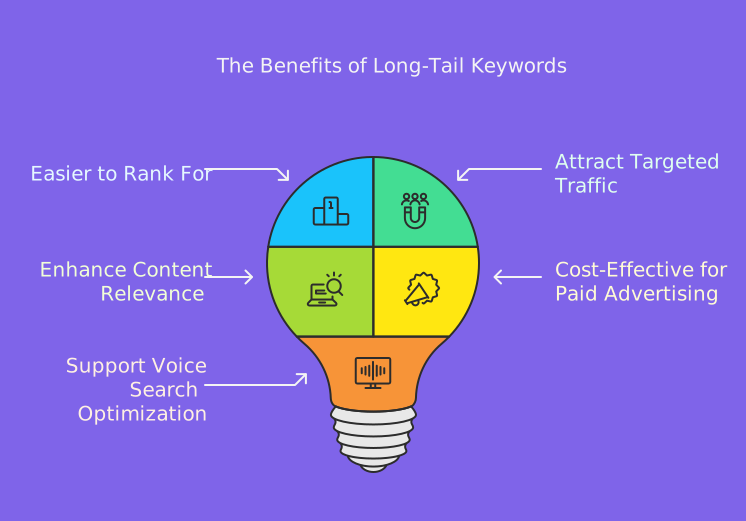
Long-tail targeting works because relevance can be more valuable than raw reach.
A page attracting 100 visitors with a clear need may create more value than a page attracting 1,000 visitors with mixed expectations.
Lower Competition and More Realistic Ranking Opportunities
Specific queries often have fewer purpose-built pages than broad terms.
A new gardening website may struggle to compete for “garden design.”
It may find a more realistic opportunity with “small north-facing garden design ideas for a UK terraced house.”
The second phrase gives the writer clear constraints. The garden is small. It faces north. It belongs to a terraced property. The advice should reflect UK conditions.
That does not remove the need for expertise.
The page still needs useful design ideas, suitable plants, light considerations, drainage guidance, space planning, and realistic examples.
Long-tail targeting is not an escape from quality. It helps you define a more specific problem.
It can reveal low-competition keywords, but competition should always be checked rather than assumed.
Qualified Traffic, Buyer Intent, and High-Converting Keywords
Specific commercial phrases often attract people with clearer requirements.
Someone searching “bookkeeping software” may be exploring the category.
Someone searching “bookkeeping software for UK Etsy seller registered for VAT” has already defined the business model and tax need.
A suitable software provider can address marketplace fees, transaction reconciliation, VAT records, bank connections, multiple currencies, inventory, and reporting.
The number of visitors may be smaller. The connection between the problem and the solution is stronger.
That is why long-tail phrases are often described as high-converting keywords.
The phrase alone does not create the conversion.
The product must suit the need. The page needs clear information. The business needs credibility. Price, design, speed, availability, proof, and usability also affect the result.
Keyword Clustering and Cumulative Organic Growth
A single long-tail keyword may bring modest traffic.
One good page may rank for many related searches.
A site can then build several connected pages around a broader subject. This approach is known as keyword clustering.
A coffee website might build a cluster around home brewing. Separate pages could cover grinder choice, water temperature, bean storage, extraction problems, cleaning, and brewing methods.
Each page should solve a distinct problem.
Internal links help visitors continue their research. They also help search engines discover the relationship between the pages.
The goal is not to publish hundreds of shallow articles. The goal is to organise complete answers around clear needs.
When Long-Tail Keywords Are Not Easier or Better
Long-tail keywords are often promoted as an easy route to rankings and conversions.
That claim needs context.
Hidden Competition Behind a Specific Query
A specific query can still be difficult.
Legal, medical, financial, insurance, education, and software searches often attract strong competitors because each visitor may have high value.
The results may include government websites, national companies, established publishers, specialist organisations, marketplaces, and comparison platforms.
The layout of the results also matters.
A local search may display a map above normal results.
A product search may display shopping listings.
A visual task may favour videos or images.
A simple question may receive a direct answer within the results.
A tool’s keyword difficulty score cannot describe every part of this environment. It is an estimate based on that provider’s data and method.
Always review the live SERP before committing resources.
Low Search Volume Is Not the Same as No Demand
Search-volume figures are estimates.
Different platforms use different databases, locations, update schedules, grouping methods, and models. Their numbers may disagree.
A phrase reported as zero can still receive occasional searches. A rare query can also represent a valuable customer.
Imagine a manufacturer selling industrial equipment worth £50,000. A keyword that brings five qualified visitors could be commercially important.
The opposite mistake is also common.
Some marketers use the uncertainty of volume estimates to justify any phrase they invent. A theoretical keyword is not valuable merely because it describes a possible customer.
Look for supporting evidence. Check related searches, customer language, Search Console impressions, market knowledge, sales questions, and competitor coverage.
Why Short-Tail and Mid-Tail Keywords Still Matter
Long-tail targeting should not replace broader keywords.
Head and mid-tail pages create structure.
A broad pillar about email marketing can introduce the subject.
A mid-tail guide about email marketing for ecommerce can cover strategy for online stores.
Focused pages can then address abandoned-cart subject lines, post-purchase sequences, win-back campaigns, list segmentation, and deliverability problems.
These pages serve different stages and needs.
Broad content builds reach and context. Specific content answers detailed questions. Internal links connect both levels.
A healthy strategy uses the full spectrum.
How to Find Long-Tail Keywords for Free
You do not need an expensive SEO platform to begin.
Some of the best ideas come from listening to customers and examining real search behaviour.
Google Autocomplete, People Also Ask, and Related Searches
Start with one or more seed keywords.
A seed keyword is a broad starting term connected to your product, service, audience, or subject.
Enter the term into Google and observe Autocomplete suggestions.
Add question words, audiences, locations, problems, materials, prices, or use cases.
A seed phrase such as “roof cleaning” may reveal questions about cost, moss, pressure washing, soft washing, damage, insurance, chemicals, and local services.
People Also Ask can expose follow-up questions.
Related searches can reveal alternative wording and adjacent topics.
These features generate ideas. They do not guarantee that every phrase is easy, valuable, or suitable for a separate page.
You still need to check intent and search results.
Google Search Console and Internal Site Search
Search Console shows the queries that produce impressions and clicks for your website.
This data is valuable because it reflects your real visibility.
A page may already appear for detailed phrases you never targeted.
Review queries with impressions but few clicks. Check the average position. Read the page again. Ask whether the title, introduction, heading, example, or section matches the searcher’s need.
Sometimes a minor update is enough.
In other cases, the query reveals a separate topic that deserves its own page.
Internal search data can show what visitors struggle to find after reaching your website.
Support tickets, chatbot logs, contact forms, and sales conversations offer similar evidence.
Customer Conversations, Communities, Reviews, and Competitor SERPs
Customers often describe problems more clearly than marketing teams.
A software company might describe its product as an inventory synchronisation platform.
A retailer may ask, “How do I stop my website selling products that have already sold in my shop?”
That sentence can become a useful tutorial, feature page, integration guide, or commercial landing page.
Read reviews. Listen to sales calls. Study support requests. Visit relevant forums. Examine comments on videos and social posts. Review competitor FAQs.
Look for questions that appear repeatedly.
Collect the language first.
Validate demand and intent second.
Choose the content format third.
Long-Tail Keyword Research Tools and How to Validate Suggestions
Paid tools can make the research process faster.
They cannot replace careful judgement.
Google Keyword Planner, Search Console, and Google Trends
Keyword Planner can generate related keyword ideas and show estimated demand for advertising research.
It is useful for understanding broad categories, language patterns, commercial interest, and possible themes.
Its competition column relates to advertising competition. It does not directly measure how hard it will be to rank organically.
Search Console becomes useful once a site has earned impressions. It shows the real queries connected with your pages.
Google Trends can help compare relative interest, seasonality, regions, and rising topics. It works best when a subject has enough demand to produce a visible pattern.
These tools answer different questions. Use them together rather than expecting one platform to provide a complete decision.
Ahrefs, Semrush, Moz, and Specialist Keyword Tools
Third-party SEO tools can provide volume estimates, SERP data, related questions, parent topics, competitor rankings, traffic potential, intent labels, and keyword competition indicators.
Ahrefs is often used to examine parent topics and shared ranking pages.
Semrush provides keyword groups, intent labels, competitive analysis, and content-planning features.
Moz and specialist platforms offer their own authority, difficulty, and opportunity measures.
The scores are not universal.
A difficulty score of 30 in one tool does not equal 30 in another. Each company uses its own calculation and database.
Use the scores to filter and prioritise. Use the search results to make the final decision.
Using AI Assistants Without Trusting Invented Search Data
AI tools can help generate audiences, problems, modifiers, questions, examples, and content structures.
They can group an existing list by likely intent. They can also help identify repeated wording and possible clusters.
They should not be trusted as a source of live volume or ranking data unless they are connected to a current, verifiable dataset.
An AI assistant may create a convincing phrase that nobody uses. It may also separate two terms that Google treats as the same topic.
Use AI for expansion, organisation, and analysis.
Validate the output through search results, first-party data, customer evidence, and recognised keyword tools.
How to Prioritise Long-Tail Keywords Using Search Volume, Difficulty, and Business Value
A large keyword list creates a new problem.
Which phrase should you target first?
The term with the highest volume is not always the best option. The easiest-looking query may have no business value.
A Practical Long-Tail Keyword Scoring Model
Evaluate each candidate against several factors.
Start with intent fit. Can you explain what the person wants?
Check audience relevance. Does the searcher belong to the group you serve?
Assess business value. Can solving the problem support a sale, lead, subscription, application, donation, or useful editorial outcome?
Review ranking feasibility. Are the current results realistic competitors?
Examine the expected content. Do you have the expertise, proof, resources, and format needed to create something better?
Consider demand, but keep it in context.
A low-volume phrase can be a strong opportunity when it attracts the right audience and fits your organisation.
Search Volume, Keyword Difficulty, and Competition Are Different Metrics
Search volume estimates how often a phrase is searched.
Organic keyword difficulty estimates the challenge of ranking.
Paid competition reflects advertiser activity.
Cost per click can suggest commercial interest, but it may be influenced by a small number of aggressive advertisers.
These measures are related, but they are not interchangeable.
A term can have low volume and high organic difficulty.
A phrase can have high paid competition while the organic results remain weak.
Another query may have moderate volume but low click potential because the SERP answers the question directly.
Do not let one number make the decision.
Business Potential and the Value of the Searcher’s Problem
The value of a keyword depends on the purpose of the website.
A publisher may want readership and newsletter subscriptions.
A software company may want trials or demos.
A local service provider may want calls and booking requests.
A university may want applications.
A nonprofit may want donations, volunteers, or educational reach.
Ask what a relevant visitor can do after receiving the answer.
Traffic that has no connection to your purpose may increase analytics numbers without creating meaningful value.
Should a Long-Tail Keyword Get Its Own Page or Join a Keyword Cluster?
This decision affects content quality, site structure, and the risk of overlap.
Creating too few pages can leave important needs unanswered.
Creating too many can produce repetitive content and internal competition.
When to Create a Dedicated Page
A phrase may deserve its own page when the intent, audience, format, product, service, or location is meaningfully different.
“Email marketing” and “email marketing for restaurants” can support separate resources.
The restaurant-focused page may discuss local customers, reservations, menu launches, seasonal offers, events, loyalty, and repeat visits.
“Email marketing for Italian restaurants” may not require another page unless the examples, audience, results, and recommendations change enough to support distinct value.
The page should exist because it helps a specific reader.
It should not exist only because a keyword tool exported another row.
When to Target Several Keywords on One Page
Close variations often belong together.
“Long-tail keyword example,” “examples of long-tail keywords,” “what is an example of a long-tail keyword,” and “which keyword is long-tail” express nearly the same need.
One strong page can answer them naturally.
You do not need to repeat every phrase word for word. You also do not need a separate section for every minor variation.
Choose one primary purpose. Answer it completely. Use natural language to cover the closely related questions.
Keyword Clustering, Internal Links, and Cannibalisation Prevention
Group keywords that share the same intent and similar search results.
Assign each group to the most appropriate page.
Connect related pages with internal links that help visitors continue their research.
If two existing pages compete for the same searches, compare their purpose and performance.
You may need to merge them, redirect one, narrow their topics, or change the internal linking structure.
Cannibalisation is not caused by using the same word on several pages.
The problem appears when multiple pages serve the same purpose without a clear reason for all of them to exist.
How to Use Long-Tail Keywords Naturally in SEO Content
Keyword use should improve clarity.
A phrase that makes the writing awkward should not be forced into every heading and paragraph.
Titles, Headings, Introductions, and Direct Answers
Use the primary phrase in the title when it describes the page accurately.
Answer the main question near the beginning.
For an article titled “Which of These Is an Example of a Long-Tail Keyword?” the reader should see a correct example immediately.
Headings should organise real questions and decisions.
The phrase may also appear in the introduction, a relevant image description, or internal link when it fits naturally.
There is no need to place the exact wording in every possible element.
Semantic Variations, Entities, and Supporting Questions
A complete guide to long-tail keywords will naturally discuss head terms, mid-tail phrases, demand, intent, SERPs, competition, modifiers, clusters, parent topics, Search Console, Keyword Planner, conversion, local search, and AI search.
These related concepts create semantic depth.
They also reduce the need to repeat the exact target phrase.
Semantic coverage should come from answering connected questions. It should not become a checklist that forces unrelated terms into the article.
Avoiding Keyword Stuffing and Formulaic Optimisation
Keyword stuffing makes content repetitive.
It often appears when the same phrase is placed in every heading, repeated several times in one paragraph, or added to image text that does not describe the image.
Write the clearest answer first.
Use a related term when it communicates the idea better.
Do not create sentences solely to insert another keyword.
A reader should not be able to see the keyword checklist behind the writing.
Long-Tail Keywords for Voice Search, Local SEO, and AI Search
Search interfaces can now process longer and more conversational requests.
People do not always need to reduce their questions to two or three words.
Conversational and Voice Search Keywords
A typed query might be “best dentist Leeds.”
A spoken query might be “Which family dentist in Leeds is open on Saturday and works with nervous patients?”
The spoken version includes service type, location, schedule, and patient concern.
A useful local page can answer those details through accurate opening hours, treatment information, staff experience, accessibility, reviews, and booking options.
Do not create unnatural question-and-answer text only to target voice search.
Clear headings, concise answers, accurate local information, and a good mobile experience are more useful.
AI Query Fan-Out and Highly Specific Sub-Questions
AI-assisted search can break a broad request into several related subtopics.
A user may ask for the best laptop for design work, travel, battery life, and a fixed budget.
The system may explore processor requirements, screen quality, software compatibility, weight, battery tests, build quality, and current price ranges.
This process is often called query fan-out.
It does not mean a publisher should create a separate page for every possible sub-question.
It increases the value of clear, complete content that answers meaningful supporting needs.
Strong foundations still matter. Pages need useful text, clear structure, crawlable links, relevant media, accurate claims, and a good user experience.
Local Specificity Without Creating Thin Doorway Pages
Local long-tail searches can be commercially attractive.
That creates a temptation to produce hundreds of pages by replacing one city name with another.
A useful location page needs original substance.
It may include the real service area, travel conditions, staff coverage, case studies, pricing factors, local property types, response times, regulations, and evidence of work in the area.
A company should not create a page suggesting that it serves a location when it does not.
Specificity must reflect reality.
How to Measure Long-Tail Keyword Performance
Publishing the page is only the beginning.
Performance should be measured through visibility, engagement, and meaningful outcomes.
Track Queries, Impressions, Clicks, CTR, and Average Position
Use Search Console to see which queries display the page.
Impressions can show growing visibility before clicks increase.
Clicks reveal which searches bring visitors.
Click-through rate can help identify titles and descriptions that do not match expectations.
Average position provides directional information. It should not be treated as one fixed ranking seen by every person.
Review the complete group of queries rather than checking only one exact phrase.
A useful page may attract traffic through dozens or hundreds of close variations.
Measure Leads, Sales, Sign-Ups, and Assisted Conversions
Visits are not the final goal for most organisations.
Track actions that matter.
These might include purchases, phone calls, enquiry forms, trials, downloads, newsletter registrations, applications, donations, or bookings.
Informational pages can support later conversions.
A visitor may read a guide, return through a branded search, and contact the company days later.
Landing-page reports and conversion paths can help reveal that wider journey.
Refresh, Consolidate, Expand, or Retire Content
Search behaviour changes.
Products are updated. Prices shift. Regulations change. New questions appear. Competitors improve their pages.
Review important content regularly.
Expand a page when it receives impressions for useful questions that are not answered clearly.
Consolidate resources when several pages cover the same purpose.
Update outdated examples, prices, screenshots, processes, and claims.
Retire content when it no longer serves readers and cannot be improved.
Common Long-Tail Keyword Mistakes
A long-tail strategy fails when keywords are treated as spreadsheet entries rather than human needs.
Treating Word Count as the Definition
The first mistake is declaring every phrase with four or more words a long-tail keyword.
Length is a clue.
It does not reveal demand, purpose, competition, relevance, or page type.
Use word count to find possible terms. Do not use it as the final decision.
Creating One Thin Page for Every Slight Variation
The second mistake is creating separate pages for singular forms, plural forms, reordered phrases, and close questions.
This approach produces repetition.
It divides links and authority between weak pages.
It can also frustrate visitors who need to open several articles to find one complete answer.
Combine variations when they share the same intent.
Choosing Keywords Without Real Demand, Relevance, or SERP Fit
The third mistake is selecting a phrase only because a tool labels it easy.
The term may be irrelevant to the business.
The searcher may expect a page format you cannot provide.
The existing results may be stronger than the difficulty score suggests.
The phrase may have no evidence of genuine demand.
Before choosing a keyword, explain who is searching, what they need, why your page deserves to answer, and what value the visitor will receive.
If you cannot answer those questions, the phrase is not ready for a content brief.
A Repeatable Workflow From Seed Keyword to Published Page
A consistent process prevents random content production.
Step 1: Begin With Seed Keywords and Real Audience Problems
Start with broad subjects connected to your expertise, audience, product, or service.
Gather real problems from customer conversations, reviews, support requests, Search Console, internal site search, forums, and competitor pages.
Do not begin by exporting thousands of terms without understanding the people behind them.
Step 2: Expand With Modifiers and Validate Search Intent
Add modifiers related to audience, use case, problem, feature, material, location, price, timing, and desired outcome.
Use search suggestions and keyword tools to expand the list.
Search the strongest candidates manually.
Check the page types, result quality, competition, and likely intent.
Remove irrelevant, invented, and duplicated phrases.
Step 3: Cluster, Map, Create, Publish, and Measure
Group the remaining terms by shared intent.
Choose one central purpose for each page.
Create the format that matches the search results and audience need.
Publish a complete answer rather than padded sections written to reach a word count.
Add internal links where they help readers.
Measure impressions, queries, clicks, engagement, and conversions.
Use the findings to improve the page and the next round of research.
Frequently Asked Questions About Long-Tail Keywords
What Is the Best Example of a Long-Tail Keyword?
“Best waterproof trail running shoes for women with flat feet” is a clear example.
It is more specific than “shoes” or “running shoes.” It identifies the product, environment, feature, audience, and physical requirement.
Do Long-Tail Keywords Always Contain Three or More Words?
No.
They often contain more words because detailed needs require more context.
Their place in the long tail depends mainly on relative search demand. A short niche term can sit in the long tail. A long phrase can become popular.
Are All Long-Tail Keywords Easy to Rank For?
No.
Some specific searches are dominated by authoritative organisations, major brands, marketplaces, government resources, or strong local companies.
Ranking difficulty depends on the SERP, content quality, authority, competition, format, and audience expectations.
Do Long-Tail Keywords Convert Better?
They can.
Specific commercial and transactional phrases often attract visitors with clear requirements.
The keyword alone does not create a sale. The page, offer, proof, price, trust, availability, and user experience still matter.
How Many Long-Tail Keywords Should One Article Target?
Target one main intent and the relevant variations that support it.
There is no perfect number.
A short article may answer a small group of questions. A comprehensive guide may rank for hundreds of related searches.
The terms should belong together naturally.
Should Every Long-Tail Keyword Have Its Own Page?
No.
Create a separate page when the query has a distinct intent, audience, format, product, service, location, or substantial answer.
Combine close variations when one page can satisfy them fully.
Are Long-Tail Keywords Good for New Websites?
Yes, when the topics fit the website and the competition is realistic.
Specific queries can offer clearer content opportunities than major head terms.
A new site still needs useful, accurate, original, and trustworthy content.
What Is the Best Free Way to Find Long-Tail Keywords?
Start with Google Autocomplete, People Also Ask, related searches, customer questions, product reviews, forums, internal search data, and competitor pages.
Use Search Console once your website begins receiving impressions.
Keyword Planner can help identify related language and estimated demand.
How Long Does It Take to Rank for a Long-Tail Keyword?
There is no fixed period.
The result depends on competition, indexing, site quality, expertise, content usefulness, internal links, external links, technical health, and demand.
A low-volume keyword is not automatically a fast ranking.
Do Long-Tail Keywords Still Matter for AI Search?
Yes.
AI-assisted search can process detailed questions and explore related subtopics.
Clear, focused, well-structured content can help answer those needs.
Publishers should still build useful pages rather than artificial content for every possible phrase.
Final Checklist: Is This Really a Long-Tail Keyword?
Before selecting a phrase, ask:
- Is it less popular than the broader searches in its topic?
- Does it express a clear problem, audience, feature, location, budget, or outcome?
- Can you identify the user’s likely intent?
- Is there evidence that the underlying need exists?
- Do the search results match a page you can create?
- Is the competition realistic for your website?
- Is the audience relevant to your organisation?
- Is the phrase a standalone topic or a supporting variation?
- Can you provide a complete and credible answer?
- Can you measure whether the resulting traffic creates value?
“Best waterproof trail running shoes for women with flat feet” is a long-tail keyword because it communicates a narrow need and receives lower relative demand than broad footwear searches.
Its value does not come from word count alone.
The phrase helps the search engine interpret the request. It helps the publisher understand what to create. It helps the searcher reach a more relevant answer.
That is the power of a strong long-tail keyword strategy.
Start with the person behind the query. Understand the problem. Validate how people search for it. Then create the clearest and most useful page for that purpose.