

A client asks whether your agency provides SEO. You know the service could increase the value of the account. You also know that delivering it properly requires far more than adding keywords to a few pages.
A serious SEO campaign can involve technical audits, market research, content planning, copywriting, local optimisation, digital PR, link assessment, analytics, and ongoing reporting. Building all those capabilities internally is expensive. It can also take months.
That challenge explains the growing interest in white label SEO services.
Under this model, a specialist provider completes some or all of the SEO work. Your agency manages the commercial relationship and presents the deliverables under its own brand. The client receives a broader service, while your business avoids building a complete fulfilment department before demand is proven.
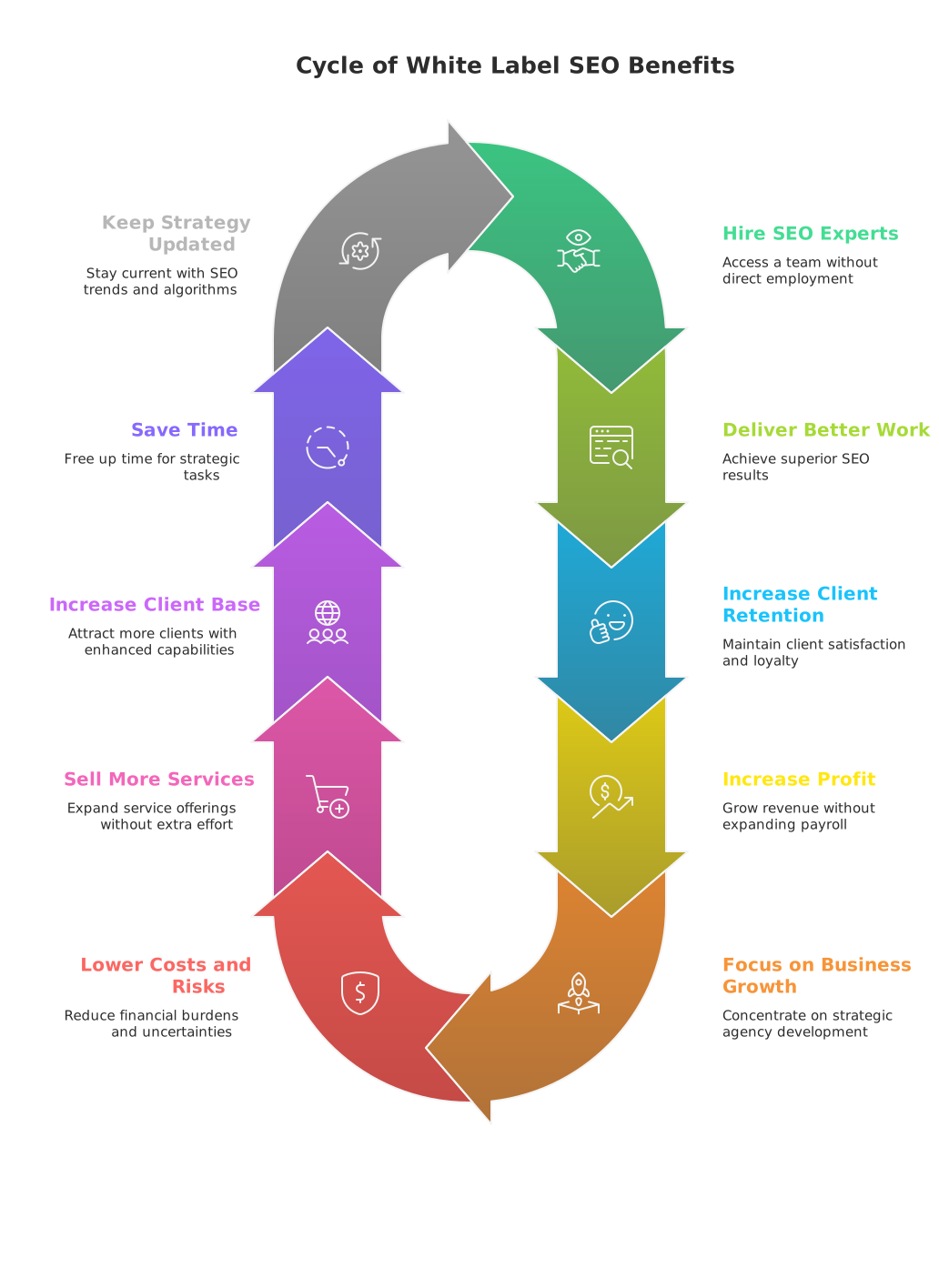
The main benefits of white label SEO can include:
- Faster service expansion without immediate recruitment
- Access to specialists, technology, and established processes
- Flexible capacity that rises and falls with client demand
- More recurring revenue from existing customer relationships
- More time for sales, strategy, and account management
Those benefits are real, but they are not guaranteed.
A weak partner can produce generic content, recommend unsuitable technical changes, create risky links, or send reports that look impressive without explaining business performance. Your agency remains accountable because the client bought the service from you.
The value of white labelling therefore depends on the operating system around it. That system includes pricing, quality control, contracts, data ownership, reporting standards, communication, and provider evaluation.
This guide explains how the model works, which businesses benefit most, how to calculate its financial value, and how to choose a partner without putting your reputation at unnecessary risk.
What Are White Label SEO Services?
White label SEO is a fulfilment arrangement in which one company performs SEO work that another company sells under its own brand.
The provider may complete technical analysis, keyword research, content production, local optimisation, link acquisition, or full campaign management. Its name does not need to appear on the client-facing work.
The reseller controls the commercial relationship. It chooses the retail price, defines the package, communicates with the client, and decides how the work is presented.
This model is widely used by web development companies, advertising agencies, branding studios, public relations firms, consultants, and digital marketing businesses that want to expand their services without creating every capability internally. Current provider offerings range from specialised link or content fulfilment to complete programmes with branded portals, reporting, local SEO, technical work, and campaign management.
The Three Parties in a White Label SEO Partnership
A standard arrangement involves three parties.
The end client is the business buying SEO. It expects useful work, clear communication, and measurable progress.
The reseller is the agency that owns the customer relationship. It sells the service, collects payment, manages expectations, and remains responsible for the outcome.
The white label SEO provider completes the agreed work behind the scenes.
That division sounds simple, but the details vary.
Some providers function as production partners. Your agency creates the strategy, assigns tasks, reviews the work, and handles every client conversation.
Other providers operate as an outsourced department. They may prepare the strategy, manage deliverables, create reports, and join client meetings using your agency’s identity.
The correct model depends on your internal expertise.
An agency with an experienced SEO director may only need writers, technical analysts, or outreach support. A design studio that has never offered SEO may need a more complete managed service.
Both arrangements can work. Problems arise when responsibilities are assumed rather than documented.
Before the first campaign starts, decide who owns discovery, strategy, implementation, approvals, reporting, meetings, and urgent support.
How a Campaign Moves from Sale to Branded Delivery
A well-run campaign normally begins with structured discovery.
The reseller gathers information about the client’s services, customers, competitors, locations, website platform, commercial goals, previous marketing, and internal resources. It also secures access to relevant first-party systems.
The provider reviews that information and assesses the website. The initial work may include technical analysis, content evaluation, competitor research, keyword mapping, local visibility checks, and backlink review.
The findings are then converted into priorities.
A responsible strategy should explain what needs to change, why it matters, who will complete the work, and how the effect will be measured. It should also distinguish between tasks the provider can implement and recommendations that require the client’s developers or internal team.
Deliverables should pass through an approval stage before they reach the client.
That approval stage matters. A provider may understand SEO but lack context about the client’s products, policies, commercial priorities, or tone of voice. Your agency must connect technical recommendations with the real business.
The final work is delivered using your branding. This may include your logo, colours, report template, dashboard address, email identity, and preferred terminology.
The provider remains behind the scenes unless the agreement allows direct or client-facing communication.
White Label SEO vs Private Label SEO, SEO Reselling and Outsourcing
The terminology can be confusing because companies often use several phrases to describe similar arrangements.
A white label SEO reseller normally purchases a provider’s existing services and sells them under another name. The process and fulfilment methods belong to the provider, while the presentation belongs to the reseller.
Private label SEO services may involve deeper customisation. The fulfilment team might adapt its workflow, methodology, reporting, team structure, and deliverables to match the reseller’s internal system.
In practice, the distinction is not always consistent. Some companies use “white label” and “private label” interchangeably. Others define white label as standardised fulfilment and private label as a more customised service.
SEO reseller services are programmes designed specifically for agencies that want to resell search marketing. They may include wholesale rates, branded reports, sales materials, account support, and client portals.
Outsourced SEO services are a broader category. A company may outsource SEO directly without rebranding the work.
SEO fulfilment services usually focus on production. The reseller may retain strategy and client management while delegating defined tasks to an external team.
The most important issue is not the name. It is the division of responsibility.
You need to know who owns the strategy, who controls the client relationship, who reviews the work, and what happens when results or delivery fall short.
Which Businesses Benefit Most from White Label SEO?
White labelling is most useful when a business already has access to customers who need SEO but lacks the resources to deliver it consistently.
This includes more than traditional marketing agencies.
A web developer may want to provide ongoing growth services after a site launches. A PPC agency may want to support clients who need both paid and organic visibility. A branding studio may want to turn a project relationship into a longer engagement.
The model can also work for consultants, software companies, hosting providers, and content firms.
Ideal Use Cases for Agencies, Consultants and Service Providers
White label SEO for agencies works best when SEO complements an existing offer.
A web design company already understands the client’s website, positioning, and conversion goals. Adding search strategy can feel like a natural extension.
A paid advertising agency already has access to search data and landing-page performance. Organic search can broaden the account beyond paid acquisition.
A public relations firm may already create stories, secure coverage, and manage brand messaging. SEO can connect that work with search demand, content planning, and authority development.
A content agency may be strong at writing but weaker at technical audits, internal linking, and analytics. A fulfilment partner can fill those gaps.
The common advantage is an existing relationship. Selling to a current client is often easier than creating a new relationship from the beginning.
There is also a defensive benefit.
When one of your clients hires a separate SEO agency, that provider may later offer content, development, paid advertising, or other services. Building a credible SEO offer can help protect the wider account.
That does not mean every agency should add SEO. The service must fit the customers you serve and the problems they need solved.
Operational Signs That Your Agency Is Ready
One sign is repeated demand.
If qualified clients regularly ask for SEO and your agency declines the work, there may be a clear commercial opportunity.
Another sign is delivery pressure. Your existing team may be missing deadlines, turning away projects, or spending too much time on tasks outside its core strengths.
Freelancer management can provide another signal. If you are constantly replacing writers, auditors, or outreach specialists, a structured provider may create more consistency.
The agency also needs sufficient commercial maturity.
You should know who the service is for, what is included, what is excluded, how it is priced, and how progress will be reported.
Selling vague promises creates risk. SEO is affected by website quality, competition, demand, implementation, brand strength, and search-platform decisions. A reseller should sell a process and a service standard, not a guaranteed position.
Internal oversight is also necessary.
Someone in your business must understand enough SEO to question recommendations, review deliverables, and explain the strategy to clients. Outsourcing execution does not remove the need for informed accountability.
When White Label SEO May Not Be the Right Choice
White labelling is not suitable for every business.
A highly specialised SEO consultancy may depend on a proprietary method that is difficult to transfer to an external team. A large enterprise account may require daily collaboration with developers, legal teams, product managers, and executives.
Some client contracts may restrict subcontracting or require named employees to perform the work.
The model is also unsuitable when the agency cannot review quality. Sending provider deliverables directly to clients without checking them transfers too much control to an external company.
A referral partnership may be safer when you do not want delivery responsibility. The client contracts directly with the SEO firm, and your company may receive a referral fee.
Building in-house may be better when demand is stable, your methodology is a major competitive advantage, and direct collaboration is essential.
White label fulfilment should solve a clear operating problem. It should not be adopted merely because it appears cheaper.
How White Label SEO Expands Your Service Portfolio
Building an internal SEO department involves more than hiring one employee.
SEO crosses several disciplines. Technical work, content strategy, local search, digital PR, reporting, analytics, and implementation may require different skills.
A provider can give an agency access to those skills through one relationship.
Add SEO Without Building Every Capability Internally
Technical SEO may involve crawling, rendering, indexation, canonicalisation, internal architecture, structured data, redirects, performance, JavaScript, and migrations.
Content SEO involves search-intent analysis, audience research, topic planning, briefing, writing, editing, and content maintenance.
Local SEO requires business-profile management, review strategy, citations, location pages, and local performance analysis.
Authority development may involve digital PR, publisher evaluation, outreach, and link-risk assessment.
A single generalist is unlikely to be equally strong in every discipline.
A white label SEO agency may provide access to several specialists without requiring the reseller to recruit each role separately.
That can shorten the launch period. The agency does not need to wait for recruitment, onboarding, training, tool procurement, and process development before accepting its first client.
Faster entry is useful, but it should not lead to careless selling. The reseller needs to understand the provider’s capacity and service boundaries before promising work.
Create Recurring Revenue from Existing Client Relationships
Many agency services are project based.
A website is designed and launched. A brand identity is completed. An advertising campaign is set up. Once the project ends, the revenue ends unless another need appears.
SEO is often delivered as an ongoing service because websites, markets, competitors, and search behaviour continue to change.
Technical problems can emerge after development changes. Content becomes outdated. New customer questions appear. Competitors publish stronger resources. Products, services, and locations change.
A recurring SEO programme can therefore create more predictable revenue.
The agency may offer search optimisation after a website launch, add content and SEO to a paid media account, or combine local search with reputation management.
Recurring revenue is valuable only when the service continues to create value.
A monthly retainer should not become a collection of repetitive tasks performed because they appear in a package. Work should be connected to current opportunities, constraints, and measurable business priorities.
Compete for Larger and More Complex Accounts
Larger clients often prefer integrated services.
They may want one partner to manage website development, content, paid media, analytics, and organic search. An agency that cannot offer SEO may be excluded from a wider contract.
A specialist partner can support the sales process. It may review a prospect’s site, help define the scope, identify technical issues, or contribute to a proposal.
This can make the agency more credible without forcing it to hire before the contract is won.
The reseller must still control how the offer is positioned.
A provider may be able to deliver an advanced audit, but the client may not have the resources to implement it. A large content plan may look impressive but be unrealistic for the available budget.
The agency’s role is to connect fulfilment capability with a practical client strategy.
Cost Benefits and SEO Agency Profit Margins
Cost savings are one of the most repeated selling points in white label SEO.
The comparison is often too simple.
A provider fee should not be compared with one employee’s salary alone. The agency must calculate the complete cost of delivering the same level of service internally.
It must also calculate the real cost of managing the external partner.
The True Cost of Building an In-House SEO Team
An internal team creates direct and indirect costs.
Direct costs may include salaries, benefits, payroll obligations, recruitment, equipment, training, and software.
Indirect costs include management time, quality assurance, non-billable meetings, leave, employee turnover, and unused capacity.
Tool costs can also be substantial. A team may require crawling software, research databases, rank tracking, reporting systems, local SEO platforms, and project-management tools.
One employee rarely covers everything.
A senior strategist may be able to direct campaigns but may not have time to write content or conduct outreach. A technical specialist may not be suited to client communication. A writer may not be qualified to diagnose crawling or indexation issues.
The agency may need several people before it can offer a complete service.
White labelling can convert part of this fixed cost into a variable cost. The provider fee rises when the agency adds clients and falls when work ends.
That structure can be attractive when demand is uncertain.
An internal team may become more economical when client volume is stable, utilisation is high, and the business can support specialist roles over the long term.
How to Calculate White Label SEO Gross Margin
Healthy SEO agency profit margins depend on accurate cost allocation.
Markup and margin are different.
Suppose the fulfilment cost is £1,000 and the client price is £1,500. The markup is 50 per cent because £500 has been added to a £1,000 cost.
The gross margin is 33.3 per cent because the £500 gross profit represents one-third of the £1,500 sale.
The basic calculation is:
Gross margin = (client revenue minus direct fulfilment costs) divided by client revenue, multiplied by 100
The direct cost should include more than the provider invoice.
Add account-management time, internal review, meetings, custom reporting, software assigned to the account, revisions, and any paid content or placement costs.
Sales commissions and onboarding time may also need to be considered when evaluating the lifetime profitability of an account.
Do not set the retail price by applying an arbitrary percentage to the provider fee.
Your agency adds value through commercial understanding, client management, integration with other services, quality assurance, and strategic interpretation. The price should reflect that contribution.
It must also leave enough margin to handle unexpected work without cutting corners.
Build a Break-Even and Capacity Calculator
A break-even model helps determine when external fulfilment is more economical than hiring.
Begin with the monthly cost of the internal roles required to deliver the service. Include salaries, taxes, benefits, tools, management, recruitment, training, and equipment.
Then estimate realistic capacity.
Do not assume that every working hour can be billed. Team members attend meetings, complete administration, take leave, review work, and continue learning.
Divide the total monthly cost by the realistic number of accounts the team can manage at the promised service level.
Compare that cost per account with the external fulfilment cost.
The calculation should test several volumes. Compare the position at five clients, ten clients, twenty clients, and after losing a major account.
This shows where internal hiring becomes economical. It also reveals how much risk the agency assumes when demand changes.
A hybrid model may produce the best result. The agency can keep strategy and account direction internally while using external capacity for technical work, content, or outreach.
Scale SEO Fulfilment Without Constant Hiring
Agency demand is rarely smooth.
One quarter may bring several new clients. Another may bring slower sales or unexpected churn.
Hiring for every short-term increase can create long-term overhead. Refusing work can limit growth.
Scalable SEO fulfilment gives agencies another option.
Replace Fixed Capacity with Flexible Delivery
A provider may allow the reseller to add or remove campaigns without changing internal headcount.
This can improve cash-flow alignment because the fulfilment cost is connected more closely to client revenue.
It can also reduce recruitment pressure. The agency does not need to find a qualified employee every time it wins another account.
Capacity should still be verified.
A company that delivers five campaigns well may not be able to accept twenty new campaigns at once. Providers can face their own hiring, training, and quality-control constraints.
Ask how much notice is required for new work. Find out whether the provider limits monthly onboarding, how it assigns specialists, and what happens when demand exceeds normal capacity.
The reseller should know these limits before making commitments.
Flexible fulfilment is useful because it reduces fixed risk. It should not be treated as unlimited labour.
Handle Multiple Niches, Locations and Campaign Types
Agencies often serve clients with different needs.
A local clinic needs a different strategy from an ecommerce retailer. A software company requires different content and technical work from a multi-location home-services business.
A broad provider may have specialists who understand several campaign types.
This can help an agency expand without hiring a new expert for each niche. It can also create access to experience gained across many websites and markets.
Specialisation still matters.
Regulated sectors such as finance, health, and legal services may require qualified review, stronger evidence, and careful claim management. International projects may require localisation rather than direct translation. Enterprise websites may require advanced technical analysis.
The provider should be able to show relevant capability. A large service menu is not proof that every service is delivered at the same standard.
Protect Quality as Client Volume Increases
Rapid growth can make quality problems difficult to see.
Reports may continue to arrive while strategic attention declines. Content may become more formulaic. Technical recommendations may be copied between accounts. Link standards may fall.
The reseller needs operational quality measures.
Track first-pass approval, revision frequency, deadline performance, unresolved issues, reporting errors, client complaints, and implementation success.
Ask who reviews each type of work. Find out whether a strategist connects the separate technical, content, and authority activities.
SEO becomes fragmented when specialists complete isolated tasks without a shared plan.
Quality should be measured before volume increases and reviewed again after scaling. A provider that performs well at low volume may need a different process when the account count grows.
Gain Access to SEO Specialists, Technology and Proven Processes
A mature fulfilment partner can provide more than extra hands.
It may bring experienced specialists, established workflows, research tools, quality-control systems, and lessons gained from managing many campaigns.
The value comes from how those resources are applied.
Access a Full SEO Skill Set
A complete SEO team may include strategists, technical analysts, content planners, writers, editors, local specialists, developers, outreach professionals, and reporting analysts.
This allows work to be matched with the right expertise.
A migration can be reviewed by someone who understands redirects, canonical tags, staging environments, analytics, internal links, and indexation.
A local campaign can be handled by someone familiar with business profiles, reviews, service areas, citations, and location-level reporting.
A content programme can involve subject research, briefing, writing, editing, fact-checking, and conversion review.
The reseller should ask how the team is structured.
Are specialists employees, contractors, or subcontractors from another company? Who owns the final decision? Who replaces a team member during absence? Who understands the full client strategy?
External specialists can increase capability, but fragmented outsourcing can create new coordination problems.
Use Advanced SEO Tools Without Duplicating Every Licence
SEO tools can support crawling, keyword discovery, rank tracking, competitor analysis, backlink evaluation, content planning, local visibility, and reporting.
A provider may already maintain the licences and data systems needed for fulfilment. This can reduce duplicated software costs.
Tools do not replace expertise.
A crawler may produce thousands of warnings. A specialist must decide which issues matter, which are harmless, and which should be prioritised.
A keyword tool may return a large list of phrases. A strategist must determine whether those searches reflect the client’s customers, offer, location, and buying journey.
The agency should retain access to first-party data.
Search Console shows how a site performs within Google Search, while Google Analytics measures behaviour after visitors reach the site. The systems use different metrics and collection methods, so clicks and sessions will not match perfectly. Used together, they provide a more complete view of discovery and on-site actions.
The client should normally own its Search Console property, analytics account, business profiles, advertising accounts, and tag-management system.
The provider should receive the access needed to work without becoming the sole owner of critical assets.
Keep Pace with Search and AI-Driven Discovery
Search now includes traditional organic listings, local results, images, videos, product results, and generative experiences.
A modern provider should understand these formats. It should also be honest about what can and cannot be controlled.
Third-party SEO tools and services do not have access to Google’s internal ranking data. They cannot guarantee ranking performance, and their predictions remain estimates. Google recommends using Search Console as the first-party source for Google Search performance data.
This matters because some providers sell answer engine optimisation or generative engine optimisation using language that implies certainty.
No agency can guarantee inclusion in an AI-generated answer. It can improve the conditions that support visibility by creating accessible, clear, original, well-supported information and strengthening the brand’s wider presence.
The durable foundations remain familiar. Search systems must be able to access the site, understand its pages, and connect the information with relevant user needs.
What Services Can You Include in a White Label SEO Package?
A provider may offer an entire managed campaign or individual services.
The correct mix depends on the client’s objectives, current condition, internal resources, and budget.
A standard package can simplify sales. It should not force every client into identical work.
SEO Audits, Keyword Research and On-Page SEO
SEO audit services assess the condition of a website and identify obstacles or opportunities.
A useful audit should not be a raw software export.
It should explain the issue, the likely effect, the recommended action, the priority, and the person responsible for implementation.
Technical findings may cover crawling, indexation, redirects, canonicalisation, duplication, structured data, performance, mobile experience, internal linking, and XML sitemaps.
Content findings may include weak topic coverage, outdated information, cannibalisation, unclear intent, poor conversion paths, and missing internal links.
Keyword research services should connect search behaviour with commercial relevance.
The provider needs to understand what the business sells, who buys it, which problems lead to demand, and how the customer moves from research to decision.
Queries should be grouped by intent and mapped to suitable pages. The process should also identify where existing pages can be improved and where new resources are needed.
On-page SEO services may include titles, headings, copy improvements, internal links, image details, structured data recommendations, and conversion-focused changes.
These tasks should serve a strategy. Editing hundreds of titles without considering intent, duplication, and page purpose creates activity without direction.
Technical SEO, Content and Link Building
Technical SEO outsourcing is useful when the agency lacks advanced auditing or development knowledge.
The scope should clarify whether the provider only identifies issues or also implements solutions.
An audit may correctly identify a rendering, canonical, or redirect problem. The client receives limited value if no one can make and test the change.
Implementation also creates risk. Technical changes should use backups, staging environments, approval rules, and post-launch checks where appropriate.
White label content services may include content strategy, briefs, landing pages, articles, product copy, editing, updating, and upload support.
The agency should ask who writes the content and how quality is assessed.
Subject expertise matters. Generic summaries rarely provide enough value in competitive markets. Content should include accurate information, useful explanation, evidence, original examples, or first-hand experience where appropriate.
White label link building requires careful due diligence.
Google defines link spam as links created primarily to manipulate rankings. Examples include buying or selling links for ranking purposes, excessive link exchanges, automated link creation, and low-value content produced mainly to manipulate linking signals. Paid advertising or sponsored placements are allowed when links are qualified appropriately.
Ask the provider how it selects sites, evaluates relevance, contacts publishers, treats paid relationships, and reports placements.
A high third-party authority metric does not prove that a link is relevant, editorially valuable, or safe.
Ecommerce, International and Migration Support
Ecommerce websites create specialised technical and content challenges.
A campaign may involve category architecture, product-page quality, internal search, filters, pagination, duplicate URLs, structured product data, discontinued items, and out-of-stock handling.
International SEO may require country targeting, language targeting, localisation, market research, and hreflang implementation.
Directly translating keyword research from one language to another is not enough. People in different markets may describe the same need in different ways.
Website migrations are another specialist area.
A migration plan may include URL mapping, redirect preparation, metadata transfer, internal-link updates, analytics checks, staging review, crawl comparison, and post-launch monitoring.
These projects need clear ownership and testing.
A migration should not be treated as an ordinary monthly deliverable because mistakes can affect large parts of the website at once.
How Branded Reporting Improves the Client Experience
Clients often judge SEO through reporting because much of the work happens outside their direct view.
A report should explain what happened, what was completed, what the data means, and what should happen next.
Branding matters, but interpretation matters more.
What a Branded SEO Report Should Include
White label SEO reporting should connect work with outcomes.
The exact metrics depend on the business.
An ecommerce company may care about non-branded clicks, organic revenue, product visibility, conversion rate, and category performance.
A local service business may care about calls, forms, bookings, direction requests, and visibility for high-value services.
A software company may care about qualified trials, demo requests, assisted conversions, and performance across informational and commercial content.
Rankings can provide diagnostic value, but they should not be the only success measure. Results vary by location, device, query wording, personalisation, and search format.
A good report also records the work completed. Clients should be able to see which technical issues were resolved, which content was created, which pages were improved, and what remains blocked.
The provider should explain significant changes rather than allowing charts to speak for themselves.
Dashboards, Executive Summaries and Data Ownership
Branded SEO reports should match the needs of the reader.
An executive may need a concise explanation of progress, risk, and commercial impact. A marketing manager may need page-level detail, query data, implementation status, and next actions.
A white label SEO dashboard can give clients ongoing access to key metrics. Current reseller programmes often promote branded portals, performance views, and client-facing reporting as central parts of the service.
The dashboard should not become a substitute for analysis.
A graph may change because of seasonality, tracking updates, market demand, website changes, or search-result volatility. Someone must explain the likely causes.
Ownership should be documented.
The agency should be able to export historical reports. The client should retain its first-party properties. The provider should not be able to remove access to essential performance information when the agreement ends.
Translate SEO Work into Client-Friendly Business Outcomes
Clients rarely purchase canonical tags, internal links, or content briefs as isolated products.
They purchase the possibility of stronger discovery, more relevant traffic, improved enquiries, increased sales, or lower dependence on paid acquisition.
Reporting should connect technical work with those outcomes.
For example, improving internal links may help users and crawlers discover important pages more easily.
Rewriting a category page may help a retailer explain its range and match more specific search needs.
Correcting local business information may reduce customer confusion and improve location discovery.
The report should also explain limitations.
SEO cannot control market demand, pricing, product quality, sales follow-up, competitor investment, or search-platform decisions.
Clear reporting builds trust because it separates influence from certainty.
Increase Client Retention and Protect Your Agency Brand
Adding SEO may support client retention for agencies because the customer can access more services through one relationship.
It can also reduce the likelihood that another provider enters the account.
Retention is not created by service quantity alone. Clients stay when the work is useful, communication is reliable, and the commercial value is clear.
Become a More Complete Marketing Partner
SEO can connect several marketing disciplines.
Search research can inform content and paid advertising. Technical analysis can identify website barriers. Organic landing pages can support broader campaigns. Digital PR can strengthen brand recognition and discoverability.
An integrated agency can coordinate these activities rather than allowing separate suppliers to work in isolation.
This may improve decision-making.
Paid search data can reveal queries that convert. Organic content can reduce dependence on expensive advertising. Website analytics can show where visitors lose interest. Client conversations can reveal questions that are not yet answered online.
A white label partner can add specialist delivery, while the reseller connects that work with the wider account.
The agency should avoid overlapping responsibilities. Two teams should not create separate keyword maps or give developers conflicting recommendations.
Maintain Consistent Voice, Standards and Communication
The provider should understand how your agency communicates.
Reports, content, emails, and recommendations should follow consistent standards.
A client should not receive highly technical language one month and vague promotional language the next. Content should not change voice because a different writer was assigned without editorial oversight.
Create templates for repeatable work, but leave room for judgement.
Every client has a different audience, offer, website, budget, and internal capacity. Templates should improve consistency, not produce identical strategies.
The agency should review client-facing work before delivery, especially during the early stages of the relationship.
Brand trust can be damaged by small mistakes. A provider logo left in a file, an incorrect company name, or a recommendation copied from another account can undermine confidence quickly.
Prevent Channel Conflict and Client Solicitation
The provider may gain access to valuable commercial information.
This can include client contacts, pricing, strategy, website access, campaign data, and future plans.
The agreement should state whether the provider may contact the client directly, attend meetings, display the work in a portfolio, or market other services.
A non-solicitation clause may help prevent direct approaches to the agency’s customers.
Confidentiality provisions can protect internal pricing, processes, documents, and campaign information.
The rules should be practical.
Some agencies want the provider to remain invisible. Others introduce it as a specialist partner. Both approaches can work when expectations are clear.
The client should never receive conflicting communication from two companies that both believe they control the relationship.
White Label Local SEO for Small and Multi-Location Businesses
White label local SEO supports businesses that depend on customers within specific geographic areas.
Typical clients include clinics, restaurants, law firms, trades, hotels, retailers, schools, and professional offices.
Local SEO combines website optimisation with business information, reviews, local content, and platform management.
Core Local SEO Deliverables
A local campaign may include business-profile optimisation, category review, service descriptions, photos, posts, review management, citation correction, and location-page improvement.
Accuracy is critical.
Incorrect addresses, telephone numbers, opening hours, or service areas can confuse customers and create inconsistency across the web.
Location pages also require care.
Publishing hundreds of pages that use the same text with a different city name creates little value. Each page should reflect the services, conditions, evidence, staff, customer needs, and useful information connected with that location.
The provider should understand the relevant platform rules. It should also have a process for verification, access recovery, duplicate listings, and profile suspensions.
Scale Location Management Without Losing Accuracy
Multi-location businesses may have dozens or hundreds of profiles.
Managing them requires structured data and controlled permissions.
A central record may contain names, addresses, telephone numbers, hours, categories, booking links, services, and ownership details.
The provider should explain how updates are approved and distributed.
Mass changes can save time, but they can also create errors across every location when the source data is wrong.
Local staff may need permission to answer reviews or update temporary opening times. A central team may need to protect core information.
The agency should define which people can edit each type of data.
Scalable local fulfilment should create consistency while preserving useful local knowledge.
Measure Local Visibility and Lead Generation
Local reporting should include more than rankings.
Useful measures may include calls, form submissions, bookings, website visits, direction requests, review growth, profile actions, and visibility for valuable services.
Location-level reporting can reveal meaningful differences.
One branch may receive strong visibility but convert poorly. Another may attract fewer visits but produce higher-value customers.
Call and form tracking should be tested carefully. It should respect privacy requirements and avoid disrupting the business’s existing systems.
Reports should also distinguish between branded searches and discovery searches where the available data allows it.
A rise in searches for the company’s name may be driven by advertising, offline marketing, or wider brand activity rather than local SEO alone.
White Label SEO vs In-House Teams, Freelancers and Traditional Outsourcing
The question of in-house SEO vs white label SEO cannot be answered with one universal recommendation.
Each model creates different costs, strengths, and risks.
The right decision depends on volume, internal knowledge, client expectations, service complexity, and the agency’s long-term plan.
Compare Cost, Control, Speed, Expertise and Scalability
| Fulfilment model | Main advantages | Main limitations | Best fit |
|---|---|---|---|
| In-house team | Direct control, deep client knowledge, stronger internal learning, easier collaboration with other departments | Higher fixed costs, recruitment pressure, limited capacity during sudden growth, possible specialist gaps | Agencies with stable volume, strong management, and enough work to support specialist roles |
| Freelancers | Flexible purchasing, access to individual specialists, useful for defined projects | Availability risk, fragmented communication, inconsistent processes, greater coordination burden | Smaller agencies with strong internal strategy and limited fulfilment volume |
| White label provider | Faster launch, access to several skills, variable capacity, branded delivery, centralised fulfilment | Provider dependency, communication layers, variable quality, less direct client context | Agencies with recurring demand that want to own the client relationship |
| Hybrid model | Internal strategy and account knowledge combined with external specialist capacity | Requires clear responsibility, disciplined review, and reliable project management | Growing agencies that want control without building every capability internally |
An internal team offers direct access and institutional memory. A specialist who has worked on one account for several years may understand the website history, internal politics, previous tests, and development constraints better than an external team.
A white label provider may offer broader specialist depth and more flexible capacity.
Freelancers can be efficient for specific tasks but may create key-person risk.
The hybrid model combines internal client leadership with external production or specialist support. Recent agency-industry analysis increasingly describes this as a practical balance for businesses that want continuity without carrying every skill internally.
When a Hybrid SEO Model Works Best
A hybrid structure often suits a growing agency.
The reseller keeps strategy, account direction, and client communication in-house. It uses the provider for selected technical, content, local, or authority work.
For example, an internal strategist may create the campaign plan and prioritise opportunities. The external team completes an audit, writes content, or manages outreach. The strategist reviews the work and presents it to the client.
This protects client knowledge and strategic continuity.
It also allows the agency to build selected internal strengths over time. The business may eventually hire a technical specialist while continuing to outsource content or digital PR.
The responsibilities must be explicit.
Two teams should not contact the same publishers, optimise the same pages independently, or create conflicting recommendations.
The hybrid model works because each party has a clear role, not because work is divided randomly.
Create a Fulfilment Decision Matrix
Begin with the business problem.
Do you need faster market entry, specialist knowledge, more capacity, lower fixed cost, or greater control?
Then assess expected client volume, contract length, service complexity, cash flow, management capacity, and internal expertise.
A small agency with irregular demand may prefer a variable external cost.
A larger agency with stable retainers may gain more value from building its own team.
A business with a distinctive methodology may keep strategy internally while buying specialised implementation.
The decision can also vary by service. You may employ an internal strategist, use a freelance editor, purchase technical audits from a specialist, and use a white label provider for local campaigns.
The correct model is the one that delivers consistent value at a sustainable cost.
Risks and Disadvantages of White Label SEO
A white label partner becomes part of your delivery chain.
Its mistakes can affect your clients, revenue, and reputation.
That does not make the model unsafe. It means the risks need to be identified and controlled.
Inconsistent Quality, Risky Links and Unoriginal Content
Provider quality varies.
Some companies use experienced specialists, documented processes, and multi-stage review. Others depend on generic templates, low-cost production, unreviewed automation, or another layer of subcontracting.
Weak content may repeat information already available elsewhere. Technical audits may prioritise harmless tool warnings. Link campaigns may focus on third-party metrics while ignoring relevance and editorial legitimacy.
Generative AI can support research and drafting, but large-scale production without added value can violate scaled-content policies. Google describes scaled content abuse as creating many pages primarily to manipulate rankings rather than help users, regardless of whether automation, human labour, or a combination produced them.
The agency should define acceptance criteria.
Content may require factual review, brand review, subject expertise, originality, source verification, and a clear purpose.
Technical recommendations may require evidence, priority, implementation instructions, and testing.
Links may require topical relevance, transparent acquisition, suitable attributes, and replacement rules.
Communication Delays and Loss of Context
Information can lose accuracy as it moves between teams.
The client explains the business to the account manager. The account manager briefs the provider. The provider assigns a specialist. Each transfer creates an opportunity for context to be lost.
A writer may not know that a service is unavailable in one region. A technical analyst may not know that a redesign is planned. An outreach specialist may use language that conflicts with the brand.
A structured brief reduces this risk.
The provider should have access to approved information about the audience, offer, competitors, terminology, tone, restrictions, and priorities.
Urgent support also needs a defined route.
A migration error, accidental noindex instruction, tracking failure, or suspended local profile may need a faster response than a normal content revision.
Service-level terms should distinguish routine questions from urgent incidents.
Dependency, Data Security and Brand Exposure
A provider can become difficult to replace when it controls the working files, reports, dashboards, or account access.
This is operational dependency.
The agency should store campaign strategies, briefs, approvals, content, technical records, and reports in systems it controls or can export.
First-party accounts should remain under the client’s ownership whenever practical.
Data access should follow the principle of least privilege. Give each person the access needed for the task, not unrestricted control.
Use named user accounts, multifactor authentication, password-management tools, and regular access reviews.
Brand exposure is another risk.
Provider branding may appear in document properties, report links, email addresses, dashboard domains, or file names.
Test the complete client-facing experience before launch. Small branding mistakes can reveal the arrangement and create unnecessary questions.
How to Choose the Right White Label SEO Provider
Understanding how to choose a white label SEO provider is more important than finding the lowest wholesale rate.
The provider will influence delivery quality, client retention, profitability, and brand reputation.
A polished website and a confident sales presentation do not prove that the fulfilment process is strong.
Verify Experience, Case Studies and Deliverable Quality
Ask to see examples of the work you plan to buy.
For technical SEO, review a real audit. Check whether it prioritises issues, explains business impact, and gives practical implementation guidance.
For content, review briefs and completed pages. Look for subject depth, factual care, clear intent, and brand suitability.
For local SEO, inspect profile-management procedures, location reports, and data controls.
For links, ask to review example placements and evaluation criteria.
Case studies should explain the starting position, actions taken, timeframe, and limitations.
Be cautious when a case study attributes all traffic or revenue growth to SEO without discussing other marketing, market changes, implementation, or seasonality.
Ask who completed the example work and whether those people will serve your accounts.
A company may show work created by a senior team while assigning new customers to a different production group.
Evaluate Processes, Communication and Capacity
A reliable provider should be able to explain its workflow in plain language.
You should understand onboarding, research, strategy, task assignment, review, revisions, reporting, and escalation.
Ask how communication is managed. Find out whether you receive a named account manager, direct access to specialists, or support through a general ticket system.
Test responsiveness before signing.
A slow or unclear sales process may indicate what support will feel like after the contract begins.
Capacity is another important question.
Ask how many campaigns each strategist manages, how new accounts are assigned, and how the provider handles staff absence or sudden demand.
The company should also explain its use of artificial intelligence and subcontractors.
The issue is not whether AI is used. The issue is where human expertise, verification, editing, and accountability enter the process.
Identify Provider Red Flags
Certain warning signs should trigger deeper investigation:
- Guaranteed rankings, traffic, leads, or AI citations
- Refusal to explain how links are acquired
- Generic content with no clear subject expertise
- Reports that emphasise task volume while ignoring business performance
- Unclear ownership of files, dashboards, or first-party accounts
- No documented review or revision process
- Pricing that appears too low to support the promised work
- Long contract commitments before a pilot or sample review
Search performance cannot be guaranteed by third-party tools or agencies. Predictions based on provider data remain estimates, and no outside service has access to Google’s internal ranking information.
A responsible provider can guarantee service standards within its control. These include deliverables, review procedures, response times, and reporting schedules.
It cannot guarantee how an external search system will rank a page.
White Label SEO Pricing, Packages and Profit Planning
White label SEO pricing varies widely.
The cost depends on the market, website size, campaign scope, content volume, technical complexity, location count, and level of strategic involvement.
Some providers sell complete monthly retainers. Others charge by deliverable, campaign, page, location, hour, or project.
Current reseller programmes commonly use monthly packages, individual service pricing, or combinations of the two.
Common White Label SEO Pricing Models
A monthly retainer provides predictable cost and a recurring delivery structure.
It may include research, optimisation, content, links, technical work, reporting, and account support.
Per-deliverable pricing allows the agency to buy individual articles, audits, briefs, links, or local tasks.
This provides flexibility but requires more internal planning. The agency must design the campaign rather than relying on a managed programme.
Project pricing suits migrations, audits, research, website launches, and other work with a defined scope.
Per-location pricing is common for local SEO.
Hourly pricing may be appropriate for consulting, implementation, troubleshooting, or specialist support.
Performance-based pricing requires caution. SEO outcomes depend on factors outside the provider’s control, including the offer, website, competition, market demand, implementation, and sales process.
A pricing model should align payment with work and value without encouraging shortcuts or disputes over attribution.
Compare Packages by Deliverables, Not Names
Terms such as starter, growth, premium, and enterprise have no standard meaning.
Compare white label SEO packages by examining what is delivered and who is responsible.
| Package element | Questions to ask | Possible hidden cost |
|---|---|---|
| Strategy and research | Is the plan customised? Who creates and approves it? | Setup fees, annual strategy charges, or extra discovery time |
| Technical SEO | Are fixes implemented or only recommended? | Development hours, platform charges, staging, and testing |
| Content | Who writes, edits, verifies, and uploads it? | Briefs, revisions, images, expert review, and publishing |
| Link acquisition | How are opportunities selected and approved? | Publisher fees, minimum orders, and replacement charges |
| Local SEO | How many locations, profiles, and citations are included? | Additional locations, profile recovery, and listing-tool fees |
| Reporting | Is reporting branded, customised, and interpreted? | Dashboard licences, custom integrations, and meeting time |
| Account support | Who answers questions and handles urgent issues? | Consulting hours, client calls, and priority support |
| Data and exit support | Can all records and assets be exported? | Migration, handover, and account-transfer fees |
A smaller package may offer better value when every task is relevant and properly reviewed.
A larger package may produce more deliverables without addressing the client’s most important constraints.
The number of keywords, articles, or links should not be used as a substitute for strategy.
Set Client Prices That Protect Margin and Service Quality
Start with the wholesale fulfilment cost.
Then add the time needed for onboarding, account management, review, meetings, reporting, sales, and coordination.
Include software assigned to the account and a reasonable allowance for revisions or unexpected work.
The retail price should also reflect your agency’s contribution.
You may provide client knowledge, strategic direction, integration with paid media, access to developers, conversion advice, and executive communication.
An SEO reseller programme may offer suggested prices or wholesale discounts. Those figures do not replace your own calculations.
Review pricing regularly.
Provider fees, salaries, tool costs, content expectations, and service complexity change. A campaign that was profitable at the start may become difficult after the client adds locations, products, meetings, or reporting requirements.
Pricing should support responsible delivery. Very thin margins create pressure to reduce review time and accept lower-quality work.
Contracts, NDAs, SLAs and Ownership Clauses
A strong agreement explains what happens during normal delivery and when problems arise.
It should define scope, confidentiality, quality, access, ownership, payment, and termination.
Legal terms should be reviewed by a qualified professional familiar with the relevant jurisdictions.
Define Scope, Quality Standards and Service Levels
The contract should identify the services and deliverables.
It should state deadlines, approval requirements, reporting schedules, revision limits, payment terms, and exclusions.
Quality standards should be as specific as practical.
A content agreement may define brief requirements, editing, factual review, originality expectations, length ranges, tone, and turnaround.
A technical agreement may define audit depth, implementation responsibility, supported platforms, testing, and developer communication.
A service-level agreement should explain response times.
Routine questions may have one response target. Urgent technical incidents may need a different route.
The agreement should also explain what happens when the agency or client delays access, approvals, or feedback.
Accountability must work in both directions.
Protect Confidentiality, Client Relationships and Data
An NDA may protect client information, prices, reports, strategies, internal processes, and unpublished work.
The contract should define client communication.
Can the provider contact the client directly? Can it join calls? Must it use an agency email address? Can it mention the relationship publicly?
Non-solicitation provisions may help protect clients and staff from direct approaches.
Data terms should explain what information is collected, who can access it, where it is stored, and how it is removed when the contract ends.
The appropriate privacy obligations depend on the countries involved, the type of data, and the relationship between the parties.
Do not give the provider more information than it needs to complete the work.
Establish Ownership, Portability and Exit Procedures
Ownership clauses should cover content, research, reports, code, design assets, keyword maps, dashboards, and campaign records.
The agreement should explain when ownership transfers. Some providers retain rights until payment is completed.
Portability is equally important.
Can you export reports, task histories, content files, link records, research, and technical recommendations?
Will accounts be transferred? Will access be removed promptly? Will the provider support handover to another team?
An exit plan reduces disruption when a client leaves, the agency changes providers, work moves in-house, or the provider ends a service.
The best time to agree on an exit process is before the partnership starts.
How to Implement a White Label SEO Partnership
Do not transfer every client to an untested provider immediately.
Begin with a controlled pilot. Use the pilot to test both the work and the operating relationship.
Start with a Controlled Pilot Campaign
Choose a project that is meaningful but manageable.
Your agency’s own website can be a useful test because you control access and understand the business.
A trusted client may also be suitable when the scope is clear and the account is not facing an immediate crisis.
Define the pilot in writing.
State the deliverables, deadlines, quality standards, access, communication, and review date.
Evaluate technical accuracy, commercial relevance, turnaround, responsiveness, reporting, and revision needs.
A strong deliverable that arrives too late may not fit your client promises.
A polished report with incorrect data is not acceptable.
A pilot should reveal how the provider behaves when questions, feedback, and unexpected problems arise.
Build a RACI-Based Workflow
A RACI framework identifies who is responsible, accountable, consulted, and informed for each task.
The provider may be responsible for drafting a technical audit. Your internal strategist may be accountable for approval. The client’s developer may be consulted. The account manager may be informed when implementation begins.
Apply this structure to onboarding, keyword research, content, technical changes, link approval, reporting, meetings, and urgent incidents.
The framework prevents gaps and duplication.
Without clear ownership, both teams may assume the other is handling implementation. Two writers may create overlapping content. Several people may send conflicting feedback.
Roles should be visible to everyone involved.
The provider also needs protection from uncontrolled requests. A clear workflow helps separate included work from additional scope.
Use a 30, 60, and 90 Day Rollout Plan
During the first 30 days, complete due diligence, contracts, access, brand guidelines, templates, communication rules, and the pilot brief.
By day 60, review the first completed work. Measure accuracy, relevance, turnaround, reporting quality, and revision needs.
Resolve workflow problems before adding more accounts.
By day 90, assess the financial and operational result.
Calculate the real internal time spent managing the provider. Review client feedback, margin, missed deadlines, and quality scores.
Decide whether to expand, change the scope, or end the test.
Growth should follow evidence.
A provider that performs well on one small content order has not yet proven that it can manage several complete campaigns. Increase volume in controlled stages.
How to Measure the Success of White Label SEO
The partnership needs to work for the client and the reseller.
Client results alone do not prove that the agency has a sustainable model. Strong agency margins alone do not justify weak client work.
Measure both.
Client SEO and Business KPIs
Select metrics that reflect the client’s commercial goal.
These may include qualified organic visits, non-branded clicks, enquiries, revenue, bookings, calls, trials, assisted conversions, and priority landing-page performance.
Technical measures may include indexation, crawl efficiency, error resolution, and implementation completion.
Content measures may include visibility, engagement, conversion contribution, and coverage of important customer questions.
Avoid judging the entire campaign through rankings alone.
A ranking can vary by location, device, language, search format, and personalisation. It also has limited value when the keyword does not lead to relevant business activity.
Performance should be compared with a clear baseline and a suitable time period.
Explain the influence of seasonality, brand campaigns, website changes, competition, and market demand.
Agency Operational and Financial KPIs
Measure gross margin and contribution margin per account.
Track account-management time, review time, revision cost, reporting effort, sales commissions, and software.
Measure delivery reliability.
Useful operational indicators include deadline performance, client escalations, unresolved recommendations, implementation delays, and retention.
Track capacity gains too.
Has the provider allowed the agency to serve more clients without increasing fixed overhead at the same rate?
Assess concentration risk.
If one fulfilment company supports most of your recurring revenue, a service disruption could affect the entire business.
Profitability should be reviewed by client and service type. A profitable technical package may be hiding losses in content or local fulfilment.
Provider Performance and Quality KPIs
Create a scorecard for the partner.
Measure on-time delivery, first-pass approval, report accuracy, response time, revision frequency, link acceptance, technical error rate, and client-facing mistakes.
Review the scorecard frequently during the early relationship.
A monthly review may be appropriate during the pilot and initial rollout. A stable partnership may move to quarterly reviews.
The scorecard should lead to action.
Repeated quality failures may require training, changed processes, service credits, reduced volume, or a new provider.
A good personal relationship with the account manager is valuable. It should not replace evidence of consistent delivery.
Future-Proof White Label SEO for AI Search and People-First Content
Artificial intelligence is changing how teams conduct research, analyse data, create drafts, and interact with search systems.
It does not remove the need for expertise, originality, and accountability.
Agencies should evaluate how providers use AI rather than accepting broad claims about AI readiness.
Use AI as a Workflow Tool, Not a Substitute for Expertise
AI can help organise research, classify topics, summarise documents, identify patterns, create initial structures, and support editing.
It cannot take responsibility for factual accuracy, legal risk, product knowledge, brand positioning, or strategic judgement.
Ask the provider where AI enters the workflow.
Was the content generated from a prompt and lightly edited? Was it drafted by a specialist using AI for research support? Were factual claims checked? Was the work reviewed by someone who understands the subject?
Google’s guidance does not ban the use of generative AI. It warns against producing many pages without adding user value and states that content should meet Search Essentials and spam-policy standards.
The agency should judge the output by its purpose and quality.
A page should answer a genuine question, help a reader make a decision, or provide information that was previously difficult to find.
Publishing more pages is not a useful goal when those pages add little.
Demonstrate Experience, Expertise, Authority and Trust
Strong content makes it clear who created it, how it was produced, and why it exists.
An author page can explain relevant experience and qualifications.
A service page can describe the process, limits, evidence, and customer experience.
A case study can document the starting position, work completed, timeframe, complications, and result.
Google’s people-first content guidance encourages clear authorship and asks publishers to assess the “Who, How, and Why” behind their content. It also explains that trust is the most important part of E-E-A-T and that quality-rater evaluations do not directly determine rankings.
A provider should understand these principles without presenting E-E-A-T as a simple score or checklist.
Trust is built through accurate claims, transparent authorship, useful evidence, responsible review, secure processes, and a website that behaves as users expect.
Measure Visibility Across Search Journeys
Customers can discover a business through traditional organic pages, local listings, product results, images, videos, forums, reviews, or generative answers.
Measurement should reflect the wider journey.
First-party data remains central.
Search Console can show queries, impressions, clicks, countries, devices, and landing pages within Google Search. Analytics can show what visitors do after arrival.
These systems answer different questions and should not be expected to produce identical totals.
Other indicators may include brand demand, assisted conversions, referral traffic, qualified mentions, and customer feedback.
Treat AI visibility metrics cautiously. Third-party platforms may estimate mentions or citations, but they cannot provide guaranteed or complete visibility into every generated answer.
The provider should explain the limitations of the data rather than presenting an experimental metric as settled truth.
Frequently Asked Questions About White Label SEO Services
Is White Label SEO Worth It for a Small Agency?
It can be worth it when the agency has real customer demand but not enough stable volume to support a complete internal team.
External fulfilment can reduce fixed costs and provide access to several specialists.
The agency still needs internal oversight, a clear service offer, and enough margin to manage the account properly.
A small agency should usually begin with a limited pilot or individual service. Moving immediately into a long, high-volume agreement creates unnecessary risk.
How Long Does White Label SEO Take to Work?
There is no fixed timeline.
The result depends on the website’s condition, competition, market demand, authority, content quality, implementation speed, and business model.
Some technical improvements can be completed quickly. Search systems may need time to crawl and process the changes.
Content and authority programmes often require sustained work before significant commercial gains appear.
The provider should identify early indicators and long-term outcomes.
Early progress may include resolved technical issues, stronger content coverage, improved indexation, and rising impressions. Leads or revenue may take longer.
Any guaranteed timeline for a specific ranking should be treated cautiously.
Can Clients Be Told About the White Label Provider?
Yes.
White label does not have to mean secret.
Some agencies keep the fulfilment company completely invisible. Others introduce it as a specialist partner.
Transparency may strengthen trust when the arrangement is explained clearly.
The contract should define who communicates with the client and under which identity.
The client should not be misled about credentials, data handling, access, or who is responsible for important work.
Are White Label SEO Services Legal and Ethical?
The fulfilment model is an ordinary commercial arrangement.
Specific contracts, marketing claims, privacy practices, and SEO methods must still comply with applicable laws and platform policies.
Ethical delivery involves accurate reporting, useful content, responsible access, honest claims, and search practices that do not depend on manipulation.
The reseller remains accountable for the service it sells.
Do Clients Know Their SEO Is Outsourced?
Not always.
A provider may work completely under the reseller’s brand. It may also join meetings using the agency’s email identity or be introduced as an external specialist.
The chosen approach depends on the service model and contract.
What matters is that the arrangement does not lead to misleading claims, insecure access, or confused communication.
Can a White Label Provider Guarantee First-Page Rankings?
No responsible provider should guarantee a particular organic ranking.
Search results are controlled by external platforms and affected by many factors outside the provider’s authority.
A provider can commit to specific work, deadlines, review procedures, and communication standards.
It cannot guarantee that a search system will crawl, index, rank, or feature a page in a particular way. Google’s current guidance is explicit that third-party services cannot guarantee performance and do not have access to internal ranking data.
Final Decision Checklist: Is White Label SEO Right for Your Business?
White label SEO can help an agency grow without immediately building a large internal department.
It can also create serious problems when the partner, pricing, or operating process is weak.
Before signing an agreement, confirm that:
- Existing clients or qualified prospects have a clear need for SEO
- Your agency can explain the service without making ranking guarantees
- Someone internally can review technical work, content, links, and reports
- The provider fee leaves enough margin for client management and quality assurance
- The provider has relevant work samples, processes, and specialist capacity
- Client-contact rules, confidentiality, access, and data ownership are documented
- Scope, deadlines, revisions, reporting, and support expectations are clear
- Content and link methods follow responsible search practices
- Campaign files and performance records can be exported during handover
- The relationship will begin with a measured pilot before wider rollout
The strongest white label partnerships do not feel like anonymous task purchasing.
The provider supplies specialist capacity and repeatable delivery. The agency contributes client knowledge, strategic direction, brand control, commercial judgement, and accountability.
That combination can reduce fixed risk, improve service coverage, support recurring revenue, and help the agency accept larger opportunities.
The benefits come from the delivery system, not the label.
Calculate the economics. Review the work. Protect the data. Define the responsibilities. Test the provider before scaling.
When those foundations are in place, white label SEO can become a durable part of an agency’s growth model rather than a short-term outsourcing fix.