

A B2B marketing strategy should tell a company where to compete, whom to serve, why buyers should care, how demand will be created, and how marketing will contribute to revenue. Most plans do not reach that standard. They become collections of channel tactics, campaign ideas, and reporting metrics with no shared commercial logic.
A useful B2B digital marketing strategy template fixes that problem. It forces leaders to connect business targets with market selection, customer evidence, positioning, content, distribution, sales execution, data, and budget. It also records the assumptions behind each choice. That matters because B2B marketing rarely fails from a lack of activity. It fails when teams fund too many audiences, publish content without a clear buyer question, route poor-fit leads to sales, or measure the easiest actions instead of the most valuable outcomes.
This guide provides a complete planning system. It can be used by a SaaS company, professional services firm, manufacturer, distributor, agency, or other complex-sale business. The framework works best when marketing, sales, finance, customer success, and product leaders complete it together. Each function sees a different part of the revenue system. The strategy becomes stronger when those views are reconciled before campaigns launch.
1. What Is a B2B Digital Marketing Strategy Template?
A B2B marketing strategy template is a structured document that turns business priorities into marketing choices. It defines the target market, ideal customers, buying stakeholders, commercial goals, positioning, channel roles, budget, measurement model, and execution plan. It should help a leadership team decide what to do, what not to do, and what evidence will justify a change.
The word template can be misleading. A weak template is a set of empty boxes. A strong one is a decision system. It asks for evidence, exposes gaps, and makes trade-offs visible. It prevents a team from jumping from a revenue target straight to a paid campaign without checking whether the audience, offer, website, content, sales process, and tracking can support the target.
The finished document should produce three practical outcomes:
- A clear strategic narrative that executives, marketers, and sales leaders can explain in the same language.
- A quantified operating model that links investment and activity to pipeline, revenue, retention, and efficiency.
- A prioritized roadmap with owners, milestones, dependencies, review dates, and stop-or-scale rules.
B2B Marketing Strategy Template vs. B2B Marketing Plan Template
A B2B marketing plan template is closely related to a strategy template, but the two are not identical. Strategy sets the direction. The plan organizes execution. A company needs both, even when they live in the same document.
| Planning layer | Core question | Typical output | Review cadence |
|---|---|---|---|
| Strategy | Where will we compete, and how will we win? | Markets, ICP, positioning, strategic plays, resource choices | Annual, with quarterly validation |
| Plan | What will we execute, when, and with whom? | Campaign calendar, channel activity, owners, deadlines, budget | Quarterly and monthly |
| Framework | How will we make and evaluate decisions? | Scoring models, stage definitions, governance rules | When the operating model changes |
| Campaign | What coordinated effort will produce a defined outcome? | Audience, message, offer, assets, media, measurement | Per campaign |
| Tactic | What specific action will support the campaign? | Ad, email, webinar, landing page, article, sales sequence | Weekly or continuously |
A B2B digital marketing plan without strategy tends to become busywork. It can contain dozens of actions while leaving the central business questions unanswered. A strategy without a plan has the opposite problem. It sounds intelligent but does not change what the team does on Monday morning.
How the B2B Marketing Framework Connects Strategy, Campaigns and Tactics
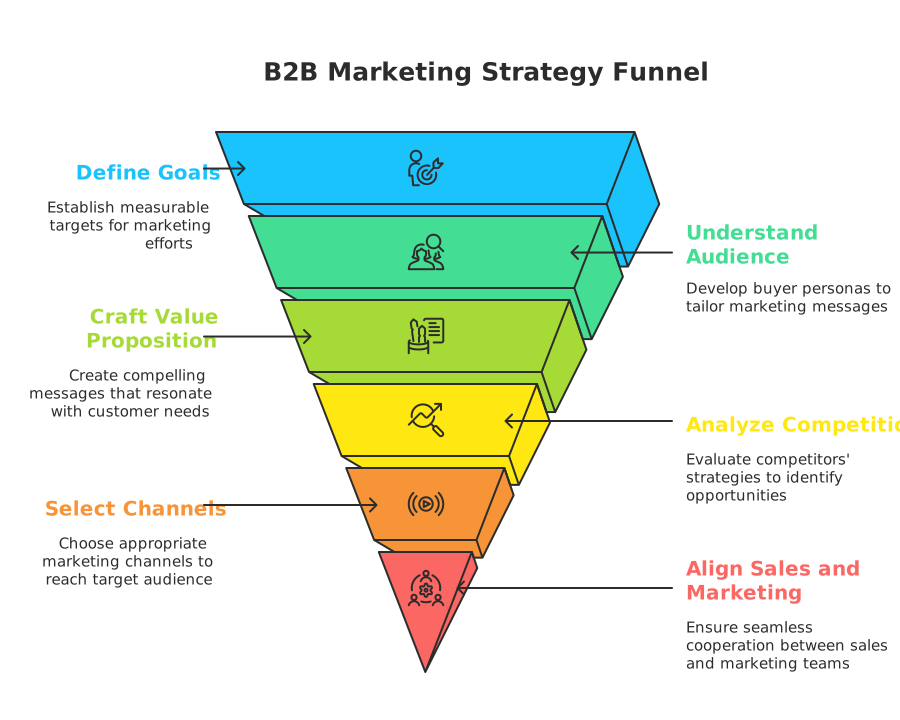
A B2B marketing framework gives the team a repeatable way to move from a business problem to an execution choice. The sequence should be consistent. Start with the target outcome. Define the market and buyer. Identify the barrier to progress. Choose the strategic play. Select channels based on their role. Build the campaign. Measure the result against an agreed threshold.
For example, suppose the company wants more enterprise pipeline. The weak response is to increase paid media. The stronger response is to ask why enterprise pipeline is low. The issue may be low awareness in target accounts, weak executive proof, missing security content, poor account coverage, or slow sales follow-up. Each diagnosis leads to a different campaign and a different investment decision.
2. How to Use the B2B Digital Marketing Plan
A strategy template is most useful when it is treated as a live operating document. It should not be completed by one marketer and filed away. The planning process should bring the relevant leaders into the same room, define the evidence each person must provide, and establish who has authority to make the final call when views conflict.
Start with the business plan. Review the revenue target, margin expectations, priority products, geographic plans, capacity limits, sales headcount, product roadmap, and customer retention goals. Marketing cannot build a credible plan when these inputs are missing or unstable.
Then separate facts from assumptions. Historical win rates are facts when the data is clean. A belief that a new industry will convert at the same rate is an assumption. Both can appear in the plan, but they should not be treated as equally reliable. Label assumptions, assign an owner, and define how they will be tested.
Annual Strategy, Quarterly Planning and Monthly Optimization
The annual strategy should contain the decisions that need stability. These include market selection, ICP criteria, positioning, the role of each major channel, the operating model between marketing and sales, and the primary measurement framework. Constantly changing these elements creates noise and makes learning difficult.
Quarterly planning should convert that direction into a focused set of programs. A quarter is long enough to launch meaningful work and short enough to respond to evidence. Quarterly reviews should examine whether the market assumptions still hold, whether pipeline coverage is sufficient, and whether the chosen plays are producing the intended behavior.
Monthly optimization should deal with execution variables. These include creative, bids, landing pages, email sequences, audience exclusions, content distribution, and sales follow-up. Weekly reviews may be useful for campaign operations, but weekly strategic changes usually create more harm than value.
The One-Page B2B Strategy Summary
The first page should let an executive understand the entire strategy in a few minutes. It should state the business target, the priority segments, the ICP, the central buyer problem, the positioning, the strategic plays, the investment level, the main risks, and the measures of success.
Keep this summary direct. Do not fill it with channel detail. A chief executive should be able to read it and answer five questions: Which customers are we pursuing? Why are they likely to choose us? What will marketing do to change buyer behavior? How much will it cost? How will we know whether it worked?
3. Establish the Baseline with a B2B Marketing Audit
A strategy starts with the current state. Without a baseline, targets become guesses and channel decisions reflect internal preference rather than evidence. A good audit examines commercial performance, customer quality, pipeline flow, channel contribution, content coverage, website effectiveness, technology, data, and team capability.
The audit should cover enough history to reveal patterns. Twelve months is a practical minimum for most businesses because it captures seasonality. Longer sales cycles may require eighteen to twenty-four months. New companies may have less data, so they should rely more heavily on customer interviews, sales evidence, and controlled experiments.
Audit Current Markets, Customers, Pipeline and Channel Performance
Begin with customers, not traffic. Identify which segments produce the strongest gross margin, retention, expansion, implementation success, and advocacy. A segment that generates many leads but creates weak customers is not a growth engine. It is a cost center hidden inside an acquisition report.
Next, examine the revenue funnel by segment and source. Review conversion from first meaningful engagement to qualified opportunity, proposal, closed deal, renewal, and expansion. Look for stage-specific leakage. A channel may produce few leads but a high opportunity rate. Another may create volume that sales cannot qualify. These differences should shape future investment.
Review sales-cycle length and reasons for loss. If deals stall during security review, marketing may need technical documentation and proof. If prospects choose a cheaper competitor, the issue may be targeting, value communication, or packaging. If opportunities disappear after a demo, the sales experience may not support the promise made by marketing.
Assess Content, Website, Technology and Data Maturity
The content audit should map every important asset to a buyer, question, journey stage, and commercial use. Count less. Judge usefulness. Ten generic articles do not replace one strong implementation guide, benchmark, calculator, case study, or technical evaluation page.
The website audit should examine whether visitors can understand the offer, see credible proof, find information relevant to their industry or use case, and take an appropriate next step. It should also check page speed, mobile usability, crawlability, indexation, internal linking, form behavior, analytics events, consent handling, and CRM capture.
Technology should be reviewed as a system. A large stack is not a sign of maturity. The key question is whether the tools support a clean journey from anonymous visit to account engagement, lead capture, qualification, sales follow-up, opportunity creation, revenue reporting, and customer expansion. Broken integrations and inconsistent fields can make sophisticated reports less trustworthy than a simple spreadsheet.
4. Translate Business Targets into B2B Marketing Goals
Strong B2B marketing goals begin with the economics of the business. They are not copied from last year’s dashboard. Revenue, margin, capacity, average contract value, win rate, sales-cycle length, retention, and expansion should determine what marketing must accomplish.
A goal such as “increase qualified pipeline by 30 percent” is more useful than “increase website traffic.” Traffic can support the goal, but it is not the business result. The plan should still contain leading indicators, because revenue arrives late. The mistake is treating a leading indicator as final proof of effectiveness.
Build a Goal Hierarchy from Revenue to Marketing Activity
Start with the revenue target. Separate new business, renewal, expansion, and partner revenue. Then calculate the pipeline required for each component. A company that needs $5 million in new revenue and closes 25 percent of qualified pipeline needs about $20 million in qualified pipeline. If the average contract value is $100,000, the company needs roughly 50 wins and 200 qualified opportunities.
Continue backward. If half of sales-accepted opportunities become qualified pipeline, marketing and sales need 400 accepted opportunities. If 20 percent of qualified leads become accepted opportunities, the system needs 2,000 qualified leads or an equivalent volume of high-intent account engagements. The exact stages vary by business. The discipline does not.
This reverse model exposes unrealistic plans early. If the required lead volume is five times historical capacity, the answer is not always more media. The company may need a higher-value offer, a stronger win rate, better retention, more partner contribution, improved sales productivity, or a narrower market.
Set Targets with Reverse-Funnel and Unit-Economics Calculations
Every major assumption should be visible. Record average contract value, gross margin, conversion rate by stage, sales-cycle length, customer acquisition cost, lifetime value, and payback period. Use segment-specific assumptions when possible. Enterprise and small-business motions rarely behave the same way.
Targets should also reflect constraints. A professional services firm cannot create unlimited demand if delivery capacity is fixed. A software company with poor onboarding should not scale acquisition while churn remains high. A manufacturer may need to account for distributor coverage, production lead times, and regional inventory.
Create base, upside, and downside cases. The base case should use the most defensible assumptions. The upside case should show what must improve. The downside case should show the impact of weaker conversion, slower sales cycles, or lower deal values. This turns the plan into a management tool rather than a single optimistic forecast.
5. Define the Ideal Customer Profile and Priority Market Segments
An ideal customer profile (ICP) describes the type of company most likely to buy, succeed, remain, and expand. It is not a broad target market. “Mid-sized technology companies” may describe a market. An ICP adds evidence about size, operating model, growth stage, technology, problem severity, purchase trigger, budget, implementation fit, and expected customer value.
The best ICPs are built from customer data and frontline evidence. Marketing contributes acquisition and behavior data. Sales contributes purchase context and objections. Customer success contributes adoption, retention, and expansion patterns. Finance contributes margin and cost-to-serve. Product contributes use-case fit and implementation complexity.
Build an Evidence-Based Ideal Customer Profile
Start by comparing the best and worst customers. Look beyond revenue. A large customer that requires constant custom work may be less attractive than a smaller customer with strong adoption and expansion. Score customers on profitability, retention, implementation effort, support demand, payment behavior, advocacy, strategic value, and product fit.
Then identify common attributes. These may include industry, employee count, revenue, geography, business model, technology environment, regulatory exposure, maturity, growth rate, hiring activity, funding, or operating complexity. Add trigger events such as a new executive, expansion into a market, a system migration, a compliance deadline, or a failed internal process.
Create a negative-fit profile as well. It should describe accounts that are unlikely to succeed or are expensive to serve. Clear exclusions improve media efficiency, lead quality, sales focus, and customer outcomes.
Prioritize Segments and Create Account Tiers
Not every attractive segment deserves equal investment. Score each segment on market size, problem urgency, willingness to pay, competitive intensity, access, sales-cycle fit, proof strength, delivery capability, and expansion potential. Then compare market attractiveness with the company’s ability to win.
Tier 1 should contain the highest-value accounts that justify coordinated research, tailored content, senior outreach, and multi-threaded engagement. Tier 2 can use segment-level personalization and targeted campaigns. Tier 3 can be served through broader demand programs and inbound capture.
Account tiers should change resource intensity, not just labels. A named enterprise account may receive a custom business case and executive event invitation. A broader mid-market segment may receive role-based content, paid social, webinars, and sales sequences built around shared problems.
6. Map B2B Buyer Personas and the Buying Committee
B2B buyer personas describe the people involved in the purchase. They should explain each person’s responsibilities, goals, risks, questions, objections, evidence needs, and influence. They should not be fictional biographies filled with irrelevant details.
A B2B buying committee often includes people from different departments who research, evaluate, approve, or block a purchase. Common roles include a champion, users, technical evaluators, financial approvers, procurement, legal, security, and an executive sponsor. The group structure and size vary by purchase, but the core planning lesson is stable: one lead record rarely represents the full decision.
Identify Champions, Users, Decision-Makers, Blockers and Approvers
Map roles by function in the purchase, not by job title alone. The person who completes a form may be a researcher with little authority. A senior executive may approve the budget without attending a demo. A technical lead may have veto power even when another team owns the project.
The champion needs help building internal support. Users need confidence that the solution will improve their work. Technical evaluators need evidence of compatibility, security, implementation, and control. Finance needs a defensible economic case. Procurement needs clarity on terms and risk. Executives need confidence that the purchase supports a strategic priority.
A strong plan assigns content and engagement to each role. It also identifies the relationships sales must build. Marketing can create awareness across the account, but complex deals often require direct human support to create consensus.
Document Jobs, Pain Points, Triggers, Objections and Decision Criteria
For each role, record the job they are trying to complete. Then define the problem, the cost of inaction, the desired outcome, the trigger that creates urgency, the likely objections, and the evidence required to move forward.
Avoid generic pain points such as “save time” or “increase efficiency.” Describe the operational consequence. A finance leader may care about forecast accuracy and cash exposure. An operations leader may care about rework, downtime, and service consistency. A technical leader may care about integration burden, access controls, and long-term maintainability.
This role-level detail improves content, ads, landing pages, demos, nurture, sales enablement, and product positioning. It also reveals when one message cannot serve the whole committee.
7. Map the B2B Customer Journey and Search Intent
The B2B customer journey is the sequence of questions, interactions, decisions, and internal actions that move an account from an unresolved problem to a purchase and beyond. It is rarely linear. Buyers pause, revisit earlier questions, involve new stakeholders, compare alternatives, and seek proof from different sources.
A useful journey map includes problem recognition, category learning, solution exploration, internal alignment, vendor evaluation, validation, procurement, implementation, adoption, renewal, expansion, and advocacy. It should show what the buyer is trying to accomplish at each stage and what friction prevents progress.
Connect Journey Stages to Questions, Content and Conversion Actions
Each stage should contain the questions buyers ask, the evidence they seek, the channels they use, and the next action marketing wants them to take. Early-stage buyers may need education and diagnostic tools. Mid-stage buyers may need use cases, comparisons, webinars, and expert guidance. Late-stage buyers may need case studies, technical documentation, security information, ROI models, references, and implementation plans.
The conversion action should match intent. A visitor reading a broad problem guide may not be ready for a sales call. An assessment, benchmark, newsletter, or related guide may be a better next step. A visitor reviewing pricing, integration, implementation, or competitor pages may justify a more direct call to action.
This approach improves search intent mapping because keywords are connected to a buyer task, not only a search volume estimate. It also prevents every page from using the same generic “book a demo” CTA.
Include Retention, Adoption, Expansion and Advocacy
The journey does not end at closed-won. Marketing should support onboarding, adoption, education, community, renewal, cross-sell, upsell, advocacy, and referral. This is especially important when customer lifetime value depends on recurring revenue or expanded usage.
Customer marketing also improves acquisition. Real implementation stories, benchmarks, lessons, and user evidence are stronger than generic brand claims. Customer questions can become content topics. Customer champions can become speakers, reviewers, references, and contributors to product education.
Include post-sale stages in the same strategy. Otherwise, acquisition receives all the attention while retention and expansion are treated as someone else’s problem.
8. Create the B2B Value Proposition and Messaging Architecture
A B2B value proposition explains why a defined customer should choose the company instead of another option or no action. It should connect the buyer’s problem with a credible business outcome. It should also explain why the company is suited to deliver that outcome.
A value proposition is not a slogan. It is the commercial logic behind the message. The slogan may be short. The underlying logic should include the target customer, the problem, the cost of the problem, the promised outcome, the mechanism, the differentiation, and the proof.
Define Category, Problem, Promise, Differentiation and Proof
First, define the category in language the buyer understands. Category language helps people place the offer in a mental and budget context. New category creation can work, but it requires greater education and investment.
Then define the problem with enough specificity to create recognition. State the consequence of leaving it unresolved. Describe the outcome in operational or financial terms. Explain the mechanism that makes the outcome possible. Show why the approach is different, and support the claim with evidence.
Proof may include customer results, product data, certifications, expertise, methodology, demonstrations, third-party validation, implementation history, or transparent limitations. Credibility rises when claims are precise and testable.
Build a Persona-by-Stage Messaging Matrix
Create a matrix with buyer role on one axis and journey stage on the other. For each cell, define the question, message, proof, objection response, content asset, and CTA. This prevents the team from using one broad message across every audience and campaign.
For example, a chief financial officer evaluating a solution may need payback, risk, and forecast impact. A technical lead at the same stage may need architecture, security, and integration detail. The offer is the same, but the decision criteria differ.
The matrix also improves consistency. Paid ads, website copy, email, sales decks, webinars, and proposals should reinforce the same core position while adapting to context.
9. Conduct a B2B Competitive Analysis and Make Strategic Choices
A B2B competitive analysis should explain how buyers understand the market, which alternatives they consider, what competitors promise, how they prove value, and where the company can establish a defensible position. It should include direct competitors, internal solutions, agencies, consultants, spreadsheets, legacy tools, and the option to do nothing.
Competitor research should inform choices, not imitation. Copying the same topics, claims, and channel mix usually creates a weaker version of the market leader. The goal is to find unmet questions, underserved segments, weak proof, poor experiences, and positions that competitors cannot easily claim.
Compare Positioning, Offers, Proof, Content, Search and Paid Presence
Review each competitor’s category language, target audience, promise, feature emphasis, pricing approach, proof, case studies, content architecture, organic visibility, paid search presence, paid social messaging, events, partnerships, and sales experience.
Pay close attention to the pages and assets built for high-intent evaluation. Competitor comparison pages, pricing pages, integration pages, implementation guides, security centers, case studies, calculators, and technical documentation reveal how seriously a company supports the buying process.
Also review customer language. Sales notes, reviews, community discussions, support complaints, and win-loss interviews can reveal the gap between a company’s positioning and the market’s experience.
Document Strategic Trade-Offs and No-Play Zones
A strategy becomes credible when it includes exclusions. Record the segments the company will not pursue, the channels it will not fund, the use cases it cannot serve well, and the claims it will not make.
This protects focus. It also makes later decisions easier. When an attractive but poor-fit opportunity appears, the team can compare it with documented criteria instead of reacting to internal pressure.
No-play zones are not permanent. They can change when the product, proof, capacity, economics, or market changes. The point is to make the current boundary explicit.
10. Select B2B Marketing Channels and Allocate the Marketing Budget
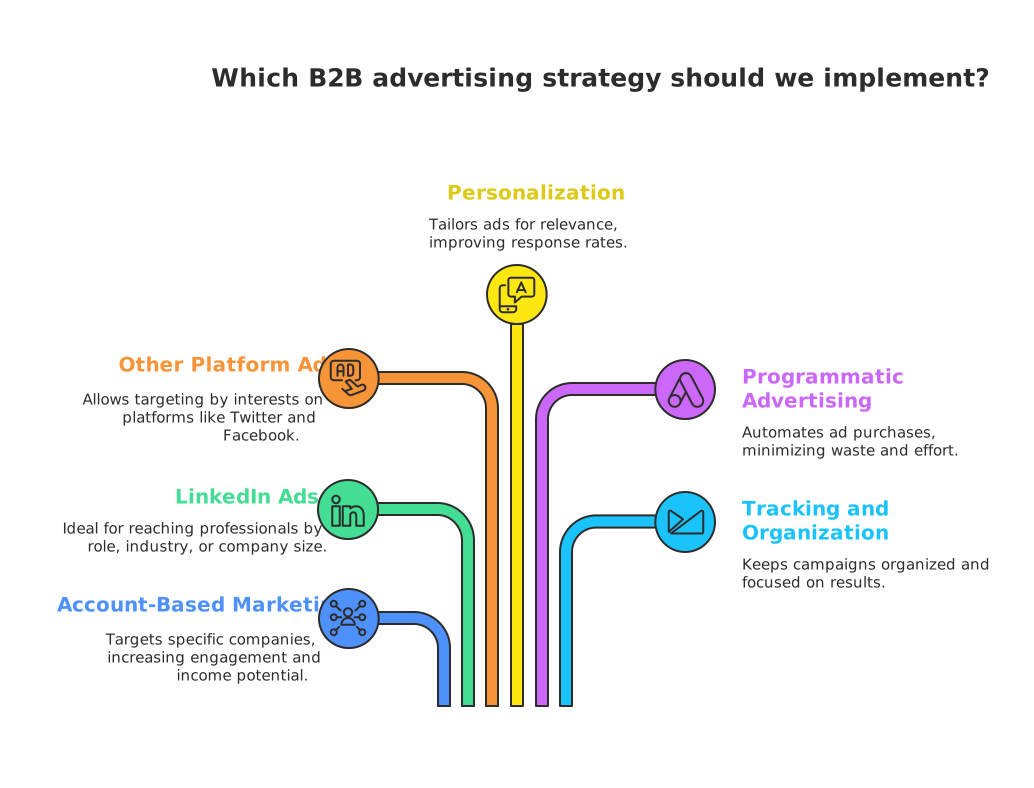
The best B2B marketing channels are the ones that can reach the right accounts, support the right buyer task, and produce an acceptable commercial return. No channel is universally best. Search can capture active demand. Content can educate and build authority. LinkedIn can reach professional audiences. Email can nurture known contacts. Events can create trust. Partners can provide access. Sales outreach can create direct conversations.
Channel selection should follow the buyer and the strategy. It should not follow the preference of the loudest internal stakeholder or the latest platform trend.
Score Channels by Reach, Intent, Economics and Organizational Fit
Score each channel on audience reach, buyer intent, cost, speed, scalability, measurement quality, creative requirements, sales support, and internal capability. A channel with attractive theoretical reach may still be a poor choice if the team cannot produce the required content or respond to demand.
Define the role of each channel. Organic search may capture problem and solution demand. Paid search may defend high-value commercial terms. LinkedIn may build familiarity across target accounts. Email may move known buyers toward the next decision. Webinars may help multiple stakeholders learn together. Partners may provide trust and access in a specialized market.
Do not force every channel to generate last-click leads. Some channels create memory, credibility, and account engagement that influence later actions. Measurement should reflect the role assigned in the plan.
Build Base, Growth and Constrained B2B Marketing Budget Scenarios
A B2B marketing budget should separate fixed capability costs from variable program costs. Fixed costs include people, technology, core content, design systems, analytics, and website infrastructure. Variable costs include media, events, contractors, data, production, and campaign-specific assets.
The base scenario funds the minimum coherent strategy. The growth scenario adds investment where capacity and evidence support scale. The constrained scenario protects the few activities most likely to sustain demand and revenue when resources tighten.
Reserve part of the budget for experiments. The amount depends on maturity and risk, but the principle is important. A plan that allocates every unit of budget to proven activity cannot discover new growth. A plan that allocates too much to unproven ideas becomes unstable.
11. Build the B2B Content Marketing and SEO Strategy
A B2B content marketing strategy should help buyers understand a problem, evaluate options, make a decision, implement successfully, and explain the choice internally. It should also give sales useful material for real conversations.
The content plan must begin with buyer questions and business priorities. Publishing frequency is a production metric. It does not prove that the content is useful, visible, persuasive, or commercially relevant.
Conduct B2B Keyword Research and Search Intent Mapping
B2B keyword research should combine search data with customer language. Search tools show demand patterns. Sales calls, support tickets, reviews, proposals, product demos, and customer interviews reveal how buyers describe the problem and what they need to believe before purchasing.
Group keywords by problem, use case, role, industry, category, feature, integration, alternative, comparison, pricing, implementation, risk, and outcome. Then assign each query to an intent and journey stage. A high-volume educational term may support awareness. A lower-volume competitor or integration query may be much closer to revenue.
The keyword map should specify the target page, primary question, audience, stage, content format, CTA, internal links, and proof requirements. This prevents overlapping pages and gives every asset a clear purpose.
Design Topic Clusters for the B2B SEO Strategy
A B2B SEO strategy should create a connected body of useful pages around the buyer’s problem and decision. A pillar page can explain the broad subject. Supporting pages can address specific use cases, roles, industries, comparisons, implementation questions, risks, and commercial terms.
Internal links should reflect the journey. An educational article should lead to a diagnostic, deeper guide, case study, or solution page. A commercial page should link to proof, implementation detail, security information, integrations, and relevant customer stories.
Technical quality still matters. Search engines need to discover, crawl, render, and understand the content. Users need fast, accessible, mobile-friendly pages. Clear titles, descriptive headings, useful internal links, structured navigation, and visible authorship make the site easier to use and evaluate. Search guidance continues to emphasize helpful, reliable, people-first content and the use of language people would use to find the page.
Create Original, Expert-Led Content for Google and AI Search
Content becomes more defensible when it contains experience that cannot be reproduced by summarizing the first page of search results. Use original data, customer patterns, expert interviews, tested frameworks, detailed examples, calculators, templates, diagrams, implementation notes, and honest limitations.
The same principle supports visibility in generative search experiences. Foundational SEO remains relevant. Unique, non-commodity, people-first content is a stronger investment than speculative tricks designed only for AI systems. Search platforms have also warned that mass-producing pages without added value can conflict with spam policies.
Write for clarity. Answer the question early. Use headings that describe the subject. Support claims with evidence. Include the details a serious buyer needs. Do not stretch a simple point across hundreds of words to reach a target length.
12. Integrate Demand Generation, Lead Generation, ABM and Paid Media
A complete strategy needs both demand creation and demand capture. A demand generation strategy builds awareness, memory, understanding, and preference before a buyer is ready to speak with sales. A B2B lead generation strategy creates identifiable responses from buyers who are willing to exchange information or begin a commercial conversation.
These motions should support each other. Demand generation without capture can produce attention that is difficult to convert. Lead generation without demand creation often reaches a narrow pool of active buyers and becomes more expensive as competition rises.
Build a Demand and Lead Generation Portfolio
Assign programs to different jobs. Thought leadership, research, communities, events, video, podcasts, and broad educational content can create demand. Search, comparison pages, paid search, retargeting, assessments, webinars, and product content can capture or progress demand.
Do not gate every useful asset. Gating can identify contacts, but it also reduces reach and creates low-intent form fills. Gate content when the exchange provides clear value, such as a detailed benchmark, assessment, calculator, workshop, template, or personalized output.
Measure both account behavior and lead behavior. An account may show meaningful engagement through several anonymous visitors before anyone fills a form. Marketing should be able to recognize increased account activity without pretending that every page view is purchase intent.
Coordinate Account-Based Marketing, Paid Search and LinkedIn
An account-based marketing strategy focuses coordinated marketing and sales effort on selected accounts. It works best when the account list is evidence-based, the potential value justifies personalization, and sales has the capacity to engage multiple stakeholders.
A B2B paid media strategy should define the role of paid search, paid social, retargeting, video, sponsorships, and other media. Paid search can capture active demand. Paid social can reach roles and accounts before they search. Retargeting can support continued evaluation. Each requires separate success measures.
A LinkedIn B2B marketing strategy can support awareness, account penetration, professional targeting, executive thought leadership, content distribution, lead capture, and sales research. It should not be reduced to sponsored lead forms. The platform is most useful when marketing and sales coordinate audiences, content, account engagement, and follow-up.
13. Optimize the Website and Conversion Paths
The website is the central decision environment for most digital programs. It must explain the offer, establish trust, answer buyer questions, support multiple stakeholders, and provide suitable next steps. A visually polished site can still fail when the message is vague, proof is weak, or evaluation content is missing.
Conversion optimization should improve both volume and quality. A higher form-completion rate is not automatically better if it attracts poor-fit prospects or creates sales workload without pipeline.
Design Pages for Problems, Industries, Use Cases and Buying Roles
Build pages around the ways buyers understand the solution. Product pages explain what the offer does. Problem pages show that the company understands the operational issue. Use-case pages explain how the solution is applied. Industry pages address context, regulation, workflows, and proof. Role-based pages can help a technical, financial, or executive buyer find the information relevant to their decision.
Avoid creating thin pages for every keyword variation. A page deserves to exist when it answers a distinct intent with useful depth. Combine closely related topics when separate pages would repeat the same content.
High-intent pages should reduce uncertainty. Explain implementation, integrations, pricing logic, security, support, timelines, requirements, expected outcomes, and limitations. Buyers often need these details before they are ready to speak with sales.
Improve Landing Pages, Forms, Demos, Chat and Lead Magnets
Match the landing page to the promise made in the ad, email, or search result. Use one clear primary action. Remove distractions that do not help the visitor decide. Show proof close to the claim it supports.
Form length should reflect intent and value. A newsletter form can ask for little. A detailed assessment may justify more information. Progressive profiling can gather data over time. Avoid asking for fields that sales or marketing will not use.
Offer different conversion paths. Some buyers want a demo. Others want pricing context, a technical conversation, a sample, an assessment, a calculator, a trial, or a guide. A single hard conversion can lose qualified buyers who need a lower-friction next step.
14. Build the B2B Email Marketing, Lead Nurturing and Automation Strategy
A B2B email marketing strategy should help known contacts move through a decision. It should not become a calendar of unrelated announcements. The message, timing, and CTA should reflect the contact’s role, account, behavior, stage, and prior engagement.
A strong lead nurturing strategy answers the next likely question. It provides evidence, handles objections, and creates a reason to continue. It also knows when to stop. Repeated emails to an unresponsive or poor-fit contact waste attention and damage trust.
Map Nurture Sequences to Behavior, Persona and Buying Stage
Build nurture around a specific entry point. A contact who downloaded an implementation guide should receive different follow-up from a contact who attended an executive webinar. The first message should deliver the promised value. Later messages should deepen the topic, provide proof, and offer a next step that fits the level of intent.
Use behavior carefully. A single page view does not prove urgency. A pattern of high-intent activity across multiple stakeholders may justify sales attention. Define which actions change the sequence, increase priority, pause communication, or trigger a handoff.
Every sequence needs an exit rule. A contact may convert, become an opportunity, unsubscribe, become inactive, or be identified as a poor fit. Continuing the same nurture after the context changes creates a broken experience.
Define Lead Scoring, Marketing Automation and Martech Requirements
A marketing automation strategy should define how data triggers useful action. It includes segmentation, scoring, routing, personalization, suppression, lifecycle updates, reporting, and governance. Automation is valuable when it makes the experience more relevant and the process more reliable.
Lead scoring should combine fit and behavior. Fit includes company and role characteristics. Behavior includes actions that indicate interest or evaluation. Keep the model understandable. Complex scores can create false confidence when the underlying data is incomplete.
Define the source of truth for contacts, accounts, campaign membership, consent, lifecycle stage, opportunity status, and revenue. Assign owners for fields and integrations. Document naming conventions. Test the full data path before launch, from the first click through CRM opportunity reporting.
15. Establish Sales and Marketing Alignment
Sales and marketing alignment means both teams share the same commercial definitions, priorities, account view, and feedback loop. It does not mean they attend more meetings. Alignment becomes real when behavior changes.
The strategy should define the target account, qualified lead, qualified account, accepted opportunity, pipeline stage, source rules, follow-up expectation, rejection reason, and ownership model. Without shared definitions, teams debate reports instead of improving performance.
Create a Revenue SLA for Qualification, Routing and Follow-Up
A revenue service-level agreement should state what marketing will provide and what sales will do in response. It should define the minimum information required for routing, the response time by lead type, the outreach expectation, the conditions for acceptance or rejection, and the process for returning a contact to nurture.
Account-based motions need account rules. Several contacts from one company should not create disconnected lead records and conflicting ownership. The system should show account engagement, open opportunities, existing customers, parent-child relationships, and current sales activity.
Review SLA performance by segment and source. A slow response may explain weak conversion. So may poor qualification, weak messaging, or limited sales capacity. The purpose is diagnosis, not blame.
Build Sales Enablement and a Closed Feedback Loop
Sales enablement should support the real decisions buyers make. Useful assets include discovery guides, battlecards, case studies, ROI models, technical documents, objection responses, implementation plans, comparison materials, and executive summaries.
Marketing should collect structured feedback from calls, opportunities, and losses. Which questions repeat? Which claims create interest? Which objections stop progress? Which competitors appear? Which content helps? Which leads should never have been sent?
This feedback should update personas, messages, content priorities, paid keywords, nurture, and qualification rules. A strategy that does not learn from sales conversations will drift away from the market.
16. Define B2B Marketing KPIs, Attribution and ROI
B2B marketing KPIs should show whether the strategy is creating the intended business effect. The measurement system needs leading indicators for speed and diagnostic value, plus lagging indicators for commercial proof.
Do not place every metric on the executive dashboard. Executives need a concise view of target, forecast, pipeline, revenue, efficiency, and risk. Channel teams need more detail to diagnose performance.
Create a KPI Tree from Attention to Revenue and Retention
A KPI tree connects activity to business outcomes. It should show how reach and engagement contribute to account interest, qualified demand, pipeline, revenue, retention, and expansion. It should also show efficiency measures such as cost per qualified opportunity, customer acquisition cost, and payback.
| Measurement layer | Example metrics | Primary management question | Common misuse |
|---|---|---|---|
| Attention | Reach, impressions, share of search, branded search | Are priority buyers becoming more aware of us? | Treating impressions as revenue proof |
| Engagement | Engaged accounts, content consumption, event participation | Are buyers spending meaningful time with relevant material? | Counting every interaction as intent |
| Demand | High-intent visits, qualified leads, qualified accounts | Are the right buyers moving toward evaluation? | Rewarding volume without fit |
| Pipeline | Accepted opportunities, pipeline value, stage velocity | Is marketing helping create credible sales opportunities? | Ignoring pipeline quality and aging |
| Revenue | Closed revenue, win rate, average contract value | Are opportunities converting into profitable business? | Claiming all influenced revenue as sourced revenue |
| Customer value | Adoption, renewal, expansion, advocacy | Are acquired customers succeeding and growing? | Excluding post-sale outcomes from marketing evaluation |
| Efficiency | CAC, cost per opportunity, payback, marginal return | Is growth economically sustainable? | Optimizing cheap leads instead of valuable customers |
Targets should be set by segment and motion. Enterprise ABM, inbound search, partner marketing, and customer expansion have different timelines and economics. Comparing them with one cost-per-lead target creates poor decisions.
Design the B2B Marketing Attribution Model
B2B marketing attribution and ROI require more than a single platform report. Attribution models assign credit to touchpoints, but the answer depends on the model, data scope, identity resolution, and reporting window. Analytics systems can compare model outputs, which is useful because different rules change how channels receive credit.
Define marketing-sourced pipeline separately from marketing-influenced pipeline. Sourced pipeline should have a clear origin rule. Influenced pipeline should require meaningful engagement, not any historical touch. Keep the definitions stable enough to compare performance over time.
Combine system attribution with other evidence. Self-reported attribution can reveal what buyers remember. Sales notes can explain the role of content and events. Experiments can test incrementality. Account-level analysis can show how multiple people and channels contributed to progress.
ROI should account for gross profit when possible, not only revenue. It should also consider the time required to create return. A campaign that produces revenue after a long sales cycle may be valuable, but it affects cash and planning differently from a faster motion.
Build an Experiment and Optimization System
Every experiment should state the problem, hypothesis, change, audience, primary metric, guardrail metric, minimum evidence, time window, and decision rule. This reduces the risk of changing the goal after results arrive.
Low-volume B2B programs require care. Statistical certainty may be difficult at the opportunity or revenue level. Use a chain of evidence. Evaluate leading behavior, quality, sales feedback, stage movement, and commercial outcomes together.
Create three possible decisions before the test starts: stop, continue learning, or scale. Scaling should require evidence that the result is repeatable and that the organization can support more demand.
17. Turn the Strategy into a 90-Day Execution Roadmap
A strategy becomes useful when it changes priorities, calendars, budgets, and ownership. The first 90 days should establish the foundation, launch a small number of coherent plays, and create a review rhythm.
Do not start every initiative at once. Sequence the work. Tracking, messaging, website readiness, content, audience data, sales follow-up, and campaign launch often depend on one another.
Build the Roadmap, Campaign Calendar and RACI Matrix
A practical 90-day sequence is:
- Days 1 to 30: confirm targets, audit data, finalize ICP and account tiers, map the buying committee, approve positioning, define lifecycle stages, and fix critical tracking or website gaps.
- Days 31 to 60: produce priority content and sales enablement, build audiences, configure nurture and routing, create landing pages, train sales, and complete pre-launch quality checks.
- Days 61 to 90: launch focused campaigns, monitor account and lead quality, review sales response, correct operational issues, and make the first stop-or-scale decisions.
The RACI matrix should identify who is responsible for doing the work, who is accountable for the result, who must be consulted, and who needs to be informed. Use one accountable owner for each major outcome. Shared accountability often means no accountability.
The campaign calendar should show audience, objective, offer, assets, channels, budget, launch date, owner, sales action, metric, and review date. This makes dependencies visible and prevents conflicting messages from reaching the same account.
Establish Review Cadence, Risks and Decision Rules
Weekly reviews should address execution and blockers. Monthly reviews should examine channel performance, lead and account quality, sales response, budget, and experiment status. Quarterly reviews should reconsider strategic assumptions, market priorities, pipeline requirements, and resource allocation.
Maintain a risk register. Common risks include poor data quality, limited sales capacity, weak proof, long production lead times, low account reach, implementation constraints, legal review, platform dependence, and unrealistic conversion assumptions.
For each risk, define an owner, probability, impact, mitigation, and trigger. A trigger is the evidence that requires action. This prevents teams from acknowledging risks without changing behavior.
Completed B2B Digital Marketing Strategy Template Example
Consider a mid-market software company that sells workflow automation to regulated service businesses. The company has a $60,000 average first-year contract value, a nine-month sales cycle, and a strong retention rate. It needs $3 million in new annual contract value.
At a 25 percent win rate, it needs $12 million in qualified pipeline. That equals about 200 qualified opportunities at the average contract value. If 40 percent of accepted opportunities become qualified pipeline, the company needs 500 accepted opportunities. The model shows that broad lead volume alone is unlikely to be sufficient. The strategy must improve account selection, buying-group engagement, proof, and sales conversion.
The ICP includes firms with 250 to 2,000 employees, distributed operations, a dedicated compliance function, an active system-modernization project, and measurable cost from manual approvals. Negative-fit accounts lack an executive owner, require unsupported custom workflows, or have no budget event within twelve months.
The buying committee includes an operations champion, compliance leader, IT evaluator, finance approver, procurement, and an executive sponsor. The core position is faster controlled workflows without sacrificing auditability. Proof includes implementation time, reduction in manual processing, audit logs, security controls, and customer references from the same industry.
The company uses educational research to create demand, SEO and paid search to capture active demand, LinkedIn to build familiarity across named accounts, webinars to engage several roles, email to nurture known contacts, and sales outreach to create internal consensus. The website contains problem, industry, use-case, integration, security, implementation, pricing-context, and customer-story pages.
The first quarter focuses on one segment and two strategic plays. The first play targets firms with a current compliance transformation. The second targets firms replacing legacy workflow tools. Each play has its own audience criteria, message, proof, content, paid campaign, nurture path, and sales sequence.
Filled Example for a Mid-Market B2B Software Company
The one-page strategy summary states the revenue target, required pipeline, ICP, priority account tier, buyer problem, value proposition, plays, investment, KPIs, and major risks. The account list contains evidence for why each Tier 1 company fits. The messaging matrix shows what operations, compliance, IT, finance, and executives need at each stage.
The content plan prioritizes a compliance workflow benchmark, a legacy-replacement guide, an ROI calculator, two industry case studies, a security center, an implementation guide, competitor comparison pages, and role-specific webinar sessions. Each asset has a defined buyer question and next action.
The dashboard reports engaged target accounts, high-intent account activity, accepted opportunities, qualified pipeline, stage velocity, win rate, revenue, CAC, and payback. Content views and ad clicks remain available for diagnosis, but they do not dominate the executive view.
How to Adapt the Template by Business Model
A professional services firm should place more weight on expertise, methodology, trust, utilization, delivery capacity, and partner involvement. Its content may include diagnostic tools, executive briefings, detailed case narratives, and point-of-view research. The conversion path may lead to a consultation rather than a product demo.
A manufacturer should include distributors, engineers, procurement, production constraints, specifications, certification, sample requests, lead times, and regional availability. Search behavior may include part numbers, applications, materials, compliance standards, and technical comparisons.
A low-contract-value SaaS company may use a shorter journey, product-led onboarding, trials, usage signals, and automated nurture. An enterprise company may require named accounts, executive engagement, multi-threaded sales, security review, procurement support, and a much longer attribution window.
A partner-led business should include partner recruitment, enablement, co-marketing, lead registration, channel conflict, shared pipeline, and partner-sourced revenue. The core framework stays the same. The routes to market and ownership rules change.
B2B Digital Marketing Strategy Template Checklist
The strategy is ready when a new team member can understand the commercial logic, a sales leader can see how demand will become pipeline, a finance leader can evaluate the assumptions, and a channel owner can explain why each activity exists.
Strategic Readiness Checklist
Before approval, confirm the following:
- The revenue target, pipeline requirement, conversion assumptions, capacity limits, ICP, negative-fit profile, account tiers, buying committee, journey, positioning, strategic exclusions, channel roles, and budget scenarios are documented.
- Every priority campaign has a defined audience, buyer problem, message, offer, proof, conversion path, sales action, owner, metric, review date, and stop-or-scale rule.
- Lifecycle stages, routing, consent, attribution, reporting, data ownership, customer outcomes, risks, dependencies, and review cadence are clear enough to operate without interpretation.
A template is complete only when it supports decisions. Extra fields do not create quality. Clear evidence, explicit assumptions, and consistent execution do.
Download the Editable B2B Marketing Strategy Template
The editable version should include the executive summary, baseline audit, reverse-funnel model, ICP scorecard, segment prioritization, account tiers, buying-committee map, journey map, positioning framework, persona-by-stage messaging matrix, competitor review, channel scorecard, budget scenarios, keyword map, content plan, campaign portfolio, martech map, sales SLA, KPI tree, attribution plan, experiment backlog, 90-day roadmap, and risk register.
Provide it in a collaborative spreadsheet or workbook. Include formulas where calculations are required. Add a filled example beside the blank fields. Use short instructions and visible definitions so the document can be completed without a separate training session.
The final B2B digital marketing plan should make one idea unmistakable: marketing is not a collection of channels. It is a coordinated commercial system. The strategy defines where the company will compete. The plan turns that choice into action. Measurement shows whether the system is working. Governance ensures the team learns before it spends more.