

Customers rarely wake up ready to buy from a brand they have never heard of.
First, they notice a problem. Then they learn what may solve it. They compare options, question claims, assess risk, and decide whether to spend money. Once they buy, a new set of needs appears. They must understand the product, use it successfully, receive ongoing value, and decide whether the brand deserves another purchase.
Only then might they recommend it to someone else.
These customer journey stages are commonly described as awareness, consideration, decision, retention, and advocacy. Each stage represents a different customer mindset. Each comes with different questions, expectations, doubts, and desired outcomes.
That is why one message cannot serve the entire journey.
A customer who has just discovered a problem does not need an aggressive product pitch. A buyer comparing vendors does not need another beginner’s definition. A new customer does not need a referral request before completing setup. A loyal customer does not need to be treated like a first-time website visitor.
Brands must provide the right information at the right moment. The content should help people understand their situation, make a sound decision, get value after purchasing, and share a positive experience when they are ready.
This guide explains what content for every stage of the buyer journey should accomplish. It covers content formats, customer questions, touchpoints, calls to action, transition signals, measurement, personalization, governance, and execution.
The goal is not to force customers through a rigid funnel. The goal is to make every stage clearer, easier, and more satisfying.
What Is the Customer Buying Journey and Why Must Content Change at Every Stage?
The customer buying journey describes the path a person or organization follows before and after purchasing.
That path starts when a need, problem, opportunity, or desire enters the customer’s mind. It continues through research, evaluation, purchase, use, support, renewal, repeat buying, and recommendation.
The phrase buying journey stages often refers to the steps leading to a purchase. Yet the complete customer experience continues long after payment. Customers still need guidance. They may need reassurance, training, troubleshooting, product education, or help reaching the result they expected.
The purpose of stage-based content is to reduce uncertainty.
Uncertainty changes throughout the journey. At first, customers may not understand the problem. Later, they may know the problem but feel unsure about available solutions. Near the purchase, their concern shifts toward price, risk, trust, implementation, or proof. After the purchase, they question whether they made the right choice and whether they can achieve value.
Useful content answers the question that matters now.
When content fails to match the stage, friction grows. Early-stage visitors feel pressured. Serious buyers struggle to find detailed evidence. New customers become confused. Long-term customers receive generic promotions instead of useful guidance.
A strong journey strategy prevents those gaps.
Buyer’s Journey vs. Customer Journey vs. Marketing Funnel
The buyer’s journey usually covers three pre-purchase stages: awareness, consideration, and decision.
During awareness, buyers recognize a problem or opportunity. During consideration, they investigate different ways to address it. During decision, they compare providers, products, plans, or offers and choose a path.
The customer journey is wider. It includes the buyer’s experience before purchase and the customer’s experience afterward.
That distinction matters because acquisition content alone cannot create lasting growth. A brand may generate leads and sales while still losing customers through weak onboarding, poor support, confusing product education, or badly timed communication.
The marketing funnel stages describe how audiences narrow as they move from broad attention to action. Funnels are useful for campaign planning and conversion analysis. They help teams estimate how many people become visitors, leads, opportunities, buyers, or repeat customers.
A journey provides a different view. It focuses on what the customer experiences across those stages.
The content marketing funnel should support both views. It should help the business measure progress while helping the customer complete a useful task at every interaction.
Funnels ask, “How many people moved forward?”
Journeys ask, “What did people need, feel, encounter, and accomplish?”
Brands need both questions.
The Five Stages: Awareness, Consideration, Decision, Retention, and Advocacy
The five-stage framework creates a practical structure for planning content.
Awareness begins when customers notice a problem, need, interest, or opportunity. They may not know the name of the solution. They may not understand the cause of the problem.
Consideration begins when customers understand the issue and start exploring possible solutions. They compare approaches, categories, methods, and providers.
Decision begins when customers are close to acting. They evaluate detailed features, pricing, evidence, implementation requirements, guarantees, and risks.
Retention starts after the purchase. It includes onboarding, activation, adoption, support, repeat use, renewal, loyalty, expansion, and service recovery.
Advocacy begins when customers willingly support the brand. They may recommend it, post a review, create content, make a referral, join a community, speak at an event, or participate in a case study.
These five stages can also be treated as broader customer lifecycle stages. The labels may change across industries, but the underlying needs remain similar.
A retailer may focus on discovery, purchase, repeat buying, and referrals. A software company may focus on awareness, evaluation, trial, activation, adoption, renewal, expansion, and advocacy. A professional service provider may focus on education, consultation, proposal, delivery, results, retention, and recommendation.
The model should fit the real customer experience. It should not force every business into identical labels.
Why Real Buying Journeys Are Non-Linear
Customers do not always move forward one stage at a time.
A buyer may reach a pricing page, discover an unexpected limitation, and return to comparison content. Another person may enter at the decision stage after receiving a recommendation from a trusted colleague. An existing customer may begin a new consideration process when evaluating an additional product.
People also pause. A purchase may be delayed by budget, timing, internal approval, changing priorities, or personal circumstances. The need remains, but the journey slows.
B2B buying journeys can become more complex because several people participate. One stakeholder may be aware of the problem. Another may evaluate technical requirements. A finance leader may focus on cost. A senior executive may care about strategic value and risk.
The journey may also move across channels. A person can discover a topic through social media, search for it later, read a comparison article, ask a friend, visit a store, return to the website, contact sales, and complete the purchase on another device.
A full-funnel content strategy must support loops, pauses, skipped stages, and re-entry. Customers should be able to find the information they need without starting again.
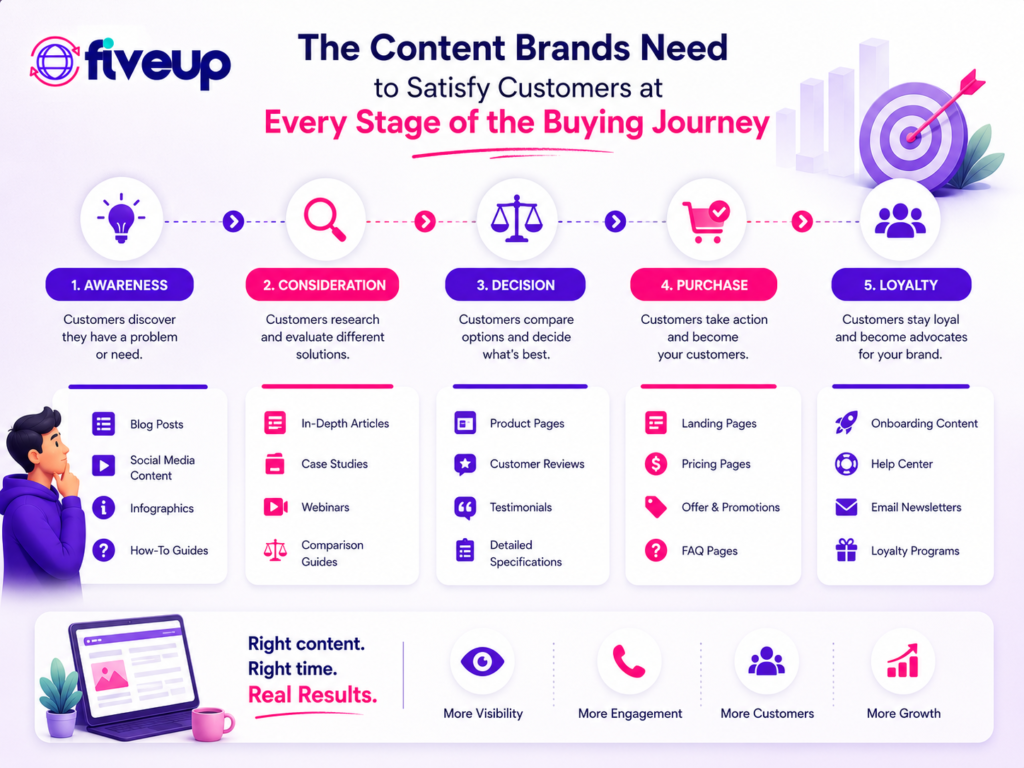
The Five-Stage Content Framework at a Glance
Every stage should be planned around six elements:
The customer’s mindset, the job they need to complete, the question blocking progress, the evidence required, the appropriate next action, and the signal that indicates movement.
The following table summarizes that relationship.
| Journey stage | Customer mindset and job | Content objective | Useful content | Suitable next action | Transition signals |
|---|---|---|---|---|---|
| Awareness | “Something is wrong, changing, or worth exploring.” The customer needs to understand and name the issue. | Educate, clarify, create relevance, and build initial trust. | Beginner guides, research, educational videos, glossaries, checklists, diagnostic tools, expert commentary. | Read a related guide, complete an assessment, subscribe, or explore the topic. | Return visit, deeper educational engagement, category search, assessment completion, email subscription. |
| Consideration | “I understand the problem and need to evaluate possible solutions.” | Explain approaches, criteria, trade-offs, use cases, and expected outcomes. | Buyers’ guides, comparisons, webinars, calculators, case studies, solution guides, expert interviews. | Compare approaches, view a relevant case study, attend a webinar, or use a calculator. | Multiple visits, comparison views, case-study engagement, webinar attendance, product-page visits. |
| Decision | “I know the type of solution I want. I need confidence in this provider or product.” | Reduce financial, performance, implementation, and trust risk. | Pricing pages, demos, trials, reviews, testimonials, ROI tools, implementation plans, guarantees, detailed FAQs. | Start a trial, request a demo, buy, contact sales, or approve a proposal. | Trial start, demo request, checkout activity, proposal acceptance, contract signature, purchase. |
| Retention | “I bought. Now help me achieve the result and keep receiving value.” | Guide setup, adoption, education, support, renewal, repeat buying, and recovery. | Welcome content, onboarding guides, tutorials, customer education, support content, product updates, loyalty content. | Complete setup, reach first value, use another feature, renew, reorder, or seek help. | Activation, repeat use, second purchase, feature adoption, renewal, positive feedback, improved health indicators. |
| Advocacy | “I trust this brand and may be willing to recommend it.” | Make recommendation easy, ethical, useful, and rewarding. | Review requests, referral resources, testimonial interviews, UGC prompts, ambassador programs, community spotlights. | Review, refer, share, contribute, speak, or join an advocacy program. | Review submission, referral, social mention, community contribution, testimonial participation, repeat recommendation. |
Customer Mindset and Job-to-Be-Done at Each Stage
The job-to-be-done is the progress the customer wants to make.
In awareness, the job is often diagnosis. The customer needs to understand what is happening and whether it deserves attention.
In consideration, the job becomes evaluation. The customer needs a clear way to compare solution paths.
In decision, the job is risk reduction. The customer wants to feel confident that the selected option will work and that the cost is justified.
In retention, the job is value realization. The customer must turn the promise into a real outcome.
In advocacy, the job may be expression, contribution, recognition, or helping others make a good choice.
Thinking in jobs keeps content customer-centered. It prevents teams from defining every stage by what the business wants.
Content Goal, Evidence, and CTA by Journey Stage
The content goal should change as the customer becomes more informed.
Awareness content earns attention by being useful. It should not demand a large commitment. A reader may be ready for another educational resource but not a sales call.
Consideration content helps organize choices. It should explain selection criteria and trade-offs. Its CTA can invite deeper evaluation.
Decision content supports action. It must provide proof, clarity, and practical detail. The CTA can be direct because the customer has shown stronger intent.
Retention content helps customers succeed. Its CTA should support activation, learning, usage, renewal, or problem resolution.
Advocacy content invites participation. The request should be timed around genuine success rather than sent automatically after payment.
The CTA must match the customer’s readiness. A mismatch creates pressure or confusion.
Stage-Transition Signals Brands Can Measure
Teams often assign content to stages based only on format. That approach is unreliable.
A blog post can support awareness, consideration, decision, or retention. The stage depends on the customer question and the purpose of the asset.
Brands need observable transition signals.
A reader who moves from a broad educational article to a solution comparison may be entering consideration. A visitor who views pricing, implementation, and reviews in one session may be approaching decision. A new customer who completes setup and repeatedly uses a core feature may be progressing through retention.
One action rarely proves the stage. Patterns are more useful than isolated clicks.
Teams should combine behavioral signals with declared information. A customer may directly state their goal, timeline, role, challenge, or current solution. That information can improve stage identification when collected respectfully.
How to Research Customers Before Mapping Content
Journey content should be based on evidence, not internal assumptions.
Many companies create a journey map in a meeting room. Team members discuss what they think customers do, then arrange those assumptions into a polished diagram. The result often describes the process the company wants rather than the experience customers have.
Real customer journey mapping starts with observation.
Useful evidence can come from interviews, search data, website behavior, sales calls, support tickets, product usage, purchase records, surveys, reviews, community conversations, returns, cancellations, and renewal discussions.
Each source reveals a different part of the journey.
Search data shows how customers describe problems. Sales calls reveal objections. Support conversations expose post-purchase confusion. Product data shows whether customers adopt important features. Reviews reveal moments people remember.
No single source provides the complete picture.
Build Buyer Personas Around Problems, Context, and Jobs-to-Be-Done
A useful persona explains why a customer behaves in a certain way.
Basic details such as age, title, company size, or location may matter, but they are rarely enough. Content decisions require deeper context.
Teams should understand the triggering event, desired outcome, current method, level of knowledge, perceived risk, decision authority, urgency, constraints, and success criteria.
For a B2B buyer, the persona should also clarify the person’s role in the decision. A user, evaluator, finance approver, technical reviewer, and executive sponsor need different content.
For a consumer, the context may include frequency of purchase, available alternatives, budget sensitivity, emotional motivations, and the role of family, friends, creators, or reviews.
The goal is to understand the decision, not to produce a decorative profile.
Map Questions, Emotions, Touchpoints, and Friction
A customer journey map should connect actions with thoughts and emotions.
For each stage, identify what the customer is trying to do, what they ask, where they look, what they feel, what blocks progress, and what evidence helps.
The map should include important customer touchpoints. These may include search results, social posts, ads, product pages, reviews, sales conversations, emails, checkout pages, packaging, onboarding screens, support interactions, invoices, communities, and renewal notices.
Friction can appear anywhere.
A confusing article may prevent the customer from understanding the problem. A vague comparison page may create distrust. A hidden price may delay evaluation. A complicated checkout may stop the purchase. A weak setup guide may damage retention.
Teams should also map emotional shifts. Curiosity may become concern. Interest may become confusion. Confidence may become anxiety after purchase. Relief may become loyalty once the promised result appears.
Content should respond to those changes.
Audit Existing Content and Build a Content-Gap Matrix
A content audit shows where the journey is over-served and where it is neglected.
Start by assigning every existing asset to a primary persona, stage, question, goal, CTA, and owner. Then assess quality, accuracy, traffic, engagement, business impact, and update needs.
This process is called content mapping.
A common pattern appears in many organizations. Awareness has dozens of articles. Consideration has a few generic case studies. Decision depends heavily on sales conversations. Retention is limited to support documentation. Advocacy consists of occasional review requests.
That imbalance creates hidden costs. Sales teams repeat explanations that content should provide. Customers contact support for basic questions. Valuable customer stories remain unpublished. Retention teams create one-off materials that are never added to the main content system.
A gap matrix should prioritize content according to customer impact and business value. A missing onboarding guide may matter more than another broad blog post. An accurate pricing FAQ may remove more friction than a new social campaign.
Awareness Stage Content: Help Customers Recognize and Name the Problem
The awareness stage begins before customers have formed a clear solution preference.
They may notice a symptom, frustration, risk, desire, or opportunity. They search for explanations. They ask broad questions. They may not know the terminology used by the industry.
The purpose of awareness stage content is to help people understand their situation.
It should explain the problem in familiar language. It should clarify causes, consequences, and possible next steps. It should give the reader a useful mental model.
The brand can introduce its perspective, but the product should not dominate the content.
Strong awareness content creates trust because it helps before asking for commitment.
Best Awareness Content Formats for Problem Discovery
Useful awareness formats include:
- Problem-definition articles, beginner guides, glossaries, checklists, original research, educational videos, podcasts, expert interviews, self-assessments, infographics, and practical social content.
- Diagnostic resources that help people recognize symptoms, estimate impact, or determine whether a problem requires action.
- Perspective-led content that explains industry changes, common misconceptions, emerging risks, or overlooked opportunities.
The best format depends on the question.
A visual demonstration may work better than an article for a physical process. A calculator may reveal the cost of an unnoticed problem. An interview may help an audience understand a complex change. A checklist may turn vague concern into a clear assessment.
Awareness content should be complete enough to satisfy the immediate question. It can guide the reader toward another resource, but it should not withhold the core answer to force a click.
Awareness SEO, Search Intent, and Distribution
Search behavior often begins with symptoms rather than products.
A customer may search “why is my website traffic dropping” before searching for technical SEO services. Someone may search “how to stop food sticking to a pan” before considering new cookware. A manager may search “why employees ignore security training” before evaluating an awareness platform.
This makes search intent central to awareness planning.
Teams should study the language customers use before they know the solution category. Internal product terms may not match those searches.
Awareness distribution should not depend on search alone. Educational content can reach people through social platforms, video, communities, newsletters, events, partnerships, public relations, and expert participation.
The same idea can appear in several formats, but each version should fit the channel. A search article needs clear answers and depth. A social post needs a focused insight. A video needs visual movement and pacing. A podcast needs a strong discussion angle.
Awareness KPIs and Common Mistakes
Awareness performance should be judged by qualified discovery and learning, not immediate purchases alone.
Useful indicators include non-branded visibility, engaged visits, content completion, return visits, subscriber growth, assessment completion, branded search growth, and assisted conversions.
The most common mistake is publishing a sales page disguised as education.
Readers notice when an article defines a problem only to claim that one product is the obvious answer. That approach weakens trust.
Another mistake is chasing broad traffic with little relevance. A large audience is not useful if the content attracts people who will never need the brand’s expertise.
Strong awareness content attracts the right curiosity.
Consideration Stage Content: Help Buyers Evaluate Solutions and Trade-Offs
During consideration, the customer understands the problem and begins evaluating ways to solve it.
This stage may involve solution categories before brands. A business may compare hiring, outsourcing, automation, training, or process change. A consumer may compare repairing, replacing, subscribing, renting, or buying.
The job of consideration stage content is to create clarity around those options.
Customers need evaluation criteria. They need to understand trade-offs, limitations, cost drivers, use cases, and likely outcomes.
Brands build trust when they explain those differences honestly.
Teach Customers How to Evaluate the Solution Category
Good consideration content helps customers ask better questions.
It may explain which solution works for a small team, which suits a regulated organization, which requires technical skill, and which has a higher long-term cost. It can show when the brand’s offer is suitable and when another approach may be better.
This honesty can reduce low-fit leads and prevent future dissatisfaction.
Evaluation criteria often include price, speed, ease of use, customization, compatibility, risk, required resources, support, scalability, implementation effort, and expected results.
The content should explain why each criterion matters.
A list of features is not enough. Customers need to understand how those features affect their situation.
Consideration Content Formats That Build Credibility
Useful formats include solution guides, buyers’ guides, webinars, calculators, expert interviews, assessments, use-case pages, comparison articles, and detailed case studies.
Product comparison content is especially valuable when it uses fair criteria.
A credible comparison states who each option suits. It explains important limitations. It uses current information. It avoids weak comparisons designed only to make the brand look superior.
Customer success stories also support consideration when they show the starting problem, constraints, process, outcome, timeline, and lessons learned.
The reader should be able to judge whether the example resembles their own situation.
Interactive tools can be powerful at this stage. A calculator can estimate cost, savings, capacity, or potential return. A selector can guide customers toward the right plan, product, or method.
These tools reduce mental effort. They turn abstract evaluation into a personal result.
Lead Nurturing Without Premature Sales Pressure
Not every consideration-stage customer is ready to speak with sales.
Effective lead nurturing content provides a logical sequence of answers.
A buyer may first need a category guide, then a comparison, then a case study, then implementation information. Sending the same promotional email repeatedly does not support that progression.
Nurture content should respond to behavior when possible. A person who attended a technical webinar may need architecture or security information. A reader who used a cost calculator may need a business case or pricing explanation.
The goal is to reduce uncertainty while preserving choice.
Consideration signals may include multiple visits, repeated engagement, webinar attendance, calculator use, case-study views, product-page visits, and comparison activity.
These signals suggest rising buyer intent, but they do not prove readiness. The next action should remain useful and proportionate.
Decision Stage Content: Reduce Risk and Make the Purchase Easier
At the decision stage, the customer has narrowed the options.
The central question changes from “What kind of solution should I choose?” to “Why should I choose this offer?”
This stage contains several forms of risk.
Performance risk concerns whether the product will work. Financial risk concerns whether it is worth the cost. Implementation risk concerns setup, migration, training, or disruption. Social or professional risk concerns how the decision will affect the buyer’s reputation.
Strong decision stage content addresses these concerns directly.
Proof Content That Answers “Why This Brand?”
Buyers need evidence that is specific enough to trust.
Useful proof can include demonstrations, verified reviews, before-and-after examples, certifications, guarantees, independent validation, detailed case studies, performance data, and transparent explanations of the method.
Customer testimonials are stronger when they contain details.
“Great service” provides little decision support. A useful testimonial explains the problem, the experience, the outcome, and why the customer would recommend the offer.
Testimonials should represent real experiences. Brands should not rewrite customer statements until every voice sounds identical.
Proof should also match the risk. A technical buyer may need security documentation. A finance leader may need a cost model. A consumer may need real-life photos, return information, sizing guidance, or product-care details.
Pricing, Demos, Trials, ROI, and Implementation Content
Pricing content should help customers understand what they will pay and what affects the price.
When exact pricing is impossible, the page can still explain ranges, cost drivers, inclusions, exclusions, billing structure, contract terms, and the information needed for a quote.
Hidden or vague pricing creates unnecessary friction.
Demos and trials should help customers test the claims that matter. A trial without guidance can fail because the user never reaches value. A demo that shows every feature can overwhelm the buyer.
The experience should focus on the customer’s use case.
ROI tools can support internal justification, but their assumptions must be clear. Inflated savings may attract attention while damaging credibility.
Implementation content is equally important. Buyers want to know how long setup takes, who must participate, which systems are affected, what training is required, and when results may appear.
Conversion Content for Checkout, Sales, and Internal Approval
Decision content should remove effort from the final action.
For ecommerce, that may involve clear shipping, returns, availability, sizing, payment, product specifications, and checkout instructions.
For B2B purchases, it may involve proposal summaries, procurement documents, security answers, implementation plans, stakeholder presentations, and business-case templates.
A buying committee often needs several versions of the same argument. The user cares about workflow. The technical reviewer cares about compatibility. Finance cares about cost. Leadership cares about risk and strategic value.
The CTA can be direct at this stage. It may invite the customer to buy, book, start, subscribe, request a proposal, or approve the plan.
The page should still make the next step clear. A confusing conversion process can undo months of good content.
Retention Starts With Onboarding, Activation, and Time-to-Value
The sale is not the end of the journey.
It is the point where marketing promises meet customer experience.
Weak post-purchase content creates doubt. New customers may not know what happens next. They may struggle with setup, overlook important features, misuse the product, or fail to reach the expected outcome.
Retention begins by preventing that confusion.
Welcome and Onboarding Content for the First Days
Effective onboarding content gives customers a clear path from purchase to first value.
The welcome experience should confirm the decision, explain what happens next, and identify the first useful action.
A software customer may need account setup, integration instructions, role assignments, a guided walkthrough, and a first success milestone.
A service client may need a kickoff plan, document checklist, timeline, communication process, and explanation of responsibilities.
An ecommerce customer may need delivery expectations, assembly instructions, care information, usage guidance, or advice for getting the best result.
The first days should not be filled with unrelated promotions.
New customers need progress. Every message should help them move closer to value.
Adoption and Customer Education Content
Setup does not guarantee success.
Customers must adopt the behavior, workflow, feature, or routine that creates the result.
Customer education can include tutorials, knowledge bases, webinars, academies, in-product guidance, advanced guides, communities, office hours, troubleshooting resources, and use-case examples.
The sequence matters. Beginner customers should not be buried under advanced information. Experienced customers should not be forced through explanations they already understand.
Education should arrive when it becomes relevant.
A feature guide is more useful when a customer reaches the point where that feature solves a real problem. A care reminder is more useful before damage occurs. A reorder prompt is more useful near the expected depletion date.
Identify and Resolve Early Retention Risk
Early risk often appears through behavior.
Warning signs can include:
- Incomplete setup, long inactivity, repeated errors, low product usage, unopened onboarding messages, multiple support contacts, negative feedback, returned items, failed payments, or missed milestones.
- Confusion about basic functions, repeated visits to cancellation pages, complaints about expectations, and lack of progress toward the promised outcome.
- A gap between the customer’s stated goal and the way the product or service is being used.
Content can resolve some issues. A targeted tutorial may remove confusion. A checklist may restore progress. A clear explanation may correct expectations.
Other problems require human support.
Automation should not keep sending cheerful tips while a customer is facing a serious unresolved issue. The content system must know when to escalate.
Retention Content That Builds Loyalty, Renewal, and Expansion
Retention continues after onboarding.
Customers need ongoing reasons to use, renew, reorder, and deepen the relationship. Those reasons should come from value, not constant discounts.
A strong customer retention strategy uses content to help customers achieve better outcomes over time.
Lifecycle Education, Support, and Community Content
Ongoing education can increase the value customers receive.
A brand can publish advanced tutorials, seasonal guidance, expert sessions, use cases, product updates, care advice, workflow templates, and customer community discussions.
Support content also matters. A searchable knowledge base can reduce frustration when it uses the customer’s language and provides clear steps.
Community content creates another layer of value. Customers can learn from peers, share ideas, solve problems, and feel part of a group with common interests.
The brand should still participate. A neglected community can spread confusion as easily as insight.
Personalized Loyalty and Expansion Content
Customer loyalty develops when positive experiences repeat.
Loyalty programs can support that relationship, but points alone do not create trust. Customers remain loyal when the brand delivers value, remembers relevant preferences, resolves problems fairly, and communicates with respect.
Personalized content can recommend the next useful product, feature, service, or educational resource.
The timing must be based on customer benefit.
An expansion message should answer, “Why would this improve my result?” It should not simply announce that a higher-priced plan exists.
For ecommerce, that may mean replenishment reminders, compatible accessories, care guidance, or recommendations based on an existing purchase.
For software, it may mean advanced features, added capacity, new use cases, or team expansion.
For services, it may mean a new engagement linked to the client’s progress.
Renewal, Feedback, Win-Back, and Service-Recovery Content
Renewal communication should begin before the deadline.
Customers need a clear record of value. The content can summarize outcomes, usage, milestones, improvements, and future opportunities.
A sudden invoice with no context turns renewal into a price discussion. A well-documented value story creates a more informed conversation.
Feedback requests should be focused. “Tell us what you think” places too much work on the customer. Ask about a specific interaction, result, feature, or stage.
When customers report a problem, service-recovery content should acknowledge it, explain the next step, set a realistic timeline, and provide a path to human help.
Win-back content should address the reason for departure. A generic discount will not fix poor fit, missing features, weak support, or lost trust.
Advocacy Stage Content: Turn Customer Success Into Credible Trust
Advocacy happens when customers use their experience to influence others.
They may recommend the brand privately, post a public review, refer a colleague, answer a community question, create a video, or participate in a case study.
Effective brand advocacy starts with genuine customer success.
A referral request cannot create satisfaction that does not exist. It can only make an existing positive experience easier to share.
Identify Advocacy-Ready Customers and Choose the Right Moment
The best time to request advocacy is often after a meaningful success moment.
That moment may be a completed project, measurable result, repeat purchase, renewal, positive support resolution, milestone, public compliment, or high satisfaction response.
Brands should combine sentiment with behavior.
A customer may give a high survey score but have limited product usage. Another customer may use the product heavily and recommend it privately without completing surveys.
Advocacy readiness is stronger when several signals agree.
Do not request a review immediately after an unresolved complaint. Do not ask customers to refer others before they have achieved value. Timing affects both response rate and authenticity.
Reviews, Referrals, Testimonials, and User-Generated Content
Different customers prefer different forms of participation.
Some will write a review. Some will make a private referral. Others may join a webinar, answer questions in a community, provide a quote, record a video, or participate in a detailed case study.
Advocacy stage content should make each option simple.
A review request can provide a direct path and a few optional prompts. A testimonial interview can use structured questions. A referral program should explain the process, benefit, eligibility, and privacy terms.
User-generated content can include photos, videos, posts, tutorials, unboxing content, creative uses, or customer stories.
Brands need permission before republishing customer material. They should explain how the content will be used and whether compensation, incentives, or editing are involved.
Incentives can encourage participation, but they should not require dishonest praise.
Recover Detractors and Close the Advocacy Flywheel
Negative advocacy deserves attention too.
A dissatisfied customer may warn others through reviews, posts, private conversations, or community comments. The first response should focus on resolution rather than reputation management.
Acknowledge the issue. Avoid defensive language. Move sensitive details into a private channel. Explain the next step and follow through.
When a problem is resolved well, the customer may regain trust. The brand should not pressure the person to remove criticism.
Positive advocacy feeds the rest of the journey.
Reviews support decision. Testimonials strengthen consideration. Customer-created tutorials support retention. Referrals introduce new customers at awareness, consideration, or decision.
This creates a customer-led growth loop.
Build a Stage-by-Stage Content Matrix
A content matrix turns strategy into an operating system.
For every asset, record the primary audience, journey stage, customer question, intent, format, channel, proof, CTA, transition signal, KPI, owner, status, and review date.
The matrix reveals gaps quickly.
If every awareness article has a “book a demo” CTA, the journey may be too aggressive. If no decision asset explains implementation, sales must fill the gap. If retention assets have no owner, updates will become inconsistent.
The matrix also prevents content from being judged by traffic alone. A low-traffic onboarding guide may create high customer value.
Match Format, Channel, CTA, and Proof to the Stage
Formats do not belong permanently to one stage.
A webinar can introduce a problem, compare approaches, demonstrate a product, train customers, or feature advocates.
A case study can support consideration, decision, retention, or advocacy.
The angle determines the stage.
Teams should define the customer question before selecting the format. Then choose the channel where the question arises.
A support question may need an in-product answer rather than a blog post. A procurement concern may need a downloadable document. A replenishment reminder may belong in email or an app notification.
Proof should match the claim. A broad claim requires strong evidence. A specific result needs context. A customer quote should not be stretched beyond what the person experienced.
Repurpose One Core Asset Across the Entire Journey
Repurposing works when the content is adapted rather than copied.
Consider an original research report.
At awareness, the brand can publish a clear article about the problem revealed by the data. At consideration, it can produce a guide explaining how organizations address the issue. At decision, it can connect the findings to a diagnostic tool or business case. During retention, it can create benchmarks that help customers assess progress. At advocacy, it can invite customers to discuss their results in a panel.
The central evidence remains consistent. The framing, detail, format, and CTA change.
This approach improves efficiency without creating repetitive content.
Adapt the Matrix for B2B, B2C, Ecommerce, SaaS, and Services
B2B journeys often involve longer timelines and several stakeholders. The content matrix should include role, buying influence, approval requirement, technical risk, and internal justification.
B2C journeys may move faster, but emotion, convenience, trust, social proof, availability, and price can carry more weight.
Ecommerce content must support product discovery, selection, shipping, checkout, use, returns, replenishment, and reviews.
SaaS content must cover trial experience, activation, adoption, feature education, account health, renewal, and expansion.
Service businesses must make an intangible process visible. They should explain method, communication, responsibilities, timelines, quality control, and expected outcomes.
The five-stage model stays useful, but the content inside each stage changes.
Personalize Content by Intent, Segment, and Behavior
Stage-based content is more useful when it reflects the customer’s context.
A beginner and an expert may both be in consideration, yet they need different levels of detail. A small business and an enterprise may evaluate the same solution through different criteria. A new customer and an experienced customer should not receive the same product guidance.
Personalization should reduce effort.
It should not create the feeling that the brand is watching every move.
Use First-Party Signals to Estimate Buying Stage
First-party signals come from direct interactions with the brand.
They can include pages viewed, resources downloaded, email engagement, purchases, stated preferences, product usage, support activity, event attendance, and account history.
These signals can help estimate stage, but they require context.
A pricing-page visit may indicate decision intent, competitor research, curiosity, or an existing customer checking plan changes. A support-page visit may indicate a problem or routine learning.
Patterns are more reliable.
Teams can combine recent behavior, frequency, sequence, customer status, and declared needs. They should also allow customers to correct assumptions through preferences and clear choices.
Personalize by Role, Account, Use Case, and Lifecycle Status
Role-based personalization is valuable in complex decisions.
Executives may need strategic impact and risk. Practitioners may need workflow detail. Technical reviewers may need architecture and security. Finance may need total cost and contract clarity.
Use-case personalization connects the offer to a specific goal.
Lifecycle personalization reflects the existing relationship. Prospects need evaluation content. New customers need setup guidance. Active customers need education. At-risk customers need support. Loyal customers may welcome advanced opportunities or advocacy invitations.
Personalization should preserve access. Customers should still be able to explore information outside the segment assigned to them.
Privacy, Accuracy, and Automation Guardrails
Personalization should use appropriate data and explainable logic.
Brands should avoid sensitive inferences that customers did not provide or reasonably expect. Data collection should have a clear purpose. Access should be controlled. Retention periods should be defined.
Automation also needs safeguards.
A customer incorrectly classified as “at risk” may receive worrying messages. A loyal customer incorrectly treated as new may lose confidence. A person who already purchased may continue receiving acquisition promotions.
Teams should review high-impact automated journeys and provide human overrides.
Good personalization feels helpful because it reflects the customer’s needs. Poor personalization feels unsettling because it exposes the machinery behind the message.
Design Content for Non-Linear and Omnichannel Customer Journeys
Customers move between stages, devices, channels, and conversations.
A journey strategy must preserve continuity when that happens.
The customer should not have to repeat the same information to every team. They should not receive conflicting claims across the website, sales material, support documentation, and onboarding content.
The experience should feel connected even when different teams own different interactions.
Plan for Loops, Pauses, Skipped Stages, and Re-Entry
Content architecture should make backward movement easy.
Decision pages should link to detailed comparisons and educational material. Consideration pages should provide access to pricing and implementation information. Customer education should connect to support and account help.
Paused buyers should be able to resume without being treated like strangers.
Existing customers may re-enter the journey when considering an upgrade, another product, or a renewal. The content should recognize what they already know.
A customer who enters through a referral may skip broad awareness content. The decision experience should still provide enough context to validate the recommendation.
Maintain Message Continuity Across Customer Touchpoints
Every important claim should remain consistent across channels.
If the website promises setup in one week, the proposal should not suggest four weeks. If an advertisement promotes a feature, the product page should explain it clearly. If sales describes a support level, onboarding and service teams must deliver it.
Content governance supports this continuity.
Teams need a shared source for product claims, pricing, positioning, proof, policies, implementation expectations, and customer language.
Channel adaptation is still necessary. A social post will be shorter than a sales document. The underlying promise should remain the same.
Coordinate Marketing, Sales, Product, Service, and Customer Success
Journey content is not owned by marketing alone.
Marketing often owns awareness and consideration assets. Sales contributes decision insight. Product teams understand features and usage. Service teams understand delivery. Support teams know recurring problems. Customer success teams understand adoption, renewal, and expansion.
Advocacy may involve marketing, community, customer success, legal, and the customer.
Teams should define ownership for every stage and asset. Shared ownership does not mean unclear responsibility. One person or team should remain accountable for accuracy and updates.
Handoffs also need content.
When a lead becomes a customer, onboarding should receive the goals, expectations, use case, and commitments discussed before purchase. When a customer becomes at risk, the support or success team should receive relevant history.
The journey breaks when context disappears between departments.
Measure Content Performance With Customer Journey KPIs
Measurement should begin with the purpose of the content.
An awareness article may be valuable because it attracts qualified discovery and leads readers to deeper education. A comparison page may be valuable because it improves evaluation. An onboarding guide may be valuable because it increases activation. A review request may be valuable because it generates credible advocacy.
These assets should not be judged by the same metric.
The following table connects customer journey KPIs to the job of each stage.
| Stage | Leading indicators | Transition indicators | Business outcomes |
|---|---|---|---|
| Awareness | Non-branded visibility, qualified reach, engaged sessions, content completion, video completion, subscriber growth. | Return visits, deeper educational views, assessment completion, category exploration. | Growth in qualified audience, branded demand, assisted leads, stronger problem awareness. |
| Consideration | Guide engagement, webinar attendance, calculator use, case-study views, comparison-page visits, nurture engagement. | Product-page visits, repeated sessions, high-intent inquiries, evaluation-tool completion. | Qualified leads, influenced pipeline, improved lead quality, stronger solution preference. |
| Decision | Pricing engagement, demo requests, trial starts, proposal activity, checkout initiation, proof-content use. | Purchase, contract signature, trial activation, approved proposal, completed checkout. | Revenue, win rate, conversion rate, shorter sales cycle, lower abandonment. |
| Retention | Onboarding completion, setup progress, product usage, support engagement, education participation. | First-value event, repeat use, repeat purchase, renewal, expanded adoption, recovered risk. | Retention rate, renewal rate, lower churn, lifetime value, repeat revenue, expansion. |
| Advocacy | Satisfaction, positive feedback, community activity, repeated success, willingness to recommend. | Review, referral, testimonial, UGC contribution, ambassador participation. | Referral revenue, earned reach, review growth, advocate-influenced pipeline, reduced acquisition cost. |
Awareness and Consideration KPIs
Awareness measurement should focus on whether the right people discovered and understood the content.
Qualified reach matters more than raw impressions. Engagement should be interpreted in context. A reader may find a complete answer quickly, while another may spend longer because the page is confusing.
Consideration measurement should track movement into deeper evaluation.
Useful signals include repeated sessions, comparison engagement, calculator use, webinar attendance, case-study views, and product exploration.
Assisted outcomes matter here. The first article may not generate the conversion directly, but it can shape the path.
Decision and Conversion KPIs
Decision measurement should show whether content reduces friction and increases confidence.
Track pricing-page behavior, demo requests, trial starts, checkout completion, proposal acceptance, win rate, and sales-cycle length.
Qualitative feedback is valuable too. Sales teams can record which questions remain unanswered, which assets support deals, and where buyers become confused.
Conversion rate alone can hide quality problems. A page may increase sign-ups while attracting poor-fit customers who later cancel.
Decision content should support suitable purchases, not any purchase at any cost.
Retention and Advocacy KPIs
Retention measurement should connect content to behavior and outcomes.
Track onboarding completion, time-to-value, product usage, repeat purchase, feature adoption, support resolution, renewal, churn, expansion, and customer lifetime value.
Advocacy measurement can include review volume, referral participation, referral conversion, testimonial participation, community contribution, earned reach, and advocate-influenced revenue.
Attribution should remain realistic. A referral may interact with other content before buying. A review may influence many customers without receiving direct credit.
Measurement should guide decisions rather than create false precision.
Strengthen E-E-A-T, Trust, and Content Governance
Content earns trust through accuracy, experience, clarity, and responsible ownership.
Claims should be supported. Examples should be real or clearly labeled as illustrative. Customer stories should include enough context to be meaningful. Authors should understand the subject or work with people who do.
Strong expertise is visible in the quality of explanation.
It appears when content addresses difficult questions, explains limitations, distinguishes similar concepts, and provides useful detail.
Use Expert Input, First-Hand Evidence, and Transparent Sources
Subject-matter experts should contribute to technical, medical, financial, legal, operational, or specialized claims.
Their role may involve interviews, drafting, review, testing, or providing examples.
First-hand evidence adds depth. It can include original data, practical observations, tested processes, screenshots, demonstrations, customer interviews, and lessons from real implementation.
The content should distinguish between evidence, opinion, and estimation.
When exact answers depend on context, explain the variables rather than hiding behind vague language.
Assign Ownership and Approval Across the Content Lifecycle
Every important asset needs an owner.
The owner is responsible for accuracy, performance, updates, and coordination with relevant teams.
Product pages may require product, legal, and marketing review. Pricing content may require finance and sales input. Security content may require technical review. Customer stories require customer permission.
Approval should be proportionate. A simple educational article does not need the same process as a regulated claim.
The workflow should protect quality without making updates impossible.
Establish Refresh, Accessibility, and Compliance Standards
Content ages at different speeds.
Definitions may remain stable for years. Pricing, comparisons, product features, laws, certifications, and platform instructions may change quickly.
Each asset should have a review schedule based on risk and volatility.
Accessibility should be built into production. Use clear headings, readable text, useful alternative text, captions, transcripts, understandable labels, keyboard-friendly interactions, and sufficient visual clarity.
Compliance requirements vary by industry and location. Teams should involve qualified reviewers where necessary.
Outdated content should be updated, consolidated, redirected, or removed. Leaving conflicting versions online creates confusion for customers and internal teams.
Common Content Mistakes Across the Buying Journey
Journey-based content fails when teams focus on volume rather than customer progress.
Publishing more content does not solve a coverage problem if the new assets repeat the same stage, topic, and angle.
The most damaging gaps often appear between departments.
Using the Same Message, Proof, and CTA at Every Stage
A single message cannot answer every level of awareness.
An early reader needs education. A serious buyer needs evidence. A new customer needs instruction. A loyal customer may need recognition or advanced value.
The proof should also change. Broad expert explanation may be enough in awareness. Decision requires specific evidence tied to performance and risk.
CTA repetition is another problem. “Book a demo” should not appear as the only next step on every page.
Offer a step that fits the question and level of commitment.
Overinvesting in Acquisition and Neglecting Post-Purchase Content
Acquisition content is visible. It attracts traffic, leads, and campaign attention.
Post-purchase gaps are often less visible until churn, returns, support demand, or negative reviews increase.
This leads many brands to produce another awareness article while customers struggle with setup.
Strong retention stage content should receive dedicated planning, budget, ownership, and measurement.
The best first investment may be a quick-start guide, onboarding sequence, product-care resource, advanced tutorial, renewal summary, or support decision tree.
Customer experience should influence the editorial calendar as much as keyword opportunity.
Measuring Vanity Metrics Without Stage Transitions
Traffic, impressions, views, and engagement can be useful. They do not prove customer progress by themselves.
Teams should define the transition each asset is meant to support.
An awareness guide may lead to a diagnostic. A consideration webinar may lead to a comparison. A decision tool may lead to a trial. An onboarding guide may lead to activation. A retention tutorial may lead to feature adoption. An advocacy request may lead to a review.
Without that connection, reporting becomes a collection of numbers with no clear decision value.
A 90-Day Plan for Building Full-Funnel Journey Content
A complete journey program does not need to be built at once.
A 90-day plan can create the foundation, address the most important gaps, and establish a repeatable improvement process.
Days 1–30: Research, Mapping, and Content Audit
The first month should focus on evidence.
Interview customers from different stages. Review search queries, sales notes, support tickets, product data, reviews, returns, cancellations, and renewal conversations.
Map the current journey. Document key questions, emotional moments, channels, friction, and transition signals.
Audit existing content and assign each asset to a stage.
By the end of the month, the team should have:
- A researched journey map, stage definitions, priority personas, customer questions, a content inventory, a gap matrix, and baseline performance data.
- Clear ownership for marketing, sales, product, service, support, customer success, and advocacy content.
- A ranked list of missing assets based on customer impact, revenue relevance, urgency, effort, and reuse potential.
Days 31–60: Build the Highest-Priority Missing Assets
The second month should focus on the gaps that create the greatest friction.
Do not assume awareness content deserves first priority. A weak onboarding flow, hidden implementation requirement, missing pricing explanation, or unresolved support question may have greater impact.
Create a small set of connected assets rather than isolated pages.
For example, a B2B company may build a category guide, comparison page, case study, implementation overview, onboarding checklist, and renewal value summary.
An ecommerce brand may build a selection guide, product comparison, shipping FAQ, care guide, replenishment sequence, and review request.
Test the content with real customers or customer-facing teams before publication.
Days 61–90: Launch, Measure, and Optimize
The final month should focus on distribution, transitions, and learning.
Publish the assets where customers need them. Add internal links between relevant stages. Update sales, support, onboarding, and lifecycle workflows.
Track the defined leading and transition signals.
Collect qualitative feedback. Ask sales whether decision questions changed. Ask support whether repeated confusion declined. Ask customers whether onboarding became clearer.
Use the evidence to plan the next 90 days.
Journey content is never finished because customer needs, products, markets, and channels change.
Customer Journey Content Checklist
Before publishing or updating an asset, review the following:
- Does the content answer a real customer question, fit a defined journey stage, use the customer’s language, provide suitable evidence, and offer a next step that matches the person’s readiness?
- Is the information accurate, current, accessible, easy to understand, and reviewed by the appropriate subject-matter expert or owner?
- Can the team measure whether the asset helped the customer progress, achieve value, remain satisfied, or advocate for the brand?
Strategy and Customer-Research Checklist
Confirm that personas are based on evidence. Document triggering events, goals, constraints, risks, decision roles, channels, and success criteria.
Make sure the journey reflects real behavior. Include loops, pauses, skipped stages, and post-purchase interactions.
Review feedback from customer-facing teams. Journey maps should not rely on marketing data alone.
Content Quality and Coverage Checklist
Every asset should have a primary stage and customer job.
Check whether important questions are answered fully. Look for overproduction in awareness and weak coverage in decision, onboarding, retention, and advocacy.
Review claims, examples, product details, and policies.
Make sure the content gives customers a useful answer even if they do not take the desired action immediately.
Measurement and Governance Checklist
Assign an owner, KPI, transition event, review date, and distribution plan.
Document who approves sensitive claims and customer stories.
Track both customer outcomes and business outcomes. A content program should create value on both sides.
Frequently Asked Questions About Content and the Buying Journey
Which Customer Journey Stage Should Receive the Most Content?
There is no universal percentage for each stage.
Investment should reflect customer questions, business model, purchase complexity, existing gaps, and the cost of failure.
A new category may require more awareness education. A complex B2B sale may require deeper consideration and decision content. A subscription business may gain more value from onboarding, adoption, renewal, and expansion.
Many brands already have enough broad awareness content. Their highest-return opportunity may be in post-purchase education or decision support.
The content audit should guide allocation.
Can One Content Asset Serve More Than One Journey Stage?
Yes, but the asset needs a clear primary purpose.
A case study may introduce a problem to an awareness audience, demonstrate an approach to a consideration audience, provide proof to a decision audience, teach a use case to customers, and recognize an advocate.
The framing and CTA should fit the context.
Do not place every possible goal into one page. That produces a long asset with no clear audience.
A better approach is to create stage-specific versions or supporting sections around one core story.
How Often Should Journey Content and Maps Be Updated?
Review frequency depends on how quickly the information changes.
Pricing, comparisons, product features, regulations, availability, and platform instructions may require frequent checks. Evergreen education may need less frequent review.
The journey map should also be revisited when the product changes, a new customer segment appears, a major channel is added, support issues rise, conversion patterns shift, or customer feedback reveals new friction.
A formal review once or twice a year can provide structure, but teams should update high-risk information whenever it changes.
Build Content Around Customer Progress
The five-stage model gives brands a useful planning structure.
Awareness helps customers recognize and understand a problem. Consideration helps them evaluate possible solutions. Decision content reduces risk and supports action. Retention content turns the purchase into lasting value. Advocacy makes it easier for successful customers to share their experience.
The strongest content strategy connects those stages.
It does not treat traffic, sales, onboarding, support, renewal, and referrals as unrelated activities. It creates continuity from the customer’s first question to their strongest recommendation.
That continuity requires more than a list of formats.
It requires customer research, accurate stage definitions, useful evidence, appropriate calls to action, measurable transition signals, cross-team ownership, and regular updates.
When brands do this well, content becomes part of the customer experience.
It helps people make better decisions. It reduces confusion. It creates faster value. It strengthens trust. It gives satisfied customers a credible reason to return and recommend the brand.
That is what a complete journey content system should accomplish.