

The main goal of the consideration stage marketing funnel is to help potential customers evaluate their options and become confident enough to move closer to buying.
People at this stage already know they have a problem, need, or opportunity. They are no longer asking whether they should act. They are trying to decide how they should act and which type of solution deserves serious attention.
Your job is to educate them, answer their questions, reduce uncertainty, show relevant proof, and explain why your solution may fit their situation. The immediate objective is not always to secure a sale. It is to earn a place on the buyer’s shortlist and create a clear path toward the next step.
That next step could be:
- Reading a detailed comparison
- Calculating potential costs or returns
- Joining a webinar
- Starting a trial
- Requesting a demonstration
- Booking a consultation
A strong consideration-stage experience turns general interest into informed preference. It helps a prospect move from “I need to solve this problem” to “This may be the right solution for me.”
The Goal of the Consideration Stage in One Clear Answer
The goal of the consideration stage is to help buyers understand, compare, and evaluate possible solutions so they can identify the option most likely to meet their needs.
This stage connects initial awareness with a future purchase. Marketing must give prospects enough information to make progress without overwhelming them or pressuring them into a commitment they are not ready to make.
The one-sentence definition marketers should use
The consideration stage is the period in which a problem-aware buyer researches solution categories, compares possible approaches, and develops confidence in a shortlist of options.
This definition matters because it keeps marketers focused on the buyer’s task. The buyer is not passively consuming content. They are trying to make a judgment.
They want to know whether a solution is relevant, credible, affordable, practical, and better suited to their needs than the alternatives.
Good marketing makes that judgment easier.
It gives buyers a reliable way to assess fit. It also helps them understand which factors deserve attention. A cybersecurity buyer may care about compliance, integration, implementation time, and vendor support. A consumer buying running shoes may care about comfort, durability, size, reviews, and price.
The criteria differ, but the underlying goal remains the same: help the buyer make a more informed choice.
Why “increase the chance of purchase” is correct but incomplete
It is reasonable to say that the consideration stage should increase the likelihood of a sale. That description is still too narrow for practical marketing work.
A sale is the downstream result. Several smaller changes must usually happen first.
The prospect must understand the solution. They must see how it relates to their problem. They need evidence that the claims are credible. They must believe the benefits justify the financial cost, time, effort, or risk involved.
They may also need to persuade other people.
This is common in business purchases. A department manager might like a platform, but finance may question the cost. IT may raise security concerns. Procurement may compare contract terms. Senior leadership may ask about return on investment.
Marketing increases the probability of purchase by addressing these decision requirements one by one.
The hierarchy of consideration-stage goals
The most useful way to understand consideration stage goals is as a sequence.
First, the buyer gains clarity. Next, they evaluate fit. Then they reduce uncertainty. After that, they begin to prefer one approach or brand. Finally, they become ready for a stronger commercial conversation.
The sequence can be expressed as:
Understanding → relevance → confidence → preference → purchase readiness.
Not every buyer moves through these steps in a perfect order. Some revisit earlier questions. Others discover new concerns after speaking to a colleague or reading a review.
The marketer’s responsibility is to make useful information available whenever those questions arise.
Where the Consideration Stage Sits in the Marketing Funnel
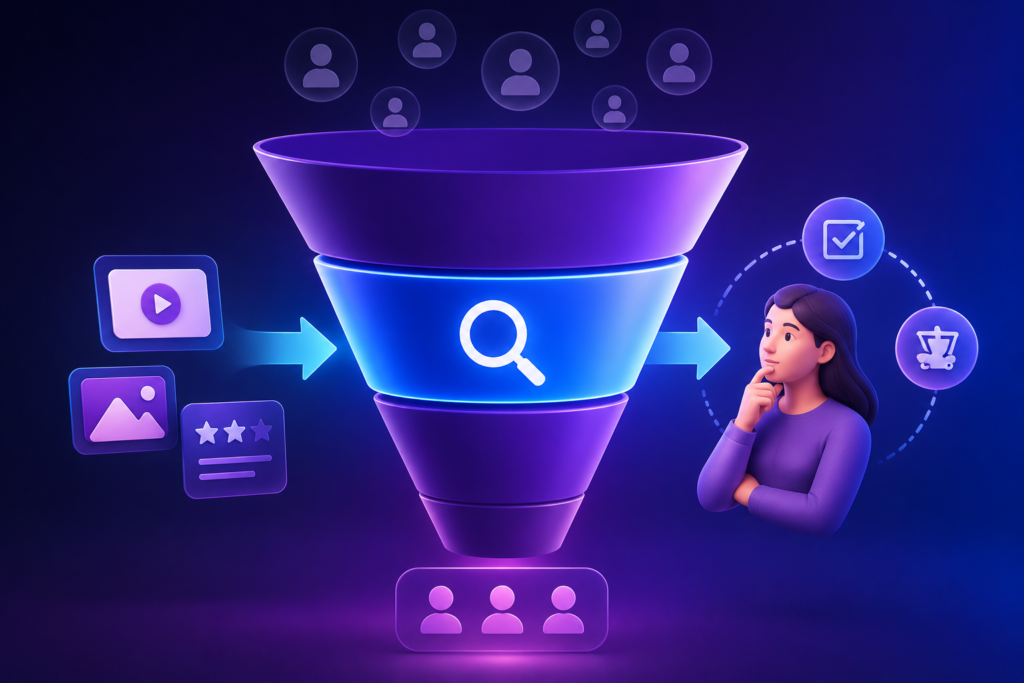
Most models place consideration between awareness and decision.
The exact terminology varies. Some frameworks use interest, evaluation, intent, conversion, purchase, or action. The labels matter less than the buyer’s state of mind.
The central distinction is simple. Awareness is about recognizing a problem or discovering a possibility. Consideration is about researching ways to respond. Decision is about selecting a specific option and completing the purchase.
Consideration as the middle of the funnel or MOFU
The consideration stage is commonly described as the middle of funnel (MOFU).
At the top of the funnel, the audience is broad. Many people may read an introductory article, watch an educational video, or discover a brand through social media. Some will be curious but have no immediate need.
The middle of the funnel contains fewer people. Those prospects tend to have stronger relevance because they are actively exploring possible solutions.
Their questions become more specific.
Instead of searching “why is employee retention falling,” they may search “employee engagement software,” “ways to measure employee satisfaction,” or “best alternatives to annual staff surveys.”
This shift from problem-focused research to solution-focused research is a strong sign that the buyer has entered consideration.
The consideration stage in awareness, consideration, and conversion models
The most familiar marketing funnel stages are awareness, consideration, and decision or conversion. Other models extend the journey to retention, loyalty, and advocacy.
The following table clarifies the role of each pre-purchase stage.
| Funnel stage | Buyer’s main question | Marketing objective | Suitable content and experiences | Common progression signal |
|---|---|---|---|---|
| Awareness | What is happening, and why does it matter? | Help the audience recognize a problem, need, or opportunity | Introductory guides, educational videos, research, social content | Deeper topic exploration |
| Consideration | Which type of solution could work for me? | Help buyers evaluate approaches, understand fit, and build confidence | Comparisons, buying guides, webinars, calculators, demonstrations, customer evidence | Repeated evaluation activity or high-intent inquiry |
| Decision | Which provider or product should I choose? | Resolve final concerns and make purchasing easier | Pricing, proposals, trials, consultations, implementation plans, contracts | Purchase, signed agreement, or completed enrollment |
Some marketers summarize this structure as awareness consideration conversion. Others use the familiar TOFU MOFU BOFU model, meaning top of funnel, middle of funnel, and bottom of funnel.
Both approaches are useful as planning tools. Neither should be treated as a perfect description of real human behavior.
Marketing funnel versus buyer’s journey versus customer journey
A marketing funnel describes how an organization categorizes movement toward a business outcome.
The buyer’s journey describes the research, questions, motivations, and decisions that occur before a purchase. The customer journey usually covers a wider period, including onboarding, product use, support, retention, and advocacy.
The buyer’s journey consideration stage therefore focuses on the prospect’s pre-purchase evaluation. The customer journey consideration stage may be mapped as part of a broader relationship with the company.
The distinction helps teams avoid an inward-looking strategy.
A funnel may tell the business that a person downloaded an ebook and became a marketing-qualified lead. A journey map asks what the person was trying to learn, whether the ebook answered the question, what concern appeared next, and whether the follow-up communication was useful.
HubSpot distinguishes the buyer journey as the process leading up to a purchase, while the wider customer journey extends into the relationship after conversion.
What Prospects Are Thinking and Doing During Consideration
The consideration stage becomes easier to market when you understand the buyer’s mental work.
The prospect is trying to reduce uncertainty. They are gathering information, applying personal criteria, comparing trade-offs, and deciding which options deserve further attention.
This buyer evaluation process can happen over several months or within a few minutes. The length depends on the cost, complexity, urgency, perceived risk, number of available alternatives, and number of people involved.
Buyers move from problem recognition to solution exploration
A person usually enters consideration after defining a problem clearly enough to research possible responses.
Consider someone responsible for a growing ecommerce warehouse. At first, the problem may appear as late orders and rising picking errors. During awareness, the manager investigates the causes.
Once the manager concludes that manual inventory processes are a major factor, the research changes. They begin exploring warehouse management software, barcode systems, process redesign, staff training, and outsourced fulfilment.
They have not chosen a product. They may not have chosen a solution category. They are comparing different approaches.
This is why consideration content should not immediately assume that your product is the buyer’s only logical option. It should help the person understand the available paths and determine when each path is appropriate.
Buyers compare solutions, trade-offs, costs, and expected outcomes
People compare solutions using criteria that reflect their goals and risks.
The buyer may evaluate price, quality, implementation difficulty, compatibility, support, durability, convenience, speed, expected results, contractual commitment, and switching costs.
Some criteria are explicit. A company may issue a detailed requirements document. Other criteria are emotional or unspoken. A buyer may fear appearing irresponsible if the purchase fails. A consumer may worry that a product will be difficult to return.
Strong marketing speaks to both practical and emotional concerns.
It explains what the buyer can expect before, during, and after adoption. It shows the effort required. It clarifies possible limitations. It gives the prospect a more realistic picture of ownership.
The messy middle of exploration and evaluation
Real buyers do not move through a clean funnel in a fixed order.
Google’s research into purchase behavior describes a “messy middle” between the initial trigger and the final purchase. Buyers loop between exploration, where they expand their options, and evaluation, where they reduce them.
A prospect may discover three possible solutions, narrow the list to one, read a critical review, and reopen the search. A colleague may introduce a new requirement. A budget change may cause the buyer to reconsider an option that was previously too expensive.
Salesforce also notes that buyers often follow non-linear paths rather than moving neatly through awareness, consideration, and decision.
This behavior changes how marketing should work.
Your content cannot depend on one fixed sequence. Key information should be easy to find through search, navigation, internal links, email, product pages, review platforms, and sales conversations.
The Core Consideration-Stage Goals Marketers Must Achieve
A complete consideration stage strategy should accomplish several connected goals:
- Educate the prospect about possible solutions and decision criteria
- Show how the offer relates to specific needs and circumstances
- Reduce uncertainty with credible information and proof
- Differentiate the brand without misleading comparisons
- Maintain engagement while the buyer continues researching
- Create a logical next step toward decision and purchase
These goals should guide content planning, campaign design, website structure, automation, and sales alignment.
Educate buyers so they can make an informed choice
Education is the foundation of effective consideration marketing.
The buyer should understand what the solution does, how it works, who it suits, what it requires, and what results are realistic.
A useful resource does more than repeat benefits. It explains the decision.
For example, a project management software guide might compare task-based, workflow-based, and portfolio-based systems. It could explain why a small creative team has different requirements from an enterprise programme office.
This type of education creates trust because it helps buyers even when they do not choose your company.
It also improves lead quality. A well-informed prospect is more likely to understand the product’s fit, pricing logic, implementation requirements, and limitations before speaking to sales.
Build trust and reduce perceived risk
Buyers hesitate when they believe the cost of making a bad choice is high.
The risk may be financial. It may involve time, reputation, security, disruption, inconvenience, or disappointment.
A business considering new payroll software may worry about data migration and compliance. A homeowner choosing a contractor may fear poor workmanship. A student evaluating an online course may question whether employers will value the qualification.
Your marketing should identify these concerns and answer them directly.
That may require security documentation, transparent policies, detailed implementation plans, independent reviews, warranties, return information, service standards, or examples from similar customers.
Trust grows when the prospect can verify what you say.
Create preference and purchase readiness without overselling
Consideration-stage communication should be persuasive, but it should not feel desperate.
The aim is to build brand preference by showing a clear and credible fit.
A strong brand does not need to claim that it is the best choice for everyone. It explains the circumstances in which it performs well, the customers it serves best, and the trade-offs a buyer should consider.
This approach qualifies as well as persuades.
Some prospects will decide that the offer is not right for them. That is not always a failure. Preventing a poor-fit customer from buying can reduce cancellations, complaints, returns, support costs, and reputational damage.
The valuable outcome is confident progress from the right buyer.
How Brands Enter the Buyer’s Consideration Set
Awareness does not guarantee serious evaluation.
A person may know ten insurance companies but request quotes from only three. They may recognize many laptop brands but limit their research to a small group that fits their budget and technical needs.
That smaller group is the buyer’s consideration set.
The role of mid-funnel marketing is to help the brand enter that set, remain there, and become easier to choose.
From awareness set to serious shortlist
A brand enters the shortlist when the prospect sees enough relevance to investigate further.
Relevance may come from several sources. The product may fit the budget. It may be recommended by a trusted person. Its features may match a specific requirement. The company may have a strong reputation in the buyer’s industry.
Availability also matters. A perfect product that cannot be delivered on time may be removed from consideration.
Brands are often excluded because they make evaluation difficult. Missing prices, unclear features, weak product descriptions, poor mobile experiences, outdated information, or a lack of credible reviews can cause a prospect to leave.
The buyer may not formally reject the company. They simply stop giving it attention.
Frame the evaluation criteria around real customer priorities
Marketing can influence the criteria buyers use to assess a solution.
This should be done responsibly.
A company can educate prospects about hidden costs, operational requirements, quality standards, or risks they may not have considered. It should not invent meaningless criteria designed only to make competitors look weak.
Suppose a buyer is evaluating website hosting. A useful guide may explain that monthly price is only one factor. Uptime, support quality, backup policies, migration assistance, security controls, server location, and renewal pricing also matter.
That framework improves the buyer’s decision while giving a strong provider an opportunity to demonstrate value.
The principle is simple: teach buyers how to choose well, then show how your offer performs against those legitimate standards.
Stay top of mind while the purchase decision develops
Many purchases are delayed.
The prospect may be waiting for budget approval, comparing options, consulting a partner, or prioritizing another project. Silence during this period creates an opportunity for competitors.
Staying visible does not mean sending constant promotional messages.
Useful follow-up can include a relevant case study, an updated comparison, a practical checklist, an invitation to an educational session, or an answer to a question the buyer previously raised.
Lead nurturing works when each interaction provides new value.
Amazon Ads identifies branded search activity as a useful indication that people are actively seeking information about a brand. Repeated branded searches, product detail visits, and deeper product interactions can show that awareness is developing into consideration.
Use the Value Proposition to Connect Pain Points With Product Fit
A broad awareness message may promise a desirable outcome. Consideration-stage messaging must explain how that outcome will be achieved.
Your value proposition should connect the prospect’s situation with a specific capability, benefit, and form of proof.
It should answer four questions:
What problem does this solve? How does it solve it? Why should the buyer believe the claim? Why is this approach more suitable than the alternatives?
Translate features into outcomes buyers care about
Features become meaningful when they are connected to a buyer’s work, priorities, or experience.
“Automated reporting” is a feature. “Reduce the time required to prepare weekly client reports” is an operational benefit. “Save an average of five staff hours per account each month” is a measurable outcome, provided the claim is supported by reliable evidence.
The strongest explanation follows a simple chain:
Problem → capability → practical effect → business or personal outcome → proof.
This structure prevents vague benefit statements.
It also helps different stakeholders understand the same feature. A manager may value time savings. Finance may value lower operating costs. Employees may value less repetitive work. Leadership may value faster decision-making.
Prove who the product is, and is not, for
Specificity improves credibility.
A company should explain its ideal use cases, required conditions, important limitations, and situations where another approach may be more suitable.
For example, an entry-level accounting platform may be ideal for freelancers and small service businesses. It may be a poor fit for a multinational company requiring complex consolidation and regional compliance.
Acknowledging that limit does not weaken the offer. It tells suitable buyers that the company understands its product.
Clear qualification also reduces mismatched expectations after purchase.
Differentiate against alternatives without unsupported claims
Differentiation should be relevant and provable.
Claims such as “best,” “leading,” “most advanced,” or “number one” mean little without context. Buyers need to know what creates the advantage and whether it matters in their situation.
Useful differentiation may involve faster deployment, a simpler interface, a specialised integration, stronger customer support, more flexible pricing, better materials, local availability, or experience with a particular industry.
Every comparison should use consistent criteria.
Do not compare your premium plan with a competitor’s basic version. Do not present an outdated feature gap as current. Do not hide an important limitation that the buyer will discover later.
Fair comparisons build more trust than exaggerated claims.
The Best Consideration-Stage Content for Helping Buyers Evaluate Options
Effective consideration stage content answers questions that arise while a prospect is researching possible solutions.
It gives the buyer enough depth to judge fit. It also lets the brand demonstrate expertise without turning every page into a sales pitch.
The best format depends on the decision. A consumer buying a simple household product may need a comparison chart and reviews. An enterprise buyer may require workshops, technical documentation, security information, financial modelling, and implementation guidance.
Product comparison content, buying guides, and interactive calculators
Product comparison content is useful when buyers need to understand differences between products, solution types, plans, methods, or vendors.
Good comparisons are structured around real decision criteria. They explain where each option performs well, who it serves, what it costs, and which limitations matter.
Buying guides perform a related role. They teach readers what to examine before making a choice.
Interactive tools can make the evaluation personal. A calculator can estimate cost, savings, capacity, repayment, energy use, or potential return. A product selector can narrow a large catalogue based on the buyer’s needs.
These tools work because they convert general information into an individual result.
Case studies, testimonials, reviews, and customer evidence
Case studies and testimonials provide evidence that other people have achieved a meaningful result.
The strongest case studies include context. They identify the customer, starting situation, constraints, chosen approach, implementation process, timeframe, and result.
A statement such as “This platform transformed our business” is weak because the reader cannot assess what changed.
A detailed account is more persuasive. It might explain that a regional retailer reduced stock discrepancies after connecting store and warehouse inventory, while noting the implementation period and operational changes required.
Reviews and testimonials become more useful when the customer resembles the prospect. Shared industry, company size, use case, location, or problem can make the evidence feel more relevant.
This is the practical value of social proof. It reduces uncertainty by showing that other people have tested the promise.
Webinars, demonstrations, white papers, and expert explainers
Complex purchases require deeper education.
A webinar allows prospects to hear an expert explain the problem, solution, and practical implications. It also creates an opportunity for questions.
A demonstration shows how the product works. Consideration-stage demos should focus on the buyer’s use case rather than displaying every available feature.
White papers and technical explainers help when the buyer needs detailed evidence. They may cover methodology, architecture, compliance, research, implementation, or economic impact.
Current content marketing guidance regularly associates middle-funnel activity with detailed guides, comparison material, webinars, product demonstrations, and evidence-based content.
Useful consideration stage content examples should always be tied to a question. The format matters less than the uncertainty it resolves.
How to Make Consideration Content Trustworthy and E-E-A-T Focused
A buyer will not trust a page merely because it is long, polished, or highly ranked.
Credibility comes from the quality of the information, the experience behind it, the clarity of the claims, and the buyer’s ability to verify important details.
This is especially important for health, finance, law, security, education, and other decisions where inaccurate information can cause serious harm.
Use firsthand experience, subject-matter experts, and clear authorship
Consideration content should show who created it and why that person is qualified to address the subject.
A technical comparison may need review by an engineer. A financial guide may need input from a qualified accountant. A product review should explain how the product was tested.
Firsthand knowledge adds details that generic writing misses.
Someone who has implemented a software system can discuss migration problems, adoption challenges, unexpected costs, and the questions teams should ask before signing a contract.
Someone who has only read product pages is more likely to repeat surface-level claims.
Clear authorship, relevant credentials, real examples, editorial review, and update dates make the information easier to evaluate.
Support claims with evidence and transparent methodology
Important claims need support.
If a company says that customers save time, it should explain how the saving was measured. If a comparison gives products a score, readers should be able to understand the criteria and weighting.
Internal data can be useful, but it should be identified accurately. A survey of 40 existing customers should not be presented as if it represents an entire market.
Transparency is especially important when the company benefits from the conclusion.
Explain assumptions. Separate measured outcomes from estimates. Distinguish customer-reported results from independently verified results. State when performance depends on implementation, usage, or circumstances.
Honest detail makes marketing more persuasive because it helps buyers judge the evidence for themselves.
Build honest comparison pages instead of disguised sales pages
A comparison page loses credibility when it always concludes that the publisher wins every category.
Real products have trade-offs.
A competitor may be better for very small teams, while your product may be stronger for complex operations. One solution may cost less initially, while another may provide better support or scalability.
Acknowledging those differences helps suitable customers make a confident choice.
It can also improve sales conversations. Prospects arrive with more realistic expectations and a clearer understanding of why the solution fits their needs.
Consideration-Stage Marketing Channels and Tactics
Buyers evaluate solutions across many touchpoints.
They use search engines, company websites, social platforms, online communities, videos, review sites, marketplaces, email, sales calls, and recommendations from people they trust.
A strong set of consideration stage tactics keeps the underlying facts consistent while adapting the message to each channel.
SEO and search content for evaluation-focused queries
Search behavior often reveals the buyer’s stage.
Broad questions usually indicate awareness. Searches involving comparison, cost, alternatives, software, tools, services, reviews, features, implementation, or “best for” language often suggest consideration.
A company should identify the questions people ask while choosing a solution and create the most useful page for each intent.
That may include:
“CRM software for small construction companies”
“Outsourced fulfilment versus in-house warehousing”
“Solar panels cost and payback period”
“Best project management method for agencies”
“Brand A alternatives”
The aim is not to insert a commercial keyword into a generic article. The page should help the reader complete the evaluation task implied by the query.
Email lead nurturing, remarketing, and consideration advertising
Email is effective when a buyer’s evaluation takes time.
The first message may provide a requested resource. Later messages can answer common questions, share customer evidence, explain a use case, or invite the prospect to a relevant event.
The sequence should reflect interest and behavior.
Someone who reads introductory content may need education. Someone who repeatedly visits integration, security, pricing, and case-study pages may be ready for a more direct conversation.
Remarketing and consideration advertising can reinforce the same progression.
Instead of repeating the original awareness ad, consideration campaigns can highlight proof, detailed benefits, demonstrations, comparisons, or specific applications.
Advertising platforms increasingly separate objectives such as awareness, consideration, and conversion, allowing campaigns to be optimized around different outcomes.
Social proof, communities, creator content, review sites, and AI answers
Buyers often trust information that appears outside the company’s controlled channels.
They may search Reddit, LinkedIn, YouTube, industry forums, marketplaces, software review platforms, local directories, and professional communities.
They may also use AI systems to summarize product categories, compare providers, or identify common complaints.
Brands cannot control every discussion. They can improve their presence by providing accurate product information, earning real reviews, responding to feedback, publishing clear documentation, and participating honestly in relevant communities.
Creator demonstrations can be valuable when the audience needs to see the product used in a realistic situation.
The goal should be accurate representation, not scripted praise that hides the commercial relationship.
Lead Nurturing and Personalization During the Consideration Stage
Consideration rarely depends on one content asset.
A prospect may read an article, leave, return through search, watch a video, subscribe to an email list, review a comparison, and speak to sales several weeks later.
Lead nurturing connects those interactions without treating every prospect in the same way.
Segment prospects by problem, use case, industry, and behavior
Basic segmentation often relies on age, location, industry, or company size.
Consideration-stage segmentation should also reflect the buyer’s problem and evaluation behavior.
Two people from similar companies may need very different messages. One may be replacing an existing system. The other may be buying the category for the first time.
The replacement buyer will care about migration, compatibility, contract timing, and switching risk. The first-time buyer may need help building a business case and understanding implementation.
Useful segmentation may include:
- The problem or outcome the person selected
- The solution or product category being researched
- The content viewed and tools used
- The person’s role in the purchase
- The organisation’s size, industry, or maturity
- The recency and depth of engagement
This is the second and final detailed list in the article. The rest of the framework is explained through prose.
Build sequences around buyer questions rather than promotional schedules
Many automated sequences are designed around the company’s calendar.
Email one introduces the company. Email two promotes a feature. Email three requests a demo. This structure may be easy to automate, but it does not reflect the buyer’s reasoning.
A better sequence follows the questions required to make the decision.
The first communication might explain possible approaches. The second might help the buyer define requirements. The third could demonstrate a relevant use case. The fourth could address implementation risk. The fifth might present customer evidence.
Each interaction should move the prospect’s understanding forward.
The next message should feel like a useful continuation, not a repeated request to buy.
Personalize for multiple B2B stakeholders
B2B purchases often involve several people.
Salesforce notes that business purchases can include large deal sizes, complex requirements, and multiple stakeholders who need to understand the potential return before moving forward.
Each stakeholder may evaluate the solution differently.
End users care about usability and daily workflow. Managers care about team performance. IT cares about integration, reliability, and security. Finance cares about cost and return. Procurement cares about commercial terms. Executives care about strategic impact and risk.
A single generic presentation will rarely satisfy all of them.
Personalization should provide each role with the information needed to support or approve the purchase while maintaining a consistent central promise.
Calls to Action That Move Prospects Toward the Decision Stage
A consideration-stage call to action should match the buyer’s readiness.
Asking every visitor to “buy now” ignores the fact that many people still need information.
The next step should require a little more commitment than the previous interaction, but not so much that it feels unreasonable.
Low-friction CTAs for buyers who are still learning
Early consideration calls to action help the prospect continue researching.
A reader may be invited to use a calculator, watch a demonstration, download a checklist, attend a webinar, compare plans, explore customer examples, or answer a short needs assessment.
These actions deepen engagement while producing useful information for both sides.
The prospect gains clarity. The company learns more about the buyer’s interests and potential fit.
The CTA should clearly state what the person will receive. “Learn more” is often too vague. “Compare the three available implementation options” gives the buyer a reason to continue.
High-intent actions that signal growing purchase readiness
Some actions suggest that the buyer is approaching a commercial decision.
Repeated visits to pricing, implementation, security, integration, availability, or contract pages may indicate serious evaluation. A request for a quote, trial, consultation, sample, or customised demonstration is usually stronger.
These signals should still be interpreted in context.
A student researching software for an assignment might view the pricing page without any buying authority. A procurement manager may download one technical document and be much closer to purchase.
Purchase intent should therefore be evaluated using both behavioral activity and customer fit.
Amazon’s advertising documentation distinguishes between signals such as product detail views, branded searches, and add-to-cart activity, with add-to-cart behavior representing stronger purchasing intent.
Use progressive next steps instead of one universal conversion
Each piece of content should lead to the next useful action.
A comparison article may lead to a product selector. A calculator may lead to a personalised report. A webinar may lead to a consultation. A case study may lead to a related demonstration.
This progression creates continuity.
It also prevents the website from sending every visitor to the same sales form, regardless of what they were trying to learn.
The best path is often visible in the question the buyer has just answered.
Consideration-Stage Metrics and KPIs
Measuring consideration is harder than measuring a completed transaction.
A purchase is a clear event. Consideration is a change in attention, understanding, confidence, preference, or intent. No single metric captures the whole stage.
Strong reporting combines behavioral indicators with progression, brand, sales, and revenue data.
Engagement and evaluation metrics
Engagement becomes meaningful when it reflects evaluation.
A long session on a comparison page may be valuable. A long session caused by confusing navigation is not.
The same principle applies to repeat visits, video completion, downloads, webinar attendance, calculator use, review interaction, and product-page depth.
Metrics should be interpreted with the visitor’s task in mind.
Contentsquare identifies friction, irrelevant content, and lack of credibility as common problems during consideration. It recommends using journey and content analysis to identify where customers struggle or abandon the process.
Funnel-progression and lead-quality KPIs
Useful consideration stage metrics show whether prospects are becoming better informed and moving toward a stronger commercial action.
The following table provides a practical measurement hierarchy.
| Measurement category | Example consideration stage KPIs | What the metric may indicate | Important caution |
|---|---|---|---|
| Content engagement | Engaged time, repeat visits, comparison-page use, video completion, webinar attendance | The prospect is investing attention in evaluation | High engagement can also reflect confusion |
| Evaluation behavior | Calculator completion, product selection, review interaction, technical-document access | The buyer is applying specific criteria | Different actions carry different levels of intent |
| Funnel progression | Consideration-to-decision rate, trial start, quote request, demo booking | Prospects are moving to a stronger commitment | A higher rate is not useful if lead quality falls |
| Lead quality | Lead-score movement, MQL rate, SQL acceptance, opportunity creation | Marketing is attracting and educating suitable buyers | Scoring models require regular validation |
| Brand response | Branded search, consideration lift, preference, favorability | More people may be thinking seriously about the brand | Survey and search data need adequate scale and context |
| Revenue influence | Assisted opportunities, influenced pipeline, cohort revenue, sales-cycle change | Consideration activity contributes to commercial outcomes | Last-click attribution may hide earlier influence |
No company needs to track every metric. The right set depends on the buying process and the decisions the team is trying to improve.
Brand consideration, preference, purchase intent, and attribution
Brand consideration measures whether people would seriously think about choosing a brand.
This is different from awareness. A person can recognise a brand without viewing it as a suitable option.
Brand-lift research can assess changes in awareness, consideration, favorability, and purchase intent among exposed and comparison groups. Google Ads documents these as distinct measurement dimensions rather than treating them as the same response.
Smaller companies may not have access to formal lift studies. They can still look for changes in branded search, direct traffic, high-intent page visits, survey responses, qualified inquiries, and the percentage of prospects who mention the brand before sales contact.
Attribution requires care.
A prospect may first discover the company through social content, return through organic search, attend a webinar, read a case study, and convert after clicking a branded paid-search ad.
Giving all credit to the final click hides the work performed by earlier touchpoints.
Use assisted-conversion analysis, CRM campaign influence, journey data, time-lag reporting, customer interviews, and cohort comparisons to build a fuller picture.
Lead Qualification and Marketing–Sales Alignment
Marketing and sales need a shared definition of consideration.
Without alignment, sales may contact prospects before they are ready. Marketing may also retain strong opportunities for too long because no clear handoff standard exists.
The answer is not to pass every engaged visitor to sales. It is to define the combination of fit, behavior, and intent that justifies personal contact.
Define stage-entry, stage-exit, MQL, and SQL criteria
Stage entry should be based on observable evidence.
A prospect may enter consideration after viewing solution-category content, completing an assessment, attending a relevant webinar, visiting comparison pages, or explicitly identifying a need.
Stage exit occurs when the person begins evaluating specific providers, confirms key requirements, requests commercial information, or takes another action associated with decision readiness.
A marketing-qualified lead should meet agreed fit and engagement conditions.
A sales-qualified lead should have enough need, authority, timing, relevance, or intent to justify direct sales attention.
These definitions will vary by business. They should be written down, measured, and reviewed using real conversion data.
Give sales the context behind each lead’s evaluation journey
A score alone provides limited information.
Sales should know what the prospect researched, which resources they used, what needs they stated, and which concerns appear most relevant.
A salesperson who knows that the buyer viewed migration, security, and enterprise integration content can begin with those topics.
This creates a better experience than opening with a generic product introduction.
Context also prevents sales from repeating information the buyer has already studied.
Use sales conversations to improve consideration content
Sales teams hear the questions that marketing content fails to answer.
Common objections, lost-deal reasons, implementation concerns, pricing confusion, competitor comparisons, and stakeholder questions should be recorded and reviewed.
Marketing can then update existing pages or create new resources.
The feedback loop should continue after purchase. Customer success and support teams can identify expectations that were unclear during consideration.
This produces better information for future buyers and reduces post-purchase disappointment.
How the Consideration Stage Changes Across Business Models
The core goal remains consistent across markets: help the buyer evaluate fit and build confidence.
The execution changes according to price, complexity, urgency, risk, frequency, and the number of people involved.
B2B SaaS and complex solution purchases
B2B software purchases can involve long research periods, several stakeholders, technical review, financial approval, legal negotiation, and implementation planning.
The buyer may need to understand integrations, data security, compliance, onboarding, support, scalability, total cost, contractual terms, and expected return.
Marketing must provide material for both individual research and internal consensus building.
A strong resource should be easy for one stakeholder to share with another. It may need an executive summary, technical documentation, a business-case template, and evidence from a similar organisation.
The objective is not limited to convincing one person. It is to help the buying group reach confidence together.
Ecommerce and consumer-product consideration
Consumer and ecommerce consideration may happen quickly, but that does not make it simple.
Shoppers compare prices, specifications, reviews, images, videos, delivery times, stock availability, payment options, warranties, and return conditions.
Product pages should make those comparisons easy.
Clear photographs, accurate descriptions, useful filters, sizing information, verified reviews, demonstration videos, and transparent delivery details reduce uncertainty.
Semrush’s ecommerce funnel guidance places product comparisons, reviews, and social proof within consideration, while behaviors such as adding an item to a cart indicate stronger intent.
Mobile usability also matters. A buyer may abandon a suitable product because the page loads slowly, the filters are confusing, or essential information is difficult to find.
Professional, local, and high-trust services
Services are often harder to evaluate because the buyer cannot inspect the final result in advance.
A patient choosing a clinic, a homeowner choosing a builder, or a company choosing a legal adviser must rely on signals of competence, process, trust, and fit.
Useful content should explain qualifications, experience, working methods, timelines, responsibilities, pricing structures, service boundaries, and what the client should expect.
Consultations are especially important for these purchases.
A strong consultation should help both sides assess suitability. It should not be treated as a scripted sales presentation.
Local reputation, professional credentials, documented outcomes, clear policies, and relevant experience may carry more weight than broad brand visibility.
Common Consideration-Stage Marketing Mistakes
Consideration fails when marketing makes evaluation harder.
The prospect may be interested but unable to find important information. They may encounter exaggerated claims, irrelevant follow-up, confusing navigation, or pressure to speak to sales too early.
These problems create friction at the exact moment when the buyer is trying to reduce it.
Pushing decision-stage sales messages too early
A buyer who has only begun researching a solution may not be ready for a proposal or sales call.
Repeated “buy now,” “book a demo,” or “limited-time offer” messages can feel disconnected from the person’s needs.
This does not mean commercial calls to action should disappear. They should be accompanied by lower-commitment paths.
A visitor should be able to learn, compare, calculate, verify, and understand before being asked to commit.
Premature pressure can also damage trust. It signals that the company is more interested in closing than helping the buyer choose well.
Publishing generic, biased, or repetitive content
Many consideration pages repeat the same claims.
They say the product is easy, powerful, flexible, reliable, and affordable. They provide little evidence and no meaningful decision guidance.
Generic content fails because it does not reduce uncertainty.
Buyers need specifics. They need to understand fit, limitations, process, requirements, outcomes, and trade-offs.
Biased comparisons create another problem. If every category has been chosen to make one brand win, readers will recognise the manipulation.
Useful content respects the buyer’s intelligence.
Measuring vanity engagement or only the final click
Traffic, impressions, and downloads may look positive while the funnel remains weak.
A campaign can generate thousands of visitors who never become suitable prospects. An ebook can attract people who want free information but have no connection to the product.
Measurement should connect engagement with progression and quality.
The opposite problem occurs when the company gives all credit to the final conversion source. Consideration content may have built trust over several months, yet the closing email or paid-search click receives the full attribution.
Both errors lead to poor investment decisions.
A Practical Framework for Optimizing the Consideration Stage
A strong consideration stage strategy should be managed as a continuous system.
Buyer questions change. Competitors update products. New objections appear. Pricing shifts. Search behavior develops. Content becomes outdated.
Optimization begins with the journey, not the individual campaign.
Audit buyer questions, content coverage, and journey friction
Start by identifying the questions a buyer must answer before making a decision.
Gather information from search queries, website analytics, sales calls, customer interviews, support conversations, reviews, surveys, and lost opportunities.
Map each question to an existing resource.
Look for missing answers, duplicated pages, outdated claims, weak proof, unclear calls to action, and dead ends where the prospect has no logical next step.
Review the journey on mobile and desktop. Test forms, calculators, downloads, navigation, video, search, filters, and contact options.
Friction can be technical, cognitive, or emotional. Contentsquare separates these forms because a buyer may struggle with the interface, the information, or the feelings created by the experience.
Test messaging, proof, format, sequencing, and personalization
Testing should begin with a clear problem.
If prospects visit the comparison page but rarely progress, the cause may be weak differentiation, missing evidence, unclear pricing, poor usability, or an inappropriate CTA.
Each test should address one explanation.
You might test a use-case-specific headline, a more detailed comparison, stronger customer evidence, a calculator, a simplified form, or a different follow-up sequence.
Measure the outcome closest to the intended change.
A headline test may focus on deeper page engagement. A proof test may measure movement to product or consultation pages. A form test may assess qualified completion rate rather than total submissions.
Build a continuous feedback loop from search, analytics, sales, and customers
Optimization improves when teams combine quantitative and qualitative information.
Analytics show where people leave. Search data shows what they ask. Sales conversations explain objections. Customer interviews reveal what influenced the final choice.
No single source provides the whole answer.
Review this information regularly. Update comparisons when competitors change. Revisit customer examples when results become outdated. Add questions that repeatedly appear in sales calls.
Treat the journey map as a living operating document rather than a one-time workshop output.
Consideration-Stage Examples From Three Different Funnels
Practical examples show how the same goal can lead to different journeys.
The following scenarios illustrate how content, proof, and calls to action can be matched to the buyer’s evaluation process.
B2B software example: from problem guide to qualified demo
Imagine a growing healthcare company looking for workforce scheduling software.
The operations manager begins by researching ways to reduce shift gaps and overtime. A detailed guide introduces several approaches, including policy changes, manual process improvements, and scheduling software.
The buyer then uses a requirements checklist and reads a comparison of scheduling methods.
After identifying software as the likely solution, the manager reviews integration information, security documentation, implementation timelines, and a case study from a similar healthcare provider.
Finance receives an ROI estimate. IT receives technical documentation. Department managers attend a demonstration focused on their workflow.
The demo request occurs after the buyer has answered several foundational questions. Sales enters the conversation with context and a stronger opportunity.
Ecommerce example: from category research to product shortlist
Consider a shopper looking for an office chair to reduce discomfort during long working hours.
The person begins with an ergonomic chair buying guide. The guide explains seat depth, lumbar support, adjustability, materials, weight limits, and desk compatibility.
A product selector narrows the catalogue according to height, budget, working hours, and preferred materials.
The shopper compares three models using consistent specifications. They watch adjustment videos, read verified reviews from people with similar needs, and check delivery and return conditions.
One chair becomes the preferred option because the information makes fit easier to judge.
The product page does not need to rely on urgency. It has reduced enough uncertainty for the buyer to act.
Professional-service example: from uncertainty to consultation
Imagine a business owner looking for help with a tax dispute.
An introductory article explains the process, possible timelines, required documents, and situations that need professional support.
The reader then reviews a page describing the firm’s experience with similar disputes. It explains how cases are assessed, what the client must provide, how fees are structured, and what outcomes cannot be guaranteed.
A short case example demonstrates the process without promising identical results.
By the time the prospect books a consultation, they understand the service, the firm’s role, and the purpose of the meeting.
The consultation becomes a mutual fit assessment rather than an information-gathering call that could have been replaced by a clear webpage.
Frequently Asked Questions About the Consideration Stage
How long does the consideration stage last?
The consideration stage may last a few minutes, several weeks, or more than a year.
Low-cost and familiar purchases tend to have shorter evaluation periods. High-cost, risky, unfamiliar, or complex purchases usually require more research.
The stage may also last longer when several stakeholders are involved, budgets require approval, implementation is difficult, or competing options appear similar.
Marketers should study the real buying cycle rather than applying one universal nurturing timeline.
Can a buyer skip the consideration stage?
A buyer may appear to skip consideration, but some form of evaluation usually occurs.
For an impulse purchase, the evaluation may take seconds. For a repeat purchase, much of the evaluation happened during the previous experience. A trusted recommendation may also reduce the amount of research required.
Urgency can compress the process. Someone needing emergency repair work may choose from the first credible providers available.
The stage can therefore become very short, invisible, or heavily influenced by past experience. It does not always disappear.
What comes after the consideration stage?
The decision stage comes next.
At that point, the buyer has usually selected a solution category or narrowed the available providers. The remaining questions become more commercial and specific.
They may examine price, contract terms, delivery, implementation, warranties, support, availability, trials, proposals, or final approval requirements.
Marketing and sales should shift from broad solution education to provider-specific proof and purchase facilitation.
What is the difference between consideration and purchase intent?
Consideration means the buyer is seriously evaluating a solution, product, or brand.
Purchase intent indicates a stronger likelihood or stated willingness to buy.
Someone can consider a product without intending to purchase soon. They may be researching for the future, comparing on behalf of someone else, or waiting for a budget.
Intent becomes stronger when the buyer performs actions tied to ownership, such as requesting a quote, checking availability, starting a trial, reviewing contract terms, or adding a product to a cart.
What is the best consideration-stage content?
The best content is the resource that resolves the buyer’s most important uncertainty.
For one buyer, that may be a comparison guide. For another, it may be a technical document, demonstration, calculator, review, webinar, customer story, or implementation plan.
Format should follow the question.
Content should be accurate, specific, easy to verify, and connected to a sensible next step.
Is a case study a consideration-stage or decision-stage asset?
A case study can support both stages.
During consideration, it shows that a solution can produce a relevant result. During decision, it can provide final reassurance that a particular provider has the required experience.
The content and placement determine the role.
A broad industry case study may support early evaluation. A detailed example involving the same use case, company size, integration, and buying concern may influence the final decision.
Final Perspective: The Consideration Stage Builds Confident Preference
The consideration stage exists to help buyers make sense of their options.
Its goal is not simply to produce more website visits, downloads, or email subscribers. Those actions matter only when they help suitable prospects understand the solution, assess fit, reduce risk, and move toward a confident choice.
Strong consideration marketing respects the buyer’s need to investigate.
It provides useful education, transparent comparisons, relevant proof, clear differentiation, and logical next steps. It remains available across a journey that may involve repeated searches, multiple channels, changing criteria, and several stakeholders.
When this stage works, the buyer does not arrive at the decision point with basic questions still unanswered.
They know what the solution does. They understand why it may suit them. They have examined the evidence. They can explain the choice to other people. They are ready to discuss price, implementation, commitment, and purchase.
That is the real goal of the consideration stage: turn awareness into informed preference and make the next decision easier.