

Finding exclusive accredited investor leads is not a simple list-buying exercise. A database can contain thousands of wealthy people and still produce no meaningful investment conversations. Contact data, financial capacity, investment intent, offering fit and accredited status are separate factors.
The best lead is not merely someone who appears wealthy. It is someone who can be contacted, has shown relevant interest, fits the offering, understands its risks and can progress through the required qualification and verification process.
That distinction matters because the market uses terms such as “exclusive,” “qualified” and “verified” loosely. One provider may call a lead exclusive because it will not sell the record again for 30 days. Another may generate the lead directly through your branded website and never resell it. Those are completely different products.
The same problem applies to verification. A working phone number may be described as a verified lead. A person who ticks an income box may be called pre-qualified. Neither action necessarily completes the legal verification required for a purchaser in a Rule 506(c) offering.
A strong acquisition system must connect five outcomes:
Lead source quality.
Permission and contactability.
Investor capacity and offering fit.
Accreditation assessment and verification.
Capital committed and funded.
This guide explains how to build that system. It covers lead generation, purchased data, qualification, compliance, nurturing, provider selection and performance measurement. It is written primarily for US private offerings because the term accredited investor has a specific meaning under Regulation D.
This article is educational. Securities counsel should review the exemption, communications, compensation arrangements and verification process used for a particular offering.
What Are Exclusive Accredited Investor Leads?
Accredited investor leads are people or entities identified as potential purchasers of private investment opportunities for which accredited status may be relevant.
For an individual, accredited status can arise through financial or professional criteria. Common financial tests include net worth above $1 million, excluding the value of the primary residence, or income above $200,000 individually or $300,000 with a spouse or partner in each of the previous two years, with a reasonable expectation of reaching the same level in the current year. Certain professionals holding Series 7, Series 65 or Series 82 licences in good standing may also qualify. Directors, executive officers, certain knowledgeable employees, qualifying family offices and various entities can qualify under other categories.
That definition establishes possible eligibility. It does not establish interest in your fund, company, syndication or private placement.
A person may meet the net-worth test but avoid illiquid assets. Another may prefer venture capital while your offering involves private credit. Someone else may like the asset class but lack capital to deploy this year.
This is why high-quality accredited investor leads should be defined by more than estimated wealth.
Lead, Prospect, Qualified Investor and Verified Purchaser Are Different
A raw lead is a person whose contact details have been collected or acquired. The information may come from a form, event, referral, survey, data provider or public source.
A prospect is a lead who appears relevant enough to contact.
Qualified investor leads meet additional marketing and commercial criteria. They may fit the target geography, investment range, asset-class preference and expected timeframe.
Pre-qualified investor leads have usually answered initial screening questions. The answers may be self-reported. The person may have selected an income range, net-worth range, preferred investment type or expected commitment.
Verified accredited investor leads is a phrase that needs careful handling. In marketing, “verified” may mean that an email is deliverable, a telephone number works or a representative has confirmed the person’s interest. In securities compliance, accredited investor verification can mean the formal process used to establish that a purchaser meets an applicable accredited-investor category.
Those meanings should never be treated as interchangeable.
A strong CRM should therefore separate contact verification, marketing qualification, offering qualification and formal purchaser verification. Combining them into one field creates reporting errors and compliance risk.
Six Tests of Genuine Exclusivity
An exclusive lead should give the buyer a meaningful competitive advantage. That requires a precise written definition.
A useful exclusivity assessment covers:
- Current exclusivity: whether the record is currently being supplied to any other buyer; historical exclusivity: whether it was sold, transferred or worked previously; time exclusivity: whether protection expires after a set period; territorial exclusivity: whether another buyer can receive the same person in a different market; offering exclusivity: whether the contact can be sold for another asset class or investment product; and ownership exclusivity: whether the buyer controls the lead data, consent record and future use rights.
- The original source of the enquiry, the date generated, the date last validated and the identity of any previous recipients should be available for audit.
- The contract should state what happens when a supposedly exclusive record is found in another provider’s delivery, the buyer’s existing CRM or an earlier campaign.
A vague statement such as “all leads are exclusive” is not enough. The buyer needs to know exclusive to whom, for how long, for which offering and under which data-use rights.
Exclusive Leads Versus Shared, Aged and Recycled Data
The following comparison shows why price per record cannot be evaluated in isolation.
| Lead type | Typical source and condition | Main advantage | Main limitation | Best use |
|---|---|---|---|---|
| First-party exclusive lead | Generated through the issuer’s own content, advertising, webinar, referral or landing page | Strong source control, clear brand context and no legitimate reason for resale | Requires marketing infrastructure and ongoing investment | Firms building a durable investor pipeline |
| Real-time exclusive lead | Delivered soon after a prospect submits an external form or survey | Faster access to recent interest | Exclusivity and consent scope depend on the provider’s contract and form language | Teams with rapid response capacity |
| Qualified appointment | Prospect has completed screening and accepted a meeting | Saves sales time and provides stronger intent | Qualification standards may differ between providers | Small capital-raising teams needing conversations rather than data |
| Shared lead | Sold or delivered to several buyers | Lower upfront price and higher available volume | Competing calls, prospect fatigue and lower differentiation | Experienced call teams with strong speed-to-lead systems |
| Aged lead | Generated weeks, months or years earlier | Low acquisition cost | Interest, contact details and financial circumstances may have changed | Reactivation campaigns with low operating costs |
| Modelled database record | Selected through wealth, profession, property or behavioural indicators | Large scale and granular segmentation | Modelled wealth does not prove accreditation or current investment intent | Research, audience planning and carefully governed outreach |
The right choice depends on the organisation’s sales capacity. A team with two investor-relations professionals may benefit more from ten well-screened appointments than 5,000 database records. A trained outbound centre may be able to test a larger accredited investor database, provided the source, consent and contact rules have been reviewed.
Confirm That Your Offering Can Use the Planned Lead-Generation Method
Before launching accredited investor lead generation, identify the exemption and communication rules governing the offering.
The marketing method cannot be separated from the securities structure. A public campaign that may be permitted in one offering can create a serious problem in another.
Rule 506(b) Versus Rule 506(c) Marketing
Rule 506(b) and Rule 506(c) are separate paths under Regulation D.
Rule 506(b) does not permit general solicitation or general advertising. It can involve an unlimited number of accredited investors and up to 35 non-accredited purchasers who meet the applicable sophistication standard. Extra information requirements apply when non-accredited investors participate.
Rule 506(c) permits broad solicitation and general advertising. However, all purchasers must be accredited investors, and the issuer must take reasonable steps to verify their accredited status.
This makes 506(c) investor leads closely connected to digital advertising, public webinars, social media campaigns and other scalable acquisition methods. Still, the ability to advertise does not remove the need for accurate communications, purchaser verification or proper recordkeeping.
A campaign should not be labelled 506(c) lead generation simply because it targets wealthy people. The offering itself must be conducted under the relevant exemption, and its process must satisfy the associated conditions.
Form D, State Notices and Offering Records
A company relying on Regulation D generally must file Form D within 15 days after the first sale. The first sale is tied to the point at which the first investor becomes irrevocably contractually committed to invest. The SEC does not charge a filing fee for Form D, though state notice filings and fees may still apply.
Form D is a notice filing. It is not an approval of the investment, the issuer or the marketing campaign.
The capital-raising team should coordinate the campaign calendar with legal and filing deadlines. Marketing may generate interest before the first sale, while subscription acceptance, funds, verification and filing obligations occur at later stages. Those dates should be recorded separately.
Campaign records should also retain approved advertisements, landing-page versions, webinar scripts, email sequences, consent evidence, suppression lists and the source of every delivered lead.
Referral Fees and Broker-Dealer Questions
A person who introduces potential investors may be doing more than marketing. The analysis becomes more sensitive when the person solicits investments, discusses terms, participates in negotiations, recommends the transaction or receives compensation tied to the amount raised.
The SEC has long treated transaction-based compensation as a strong indicator of broker activity. Whether registration is required depends on the full set of activities and circumstances, not the title placed in a contract.
An issuer should not assume that calling someone a consultant, affiliate, finder or lead generator resolves the issue. A flat advertising fee and a percentage of invested capital present different regulatory considerations.
Securities counsel should review referral arrangements before the campaign starts. This is particularly important when an investor lead generation agency offers to work for a success fee based on subscriptions or capital raised.
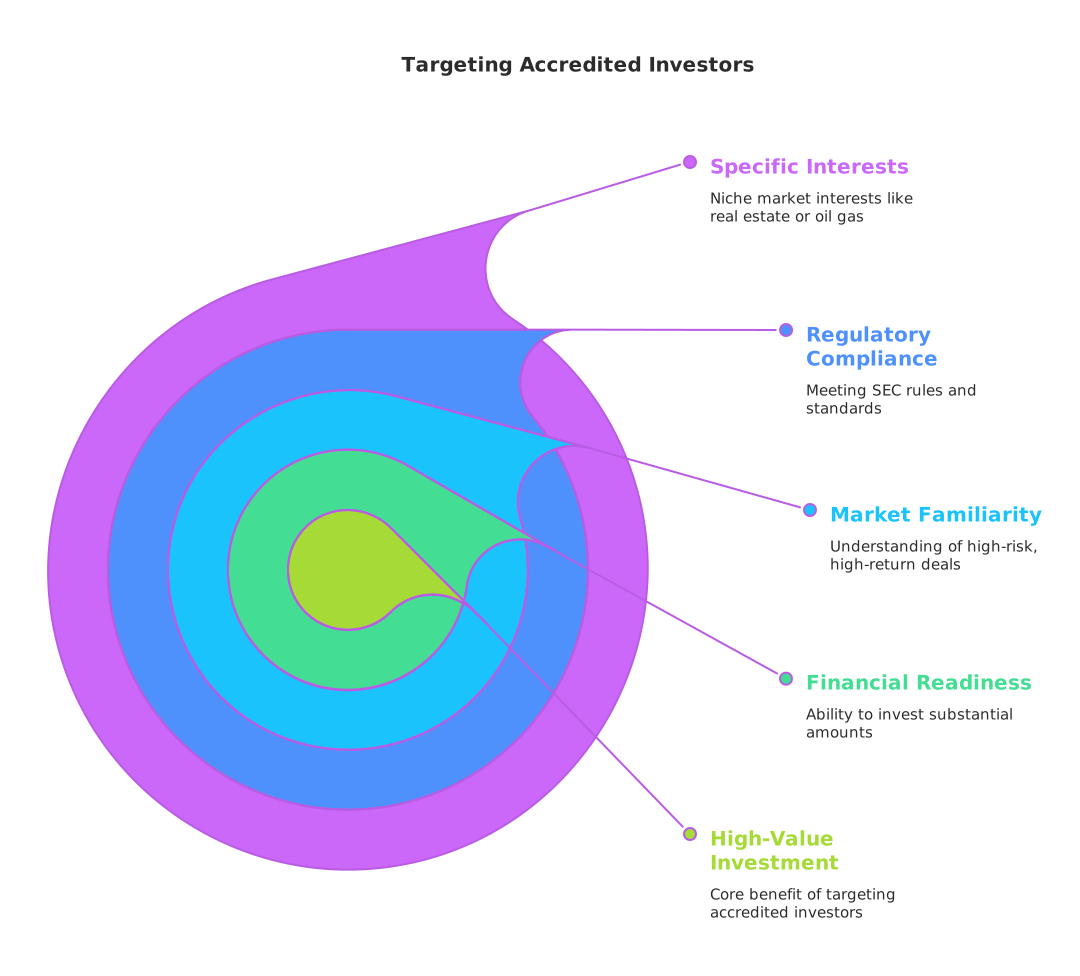
Define Your Ideal Accredited Investor Profile Before Sourcing Leads
Financial eligibility is only one part of investor fit.
The strongest campaigns create an ideal accredited investor profile before choosing a provider, advertising platform or content strategy. This profile should describe the person most likely to understand, value and complete the investment.
Match Capacity to the Investment Minimum
Start with the capital target and expected commitment.
Suppose a fund seeks $10 million and expects an average funded commitment of $200,000. It needs around 50 funded investors. If only one in five qualified meetings becomes a funded investor, the team needs roughly 250 qualified meetings. If 20 percent of suitable leads book meetings, it needs around 1,250 qualified leads.
The exact ratios will differ. The point is to work backwards from funded capital rather than selecting an arbitrary lead volume.
A lead’s stated investment range should fit the offering minimum. A $100,000 minimum paired with a database dominated by people willing to invest $10,000 creates predictable waste.
Capacity also includes liquidity. Someone may have substantial net worth tied up in property or a private business but little cash available for a new commitment. Asking about investable assets or expected allocation can be more useful than asking only about total wealth.
Segment by Asset Class, Risk and Holding Period
Different investors seek different outcomes.
People evaluating real estate syndication investor leads may care about property type, market, leverage, distributions, tax treatment and expected hold period. Private-credit prospects may focus on collateral, seniority, default protection and yield. Venture-capital prospects may accept a long time horizon and high loss rates in exchange for greater upside potential.
A useful profile covers preferred asset class, target return, income needs, risk tolerance, liquidity expectations, expected holding period and previous private-market experience.
The offer should also fit the investor’s portfolio. An accredited person with heavy real-estate exposure may not want another property investment. Another person may be actively trying to increase alternatives.
This is why high-net-worth investor leads should not be treated as one homogeneous audience.
Add Geography, Tax Context and Investment Timing
Geography can affect eligibility, filing requirements, tax considerations and the relevance of the underlying opportunity.
A local real-estate project may appeal to investors who know the market. A national private-credit fund may have a wider audience. An international prospect may create additional legal and operational questions.
Timing matters just as much. A person who expects a business sale, property disposal, bonus, inheritance or portfolio reallocation may have near-term capital. Another may have interest but no available liquidity until the following year.
The qualification form should therefore capture investment timing in practical ranges, such as within 30 days, within 90 days, within six months or researching for later.
Choose the Right Accredited Investor Lead-Acquisition Model
There is no single source that works for every issuer.
The main decision is whether to buy access, build owned demand or combine both. Speed, control, exclusivity and cost vary sharply between models.
Purchased Lists, Real-Time Leads and Qualified Appointments
People searching for accredited investor leads for sale usually encounter several products presented under similar language.
An accredited investor lead list may be a downloadable file assembled from surveys, public records, subscriptions, financial indicators or previous campaigns. The entries may never have expressed interest in the buyer’s company.
A real-time lead has usually completed a recent form. The form may concern a specific asset class, a general investing topic or a broader financial service. Quality depends on the question asked and the brand shown to the person.
A warm transfer connects the prospect to the buyer by telephone after an initial screening conversation. A booked appointment goes one step further by placing a meeting on the calendar.
Appointments cost more because the provider performs part of the outreach and qualification. Yet a meeting is only valuable when the qualification standard matches the offering. A person who agrees to a call about “investment opportunities” may still have no interest in a five-year illiquid private placement.
Owned Inbound Leads
Owned acquisition means the investor enters through the issuer’s own website, webinar, event, referral system or branded campaign.
This approach creates stronger first-party context. The prospect knows which company will contact them. Consent language can be designed around the intended communication. The issuer owns the landing page, tracking, content, data and relationship.
Owned leads are often the most defensible form of exclusivity. They also create a long-term asset. A useful educational article may continue generating prospects for years, while a purchased file is depleted as soon as the records are worked.
The drawback is time. Search visibility, reputation and content libraries develop gradually. Paid acquisition can speed up traffic, but the conversion system still needs testing.
Professional Referrals and Investor Communities
Accountants, attorneys, wealth advisers, founders, business owners and current investors often know people who fit a private offering.
A warm introduction can carry more trust than a cold form fill. It can also provide useful context about the prospect’s interests and experience.
The relationship must still be handled carefully. The introducer should not make unauthorised claims or receive compensation that creates an unreviewed broker-dealer issue.
Referral performance should be tracked in the CRM. Record who made the introduction, what permission was given, the date, the stated reason for interest and the eventual outcome.
Generate Exclusive Leads Through Trust-Based Inbound Marketing
Strong accredited investor marketing starts before an offering page asks for a meeting.
Private investments require trust. The prospect needs to understand the team, strategy, risk, fees and process. A thin landing page with projected returns and a form rarely supplies enough context.
Build Search Topics Around Investor Decisions
The best content addresses the decisions investors make before committing capital.
An issuer can create educational clusters around accredited-investor rules, private-market risks, portfolio construction, liquidity, due diligence, fees, tax questions, sponsor evaluation and the specific asset class.
The purpose is not to publish generic financial definitions. Each article should help the reader make a better decision.
A real-estate sponsor might explain how leverage affects risk, how preferred returns work, what happens when a project misses its exit date and how property-level cash flow differs from a fund distribution.
A private-credit manager might explain loan seniority, covenants, default management, collateral valuation and concentration risk.
This depth creates a better audience than content that speaks only about high returns.
Create Lead Magnets That Reveal Intent
A lead magnet should help identify what the prospect cares about.
A general “wealth guide” may attract a broad audience. A due-diligence checklist for evaluating private-credit funds signals much stronger relevance.
Useful assets include an investment-thesis report, market outlook, risk worksheet, sponsor due-diligence checklist, portfolio-allocation guide, webinar or case-study briefing.
The form should request enough information to support segmentation without feeling intrusive. Name, email, location, investor type, preferred asset class and expected investment range may be sufficient for the first conversion.
Sensitive documents do not belong in a basic marketing form.
Build Investor-Focused Landing Pages
A strong landing page tells the prospect what they will receive and what will happen next.
The page should identify the asset class, investment audience, educational purpose and intended action. It should explain whether the visitor is requesting information, applying for access, joining a webinar or booking a call.
Credibility should come from clear facts. Explain the team’s relevant experience, strategy, process and service providers. Discuss material risks rather than presenting benefits alone.
Avoid using urgency to push unsuitable people into a call. The aim is not the highest form-completion rate. It is the highest rate of suitable conversations.
Use Paid Acquisition Carefully for Rule 506(c) Investor Leads
Paid channels can produce fast data. They can also produce expensive noise.
Success depends on the audience, message, qualification process and follow-up. The platform alone does not create lead quality.
Capture High-Intent Search Demand
Paid search works best when the query shows a clear problem or investment interest.
Someone searching for private-credit funds, multifamily syndications, alternative income investments or how to evaluate a private placement may be closer to action than someone searching for the definition of net worth.
Campaigns should separate educational, comparison and offering-related terms. Each group should have a relevant page.
Negative keywords are equally important. Searches related to jobs, personal loans, grants, free funding, public stocks or unrelated financial services can consume budget without creating suitable prospects.
Search advertising should also avoid claims that cannot be supported. A high click-through rate does not justify exaggerated return language.
Use Paid Social for Education and Retargeting
Social advertising can reach people based on professional, behavioural and interest signals. These signals can help identify a likely audience. They do not establish legal accredited status.
The most effective first interaction is often educational. A market report, webinar or due-diligence guide gives the prospect a reason to engage without making an immediate investment decision.
Retargeting can then present deeper information to people who read key pages, watched a briefing or returned to the site.
Audience precision should never be overstated. Platform targeting changes frequently, and estimated wealth signals can be wrong. The campaign still needs direct qualification.
Connect the Ad to the Entire Investor Marketing Funnel
A successful investor marketing funnel should be measured from impression to funded capital.
The path may include an advertisement, landing page, form, screening questions, email sequence, qualification call, investor meeting, data room, verification, subscription and funding.
Weak campaigns optimise the first two steps. They celebrate cheap clicks and cheap leads while the investor-relations team receives unsuitable contacts.
The campaign owner should inspect quality by source, creative, audience and landing page. If one advertisement produces more expensive leads but twice the qualified-meeting rate, it may be the better investment.
How to Buy Accredited Investor Leads Without Wasting Your Budget
People who search buy accredited investor leads are often shown large files and strong guarantees. The safest approach is to slow the buying decision down.
The provider should be able to explain the origin, age, permissions, screening and sale history of its data. Refusal to provide that information is itself useful information.
Ask the Provider Specific Due-Diligence Questions
Before paying for a sample or pilot, ask:
- What exact source generated each record; what page, advertisement, survey or relationship collected it; which consent language was shown; which business was named; when was the consent captured; when were the email and telephone last checked; which fields are self-reported; which fields are modelled; how many buyers have received the record; whether the record was contacted in a previous campaign; what exclusivity period applies; whether exclusivity covers other asset classes; how duplicates are identified; what causes a record to qualify for replacement; and what deletion, audit and suppression rights the buyer receives.
- Ask the provider to define “accredited,” “qualified,” “exclusive,” “verified,” “interested” and “appointment” in the contract rather than in a sales presentation.
- Require the delivered file to include source and date fields. A record without provenance is difficult to assess, govern or defend.
A reputable provider may have legitimate confidentiality concerns about proprietary acquisition methods. That does not prevent it from explaining the type of source, consent scope, validation process and exclusivity rules.
Request a Sample and Run a Controlled Pilot
A sample reveals file structure and obvious quality problems. It does not prove conversion performance.
The first paid order should be small enough to limit risk but large enough to produce a meaningful test. The right size depends on expected contact and qualification rates.
Distribute the pilot across a controlled period. Use the same response process for every record. Track call attempts, replies, incorrect details, duplicates, denials of consent, qualification outcomes, meetings and capital.
Do not mix several new providers into one unlabelled campaign. Source-level tracking is necessary to identify what worked.
Put Quality and Remedies in Writing
The contract should state the delivery fields, validation date, permitted use, exclusivity scope, replacement process and dispute deadline.
A disconnected telephone number may be a clear replacement. A person who answers but has no interest is harder to classify. If the provider promises interested prospects, the agreement should explain how that interest was established.
Ownership also matters. The buyer should know whether it may continue nurturing the lead after the contract ends and whether the provider can resell the same person later.
Audit Freshness, Accuracy, Consent and Source Provenance
Contact accuracy is not the same as lead quality.
A record can contain a valid telephone number while being outdated, over-contacted or irrelevant. A person can be wealthy but have no current interest in private investments.
Build a Lead Acceptance Standard
Create an acceptance specification before the delivery arrives.
Mandatory fields may include full name, email, telephone, location, source type, generation date, last validation date, consent scope, stated investment interest, expected investment range and accreditation indicator.
The specification should identify which fields are self-reported, inferred or modelled.
Freshness should be measured from the underlying action. A file exported today may contain leads generated three years ago. The export date has little value without the original collection date.
The team should record rejection reasons consistently. Useful categories include duplicate, invalid contact, wrong geography, no relevant interest, below investment minimum, consent concern and previously opted out.
Suppress Duplicates and Existing Relationships
Every delivery should be checked against the existing CRM before outreach.
Exact email matching is not enough. The same person may appear with a second address, altered telephone format or company email. Matching should consider name, telephone, email, location and related entity.
Existing investors should not receive cold acquisition messaging. Active prospects may already be in a more advanced sequence. People who have opted out must remain suppressed across providers and campaign tools.
A provider should not charge for records already held by the buyer when the agreement promises net-new leads.
Separate Modelled Wealth From Verification
Data companies may estimate wealth through property ownership, occupation, business interests, location or consumer behaviour.
These indicators can support accredited investor prospecting, but they do not establish formal status.
A senior executive may have a high income and heavy liabilities. An expensive property may have substantial mortgage debt. A business owner may have considerable net worth but no liquid capital.
Modelled data is best used to prioritise research and targeting. The issuer must still apply the correct assessment or verification process before accepting a purchaser.
Create an Investor Lead Qualification and Scoring Framework
A good qualification process protects both the investor-relations team and the prospect.
It prevents senior staff from spending hours with people who cannot participate, do not understand the offering or have no interest in its structure.
Score Eligibility Separately From Offering Fit
Investor lead qualification should answer several independent questions.
Does the person appear to qualify under an accredited-investor category?
Can the person meet the investment minimum?
Does the asset class match their interests?
Can they tolerate the holding period and risk?
Do they have a realistic investment timeframe?
These answers should not be collapsed into one yes-or-no field.
A person can score highly on financial capacity but poorly on strategy fit. Another may have strong interest but require verification through a professional-credential category rather than income or net worth.
Use an Investor Lead Scoring Model
A practical investor lead scoring system can assign up to 100 points.
Accreditation indication might carry 25 points. Investable capacity may carry 20. Offering fit can carry 20. Behavioural engagement can carry 15. Investment timing may carry 10. Referral strength or existing trust can carry the final 10.
The weighting should reflect the offering.
A webinar attendee who asks detailed questions, returns to the risk page and books a call may deserve fast personal outreach. A person who downloaded a broad guide and never opened a follow-up email belongs in a lower-priority sequence.
Scores should guide attention, not make legal decisions. A marketing score cannot replace verification or suitability analysis.
Create Routing and Disqualification Rules
High-scoring leads should move to investor relations quickly.
Medium-scoring leads may enter a targeted educational sequence. Low-scoring leads may remain in a general newsletter, provided the person has given the relevant permission.
Disqualification should have a reason and review date. A person who lacks current liquidity may become relevant later. A person outside the permitted geography may remain permanently unsuitable for that offering.
The system should also identify hard stops. These can include failed identity checks, clear ineligibility, repeated opt-outs, inability to meet the minimum or expectations that conflict with the investment’s risk and liquidity.
Verify Accredited Investor Status at the Correct Stage
Formal verification should occur in a secure and documented process.
It should not be confused with the first marketing form. Asking every website visitor to upload tax records creates unnecessary friction and privacy risk.
Understand Rule 506(c) Verification
Under Rule 506(c) verification, the issuer must take reasonable steps to verify that each purchaser is accredited.
The rule includes non-exclusive methods, but it also permits a principles-based analysis. The appropriate steps can depend on the investor, information available, offering terms and other circumstances.
A 2026 SEC staff interpretation confirms that an issuer may use different verification methods for different purchasers in the same Rule 506(c) offering. One investor may qualify through income documentation, another through net worth, and another through a recognised professional credential.
This flexibility does not mean the process can be skipped. It means the method can fit the purchaser’s situation.
Documentary and Third-Party Methods
Income verification may involve reviewing specified tax records and obtaining the required written representation.
Net-worth verification may involve reviewing specified asset and liability documentation dated within the permitted period, along with written representations. If information creates questions about liabilities, additional steps may be needed.
Certain qualified third parties may provide written confirmation within the framework described by the rule.
The issuer should use a secure verification portal or specialist workflow. Tax returns, brokerage statements and liability records should not be passed casually through email or stored in a general-purpose marketing system.
Apply the 2025 Minimum-Investment Guidance Carefully
In March 2025, SEC staff agreed that a high minimum investment can be a relevant factor in determining reasonable verification steps under specified conditions.
The approach described in the no-action response included written representations regarding accredited status and confirmation that the minimum investment was not financed by a third party for the specific purpose of making the investment. The staff response was tied to the facts and minimum-investment conditions presented in the request.
It should not be reduced to a claim that any large cheque automatically proves accreditation.
Legal counsel should assess whether the offering’s facts fit the guidance and what records should be retained.
Build a Compliant Investor Outreach Process
A lead’s presence in a file does not remove the buyer’s responsibility for how the person is contacted.
Channel rules, consent, suppression and securities communications must be addressed together.
Email Outreach and Unsubscribe Handling
An accredited investor email list may contain deliverable addresses while still raising questions about collection, consent and expected use.
CAN-SPAM applies to commercial email sent individually as well as in bulk. Commercial messages need accurate routing information, non-deceptive subject lines, required identification and a functioning opt-out process.
The business should maintain a central suppression list. An opt-out in one system should not be lost when data moves to another platform or agency.
The first message should make the relationship clear. A person who downloaded another company’s guide should not receive an email written as though they contacted your firm directly.
Telephone Outreach, DNC and Purchased Leads
Purchased data requires careful telephone compliance.
The FTC’s Telemarketing Sales Rule includes disclosure, calling-time, misrepresentation, recordkeeping and Do Not Call requirements. A seller cannot assume that a lead generator’s relationship with a consumer automatically creates the same relationship for every company that buys the lead.
The calling team should know the source, permission and applicable restrictions before dialling.
Automated calls, prerecorded messages and text messaging can involve additional requirements. Those campaigns require specific legal review rather than a generic lead-provider assurance.
Keep Communications Balanced
Marketing for private investments should communicate risk as clearly as potential benefit.
For FINRA member firms, Rule 2210 governs communications with the public and includes approval, content and recordkeeping standards. FINRA guidance for private placements stresses balanced treatment of potential benefits and risks, including possible loss, illiquidity and speculative features.
Even when an issuer is not a FINRA member, fair and supportable communication is good practice.
Avoid implying SEC approval. Avoid presenting projections as guaranteed outcomes. Explain the basis of track-record figures and identify material differences between past projects and the current offering.
Nurture Investor Leads With Trust and Relevance
Most people do not move from a first click to a funded subscription in one step.
Investor lead nurturing should answer the questions that prevent a suitable prospect from moving forward.
Build an Investor Trust Stack
Trust is created through accumulated evidence.
The investor should be able to understand who manages the offering, how decisions are made, what experience is relevant, which third parties are involved, how fees work and what can go wrong.
A useful trust stack includes detailed team biographies, strategy explanation, risk discussion, fee disclosure, service-provider information, investment process, due-diligence material and clear answers to recurring questions.
Track records need context. Explain whether results are realised or unrealised, gross or net, audited or unaudited, and whether they came from a strategy comparable to the current offering.
Segment the Nurture Sequence
Do not send the same sequence to every lead.
A person interested in monthly income should receive different information from someone focused on long-term capital growth. A prospect who attended a real-estate webinar has different questions from one who downloaded a private-credit report.
The sequence should also reflect engagement.
A new educational lead may receive foundational material. A qualified prospect may need the investment thesis, risk framework and manager process. A person reviewing documents may need operational details, service-provider information and answers about subscription.
Address Objections Transparently
Common concerns include illiquidity, fees, market risk, manager risk, valuation, leverage, conflicts and exit timing.
Do not treat every objection as a sales barrier to overcome. Some objections reveal that the offering is unsuitable for the person.
A useful response explains the issue, the relevant safeguards and the remaining risk. When the risk cannot be removed, say so.
Transparent answers may reduce immediate conversion. They improve the quality of the investors who continue.
Create a Fast and Secure CRM Handoff
Lead generation fails when marketing and investor relations use different definitions.
The CRM should preserve the story of the lead from source to funding.
Set a Speed-to-Lead Standard
Recent enquiries should receive a timely response while the context is fresh.
The best response is not always an immediate sales call. A person who requested a report may first need the promised document and a clear introduction. A person who requested a meeting should receive confirmation and direct contact quickly.
Service levels should vary by intent. A booked call deserves faster personal attention than a low-intent newsletter signup.
The team should also define the number, timing and channel of follow-up attempts. Endless calling damages the brand and may create compliance issues.
Use Investor-Specific CRM Stages
A practical pipeline can move through new lead, attempted contact, contacted, marketing qualified, offer qualified, meeting booked, due diligence, verification pending, verified, subscription pending, funded, nurture and disqualified.
Each stage should have entry and exit rules.
A lead should not move to “verified” because a salesperson thinks the person is wealthy. A signed subscription should not be recorded as funded until the relevant funds and acceptance steps are complete.
The CRM should also store source, consent date, investment range, strategy preference, last activity, expected timing and disqualification reason.
Protect Sensitive Information
Marketing teams do not need unrestricted access to tax returns or brokerage statements.
Verification data should be stored in a secure system with role-based access. The organisation should decide who may view documents, how long records are retained, how downloads are controlled and how deletion requests are handled.
The CRM can store a verification status and date without exposing the underlying documents to every user.
Measure Lead Quality Through Capital Outcomes
A low accredited investor lead cost can be attractive and misleading.
A $20 record that never answers is more expensive than a $300 lead that becomes a qualified meeting. A $1,000 appointment can be economical when it produces a substantial funded commitment.
Track the Full Funnel
At minimum, measure delivered leads, valid contacts, contacted leads, qualified leads, meetings, due-diligence participants, verification completions, subscriptions, commitments and funded investors.
Key calculations include:
Contact rate = contacted leads ÷ delivered leads.
Qualification rate = qualified leads ÷ contacted leads.
Meeting rate = completed meetings ÷ qualified leads.
Verification rate = verified prospects ÷ prospects entering verification.
Funded investor rate = funded investors ÷ delivered leads.
Measure these figures by source and cohort. Blended averages can hide a poor provider or advertising campaign.
Calculate Cost per Qualified and Funded Investor
Cost per qualified investor lead is more useful than basic CPL.
Cost per qualified lead = total acquisition cost ÷ qualified leads.
Cost per meeting = total acquisition cost ÷ completed qualified meetings.
Cost per funded investor = total acquisition cost ÷ funded investors.
Total acquisition cost should include provider fees, media spend, agency costs, technology, data validation and the labour required to work the leads.
A cheap list may become expensive after hundreds of calling hours.
Calculate Cost per Committed Dollar
Cost per committed dollar connects marketing expenditure to the capital-raising goal.
Cost per committed dollar = total acquisition cost ÷ capital committed.
Also calculate cost per funded dollar:
Cost per funded dollar = total acquisition cost ÷ capital received.
The distinction matters because commitments can be withdrawn, rejected or fail to fund.
For example, a campaign costing $100,000 that produces $5 million in funded capital has a cost per funded dollar of $0.02. Another campaign may produce cheaper leads but only $1 million in funded capital, making it less efficient.
Cohort reporting should continue after the initial close. A source may produce investors who participate in later offerings, refer others or increase commitments. That longer-term value should be visible.
Compare Pricing and Contract Models
Published prices for investor leads vary because the products are not equivalent.
One seller may charge for old records. Another may manage advertising, qualification and appointment setting. A third may provide a complete marketing system.
Understand the Main Pricing Structures
Per-record pricing usually applies to database contacts or aged leads.
Per-lead pricing may apply to fresh form submissions.
Per-appointment pricing covers a scheduled conversation, though attendance and qualification guarantees vary.
Agency retainers can include strategy, advertising, creative work, landing pages, content, CRM automation and reporting. Media spend may be separate.
Performance-based compensation needs careful review when payment is connected to securities transactions or capital raised.
Ask for the full cost rather than comparing headline prices.
Calculate the True Acquisition Cost
The true cost includes provider payments, advertising, technology, verification, internal labour, data cleaning and compliance review.
It also includes opportunity cost. Investor-relations professionals working low-quality records are not speaking with stronger prospects.
Replacement guarantees can reduce waste, but only when they are practical. A seven-day dispute window may expire before a reasonable contact sequence has been completed.
Treat Guarantees as Contract Terms
A connection guarantee may mean only that the telephone rings.
An appointment guarantee may not guarantee attendance.
A qualified-lead guarantee may rely on the prospect’s self-reported answers.
An exclusivity guarantee may last for a limited period.
Read the definition attached to each promise. The contract should specify evidence, remedies and timelines.
Recognise Red Flags in Investor Lead Providers
A trustworthy provider should be willing to explain what it sells.
Be cautious when the sales claim is stronger than the underlying evidence.
Common warning signs include:
- No clear data source; no generation dates; no consent evidence; unexplained use of “verified”; an unlimited supply of supposedly exclusive prospects; guaranteed investment commitments; guaranteed accreditation based only on wealth modelling; refusal to provide a sample; unclear previous-sale history; no duplicate policy; no DNC or suppression process; no written replacement rules; pressure to purchase a large package immediately; unverifiable testimonials; and compensation tied to capital raised without a documented legal review.
- Data warning signs include high bounce rates, disconnected numbers, repeated records, identical files from different vendors, prospects who deny requesting contact, outdated employers, missing timestamps and unexplained financial estimates.
- Campaign warning signs include very low lead costs paired with almost no qualification, advertisements focused only on returns, repeated contact after opt-out, investor documents sent before basic fit is established and funds accepted before the required verification process is complete.
A bad pilot should be stopped quickly. More volume rarely repairs a source problem.
Build a 90-Day Accredited Investor Lead-Generation Plan
A clear implementation sequence keeps the team from buying traffic before its infrastructure is ready.
Days 1 to 30: Positioning and Infrastructure
The first month should define the offering audience, legal framework and operating process.
Confirm the offering exemption and communications rules. Build the ideal investor profile. Set qualification criteria and CRM stages. Prepare the landing page, lead magnet, approved messages and tracking.
The team should also establish the lead-acceptance standard, provider questionnaire, suppression process, response times and performance dashboard.
Do not launch at scale until the team can identify where every lead came from and what should happen next.
Days 31 to 60: Controlled Testing
Test a limited number of channels.
One owned inbound campaign, one paid campaign and one provider pilot may create enough contrast to learn without creating operational confusion.
Use the same qualification definitions across every source. Record every outcome. Review calls and messages for quality as well as conversion.
During this period, improve landing-page clarity, remove poor audience segments and refine the nurture sequence based on real questions.
Days 61 to 90: Optimisation and Scale
Scale only sources that produce relevant conversations.
A source should not receive more budget because it delivers more names. It should earn budget through contactability, qualification, meetings, verification progress and capital outcomes.
Add content that addresses recurring objections. Improve source-specific follow-up. Stop providers that cannot meet the agreed quality standard.
At the end of 90 days, the business should know which channel produces the lowest cost per qualified investor, funded investor and funded dollar.
How to Select the Best Investor Lead Generation Agency or Provider
The right partner should understand both demand generation and the sensitivity of private-investment communications.
A generic agency may be capable of buying traffic but unfamiliar with investor qualification, offering stages, risk language and long sales cycles.
Use a Weighted Provider Scorecard
Compare providers through the same criteria.
| Evaluation category | Suggested weight | What strong evidence looks like |
|---|---|---|
| Source transparency and consent | 20% | Clear acquisition method, timestamps, consent scope and provenance fields |
| Relevant investor-sector experience | 15% | Demonstrated work in the applicable asset class and offering model |
| Qualification methodology | 15% | Written questions, definitions, call process and disqualification rules |
| Exclusivity and duplicate protection | 15% | Contractual scope, historical-sale disclosure and practical remedies |
| Compliance-aware process | 15% | Approved messaging workflows, suppression procedures and role clarity |
| Reporting and attribution | 10% | Source-to-funded-capital reporting rather than lead totals alone |
| CRM and operational integration | 5% | Reliable field mapping, status feedback and secure data transfer |
| References and pilot flexibility | 5% | Verifiable client context and a controlled test before long commitment |
Scores should be supported by documents and demonstrations, not sales claims.
A provider with strong creative work but poor data governance should not receive a high overall score. A provider with excellent records but no ability to connect with your CRM may also create avoidable problems.
Choose Internal, Agency or Hybrid Delivery
Internal teams offer control. They own the accounts, data, content and investor relationships.
Agencies provide specialist capacity and faster execution. They may bring media buying, copywriting, design, automation and campaign experience.
A hybrid model often works best. The issuer owns its domain, advertising accounts, CRM and data. The agency manages agreed acquisition functions. Investor relations, verification and subscription decisions remain with authorised personnel.
Contract terms should prevent the partner from holding the organisation’s lead history or advertising data hostage.
Require a Pilot With Success Criteria
A pilot should define the audience, channels, budget, duration, expected lead fields and reporting.
Success criteria should include valid-contact rate, qualification rate, completed meetings and progression through due diligence. Funded-capital outcomes may take longer, so the pilot should also define how later results will be attributed.
The agreement should explain what happens to landing pages, creative materials, advertising audiences and lead data when the pilot ends.
Frequently Asked Questions About Exclusive Accredited Investor Leads
Where Can You Buy Exclusive Accredited Investor Leads?
Leads are available from data providers, appointment-setting firms, marketing agencies and specialised financial lead companies.
Do not choose a provider based only on file size or headline price. Ask how the records were generated, whether they were previously sold, what consent was collected and how exclusivity is defined.
A small controlled purchase is safer than a large first order.
How Much Do Accredited Investor Leads Cost?
There is no universal price.
An aged database record may cost very little. A recent opt-in lead costs more. A screened meeting can cost far more because it includes human outreach and calendar booking.
The relevant question is not simply, “What does the lead cost?” Ask what it costs to generate a qualified meeting, verified purchaser, funded investor and funded dollar.
Are Exclusive Leads Always Better Than Shared Leads?
Exclusive leads reduce direct competition, but exclusivity does not fix poor targeting or weak intent.
A genuinely interested shared lead can outperform an exclusive record selected only through demographic modelling.
Evaluate exclusivity alongside source, freshness, permission, fit and conversion history.
Is Self-Certification Enough for Rule 506(c)?
A prospect’s self-reported answer can support initial screening. Rule 506(c), however, requires the issuer to take reasonable steps to verify accredited status.
The process may use specified documentary methods, qualified third-party confirmation or an appropriate principles-based method.
Can Different Investors Use Different Verification Methods?
Yes. SEC staff clarified in 2026 that an issuer may use different methods for different purchasers in the same Rule 506(c) offering.
The issuer should document the method and basis used for each purchaser.
Can a Rule 506(b) Offering Run Public Investor Ads?
Rule 506(b) does not permit general solicitation or general advertising. A business planning public promotion should obtain legal advice about the offering structure before launching the campaign.
Are Accredited Investor Email Lists Effective?
They can support research and outreach when the source, permissions, relevance and data quality are strong.
They are less useful when records are old, repeatedly sold or selected only through broad wealth indicators. Email deliverability does not prove investment intent.
Are Booked Appointments Better Than Lead Lists?
Appointments reduce prospecting work and can improve sales efficiency.
Their value depends on attendance, qualification and offer fit. Ask what questions were asked before the meeting and whether the appointment is exclusive.
How Quickly Should a New Investor Lead Be Contacted?
High-intent requests should receive a prompt response.
The method should match the action. A meeting request deserves fast personal follow-up. An educational download may begin with delivery of the requested resource, followed by relevant communication.
Quality and context matter more than calling every lead within seconds.
How Many Leads Are Needed to Raise a Target Amount?
Work backwards from the capital goal.
Estimate the average commitment, number of funded investors required, meeting-to-funded conversion rate and lead-to-meeting rate.
For example, a $5 million target with an expected $250,000 average commitment requires around 20 funded investors. If 20 percent of completed qualified meetings fund, the team needs about 100 meetings. If 25 percent of qualified leads complete a meeting, it needs about 400 qualified leads.
Use your own data as soon as it becomes available.
What Is the Best Source of Private Placement Investor Leads?
The best source is the one that delivers suitable investors at sustainable economics.
For some issuers, this will be current-investor referrals. For others, it will be owned search content, paid acquisition, professional introductions or carefully selected private placement investor leads.
Source quality should be judged through funded outcomes rather than lead volume.
Final Checklist: What the Best Leads Must Prove
The best investor leads do not come from one specific platform or vendor.
They prove their value through a chain of evidence.
The source is known. The contact information is current. The person expected communication. Exclusivity is defined. The prospect fits the asset class and investment range. Marketing qualification is separate from formal verification. Communications are accurate and balanced. The CRM records every stage. Performance is measured through qualified, verified and funded outcomes.
This approach also protects the business from false efficiency.
A cheap record can consume hours of staff time. A large list can create the appearance of pipeline growth while producing no capital. A provider’s “verified” label can hide the absence of genuine accreditation evidence.
The strongest system combines owned inbound acquisition, carefully controlled paid campaigns, trusted referrals and selective external providers. It uses each source for a clear purpose.
Owned content builds authority and first-party demand. Paid media tests messages and creates scale. Referrals add trust. Purchased leads or appointments provide speed. Qualification protects sales capacity. Verification protects the offering process. Measurement directs budget toward real results.
That is how to get the best exclusive accredited investor leads. Do not optimise for the largest database or lowest cost per form. Optimise for contactable, permission-supported and offer-aligned people who can move responsibly from initial interest to informed, verified and funded participation.