

A VSL funnel is a sales process built around a persuasive video. The video explains a problem, presents a solution, answers objections and asks the viewer to take a specific action.
That action may be buying a product, applying for a programme, booking a call, starting a trial or joining an email list.
The video is only one part of the system. A complete video sales letter funnel also includes the traffic source, landing page, offer, payment or booking process, follow-up messages and tracking setup.
This distinction matters. A strong video placed inside a weak funnel can still fail. The viewer may watch most of the presentation and then leave because the offer is unclear, the checkout feels risky or the page loads badly on a phone.
The opposite can also happen. A polished funnel cannot rescue a vague promise or an offer that the market does not want.
A complete VSL funnel may include:
- An advert, email, social post, affiliate link or search result that sends qualified traffic to the page
- A focused landing page containing the video, headline, proof and call to action
- A checkout, application form, booking calendar or trial registration page
- Follow-up emails for viewers who do not convert immediately
- Order bumps, upsells, downsells or onboarding steps after conversion
- Analytics that connect video engagement with leads, bookings and revenue
This guide answers two connected questions: what is a VSL funnel, and how to build a VSL funnel that works as a complete business system.
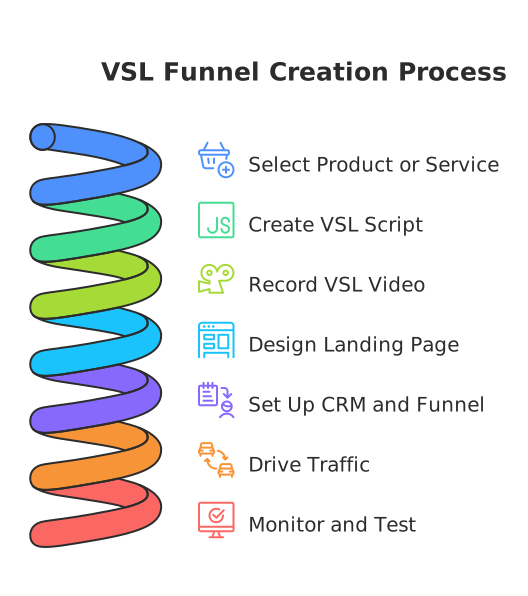
You will learn how to choose the right funnel model, research the audience, develop the offer, write the script, produce the video, build the landing page, track performance and diagnose weak results.
The goal is not to create a longer sales video. The goal is to create a clearer buying journey.
What Is a VSL Funnel in Marketing?
A VSL funnel is a structured path that uses a video sales message to move a defined audience towards a conversion.
VSL stands for video sales letter. The name comes from traditional direct-response sales letters, which were written to hold attention, present an argument and persuade the reader to respond.
A VSL applies the same principles through spoken words, visuals, demonstrations, graphics and on-screen proof.
The complete funnel surrounds that video with the steps needed to generate and complete a conversion.
For example, a software company may run an advert that sends visitors to a VSL page. The video explains the problem, demonstrates the platform and asks the viewer to start a trial. The visitor then reaches a registration page, receives onboarding emails and enters a product activation sequence.
A consultant may use a different flow. The video could explain the consultant’s method and invite qualified viewers to complete an application. Approved applicants can then book a call.
Both businesses use VSLs, but their funnels serve different commercial goals.
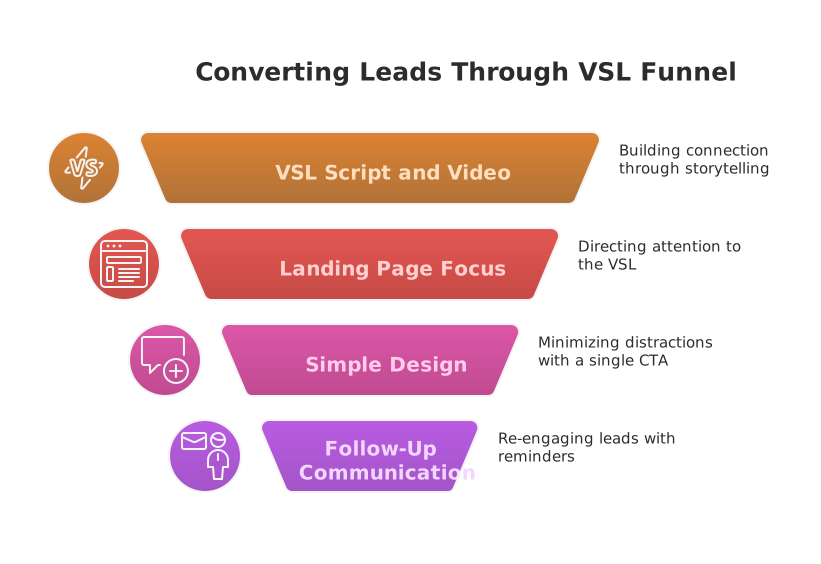
Video Sales Letter vs VSL Sales Funnel
A video sales letter is the persuasive presentation itself.
A VSL sales funnel is the whole conversion process in which that presentation operates.
The video may include the problem, story, solution, proof, offer and call to action. The funnel includes everything that happens before, during and after the viewer watches it.
This includes how people discover the page, what promise brought them there, how they respond, how their details are captured and what happens after they leave or convert.
A standalone VSL can still be useful. A salesperson might send a personalised video to one prospect. A founder may place a short sales video on a homepage. A product team may use one during onboarding.
It becomes a funnel when the video is connected to a planned sequence of pages, decisions, messages and measurable outcomes.
How a VSL Funnel Moves Viewers from Click to Conversion
A good funnel creates continuity.
The promise made before the click should match the opening of the video. The problem described in the video should match the offer. The call to action should lead to a logical next step.
Suppose an advert promises to show accountants how to reduce the time spent collecting client documents. The landing-page headline should repeat that idea. The VSL should explain the cause of the problem, show the process and introduce a relevant solution.
The call to action might invite the viewer to start a trial. It should not suddenly ask them to book a broad strategy session that was never mentioned.
Every step should feel like the natural continuation of the previous one.
That consistency is called message match. It reduces confusion and reassures the visitor that they reached the right page.
Why VSL Funnels Work and Their Real Limitations
Video can combine voice, pacing, demonstration, facial expression, screenshots and customer evidence in one presentation.
This makes it useful when a product is difficult to explain through a headline and a few product images.
A VSL can also control the order in which information is introduced. The viewer hears the problem before the solution, the mechanism before the offer and the evidence before the price.
That sequence can make a complex argument easier to follow.
Still, video is not automatically more persuasive than written copy. Some people prefer to scan. Others are in a place where they cannot play sound. Some want to compare features before committing to a long presentation.
The strength of VSL marketing comes from matching the format to the decision, not from forcing every prospect to watch a video.
Attention, Storytelling, Demonstration and Perceived Trust
A well-produced VSL gives the marketer several ways to communicate at the same time.
The speaker can explain the idea while the screen shows evidence. A software product can be demonstrated while the narration explains the benefit. A customer can describe an experience while relevant results appear on screen.
Stories can also make an abstract problem feel specific. Instead of saying that business owners waste time, the script can show a realistic sequence in which a team member searches through emails, spreadsheets and messages to find one missing document.
The story creates recognition. The demonstration creates clarity. Proof reduces doubt.
Human presence can help when trust is central to the sale. A consultant, adviser, coach or founder can speak directly to the viewer. This allows the audience to judge clarity, confidence and communication style before buying or booking a call.
When a VSL Creates Friction Instead of Reducing It
Video creates friction when it withholds information or limits the viewer’s control.
A visitor may become frustrated when the price is hidden until the final minute, the video cannot be paused or the call-to-action button appears only after a long delay.
Autoplay with sound can also create a poor first impression. Mobile visitors may be using limited data or browsing in a public setting. A heavy video player can make the page slow before the user has chosen to watch.
The page should therefore support the video rather than trap the visitor inside it.
Provide a clear headline, useful supporting copy, captions and visible controls. Make important offer information accessible without requiring perfect hearing, uninterrupted attention or a particular device.
A high-converting VSL respects the viewer’s time and makes the next step easy to understand.
When Should You Use a VSL Funnel?
A VSL works best when the product needs explanation, demonstration, belief building or objection handling.
It is especially useful when the audience understands the problem but does not yet understand why the proposed solution is different.
A VSL can also help when the seller’s credibility influences the decision. This is common in consulting, coaching, education, professional services and high-value B2B sales.
The key question is not whether video is popular. Ask whether a structured visual presentation makes the buying decision clearer.
Best Uses for Digital Products, SaaS, Services and High-Ticket Offers
A VSL funnel for digital products can explain the promised transformation, show what is included and address doubts about implementation.
This model is common for courses, memberships, templates, training products and specialist information. The VSL can show the curriculum, platform, process and expected workload before asking for the purchase.
Software companies can use VSLs to make complex features tangible. A screen demonstration can show the problem being solved in real time. The call to action may lead to a free trial, product tour or booked demonstration.
Service businesses can explain their method and qualify prospects. Rather than inviting every visitor to book a call, the VSL can show who the service is for, how the engagement works and what level of commitment is required.
A high-ticket VSL funnel often leads to an application or sales call rather than immediate payment. This gives the seller a chance to confirm fit, answer individual questions and manage a more complex purchase.
When a VSL Funnel Is the Wrong Choice
A VSL may be unnecessary for a simple product that is easy to understand and compare.
A customer buying a low-cost household item may only need clear photographs, dimensions, delivery details and reviews. A long sales presentation could slow down the purchase.
A VSL is also a poor starting point when the offer has not been validated. Production quality does not solve weak demand. It is usually better to test the promise, pricing and audience through simpler pages, sales calls or small campaigns first.
The format may also be wrong when customers need rapid access to technical specifications. Procurement teams, engineers and experienced buyers often want documentation they can scan, share and compare.
In that situation, video can support the page, but it should not replace the written information.
VSL vs Webinar Funnel, Sales Page, Product Demo and Advert
Different formats solve different sales problems.
A VSL is designed to present a controlled sales argument. A webinar allows more depth and may include interaction. A written sales page is easy to scan. A product demo focuses on how the product works. An advert earns attention and creates the click.
The right format depends on the audience’s awareness, the offer’s complexity and the action required.
The following comparison helps clarify the choice.
| Format | Best use | Typical depth | Viewer control | Common conversion action |
|---|---|---|---|---|
| VSL funnel | Structured persuasion for a defined offer | Medium to high | Moderate | Purchase, application, booking or trial |
| Webinar funnel | Education, authority building and complex offers | High | Lower during a live session, moderate when recorded | Application, call or purchase |
| Long-form sales page | Detailed information that buyers may scan and revisit | Medium to high | High | Purchase or lead submission |
| Product demo | Showing features, workflow and use cases | Medium | High | Trial, demo request or purchase |
| Short-form advert | Creating interest and earning the next click | Low | High | Visit a landing page or watch a longer presentation |
VSL Funnel vs Webinar Funnel
The VSL vs webinar funnel decision often comes down to depth and interaction.
A webinar may be better when the audience needs education before it can assess the offer. It can support longer explanations, live questions, demonstrations and case studies.
A VSL is usually easier to consume on demand. The viewer does not need to register for a scheduled event or wait for a presentation to begin.
For a warm audience, a focused VSL may reach the offer faster. For a complex or unfamiliar topic, a webinar may create more space for teaching.
The two formats can also work together. A short VSL can sell registration for a webinar. A recorded webinar can be edited into a more direct evergreen VSL after the marketer learns which points create the strongest response.
VSL vs Long-Form Sales Page
A written sales page gives the visitor control over reading speed and order.
Someone who already understands the offer may skip directly to pricing, features, terms or frequently asked questions. A video follows a fixed timeline.
That does not mean you must choose one.
Many effective VSL pages use video for the core sales message and written copy for scanning, accessibility and reinforcement. The page can summarise the promise, display proof, explain the offer and answer common questions below the player.
This hybrid format serves both viewers and readers.
VSL vs Product Demo, Explainer Video and Short-Form Ad
A product demo shows what the product does. A VSL explains why the viewer should care, why the problem matters and why this offer is the right next step.
An explainer video usually focuses on understanding. It may describe a process without making a complete sales argument.
A short-form advert is designed to stop attention and create curiosity. It should rarely carry the full burden of persuasion for a complex offer.
A simple acquisition flow may therefore use a short advert to attract attention, a VSL to present the argument and a demo to prove the product works.
Choose the Right VSL Funnel Structure
There is no single VSL funnel structure that fits every offer.
The correct sequence depends on what you sell, how much it costs, how quickly buyers can decide and whether human qualification is needed.
The most common models are direct purchase, application and booking, lead generation and low-ticket entry offers.
Direct-Purchase VSL Funnel
A direct-purchase funnel sends the viewer from the VSL to a checkout.
It is suitable when the buyer can understand the product, evaluate the terms and make the decision without speaking to a salesperson.
A common flow begins with an advert, email or organic page. The visitor reaches the VSL landing page, watches the presentation and clicks through to the order form.
After payment, the customer may see an order confirmation, onboarding instructions or a relevant upsell.
The checkout should repeat the product name, price, billing terms and core promise. Do not assume the visitor remembers every detail from the video.
The payment page is a decision page, not an administrative form.
High-Ticket VSL Funnel with Application and Booking
A high-value service often needs qualification.
The VSL introduces the problem, explains the method and helps the viewer decide whether the service is relevant. The call to action leads to an application rather than immediate payment.
The application collects information about goals, current situation, timing, authority and ability to proceed.
Suitable applicants then reach a calendar. After booking, they receive confirmation messages, reminders and preparation material.
These are separate conversion points. An application submission is not the same as a booking. A booking is not the same as attendance. Attendance is not the same as a sale.
Track each stage separately.
Lead-Generation or Low-Ticket Front-End VSL Funnel
Some funnels use a low-risk first action.
The visitor may download a resource, register for a trial or buy an inexpensive introductory product. This creates a relationship before the core offer is presented.
A low-ticket offer can also offset part of the acquisition cost. The buyer then enters a follow-up sequence that introduces a more complete solution.
This approach works when the market is not ready to make the main commitment on the first visit.
Do not add a low-ticket step merely because other funnels use one. It should attract the same type of customer who is likely to want the core offer.
Map the Complete Video Sales Letter Funnel Before Building It
Do not begin by choosing colours or page templates.
First map the customer journey on paper. Define the traffic source, the landing page promise, the conversion action and the messages that follow.
The VSL funnel stages should reflect real decisions made by the buyer.
For example, a viewer may first decide whether the page is relevant. Next, the viewer decides whether to play the video. Later, the viewer decides whether to trust the mechanism, believe the proof and accept the offer.
The final page should support those decisions in sequence.
Define the Traffic Source and Message Match
Traffic source affects the amount of context the VSL must provide.
A subscriber who has read several emails may already know the brand and problem. A visitor arriving from a cold social advert may know very little.
Search traffic can be different again. Someone searching for a comparison or price may have strong purchase intent and little patience for a long introduction.
Document what the visitor knows before arriving. Record the promise or angle that earned the click.
The landing-page headline and opening of the VSL should confirm that promise quickly.
Assign One Objective to Every Funnel Step
Every page needs one primary job.
The advert earns a qualified click. The VSL page creates belief and motivates action. The application confirms fit. The calendar secures a time. The checkout completes payment. The confirmation page sets expectations.
Problems appear when one page tries to perform too many jobs.
A VSL page with several unrelated offers, navigation menus and multiple calls to action divides attention. A checkout page filled with new sales arguments can create last-minute doubt.
Keep each step focused.
Create a Funnel Wireframe and Tracking Plan
Sketch each page before building it.
Mark the headline, player, proof, call to action, form, checkout and confirmation message. Draw the possible exits.
Ask what happens when the visitor watches but does not click. Ask what happens after an incomplete application. Ask how an abandoned checkout is recovered.
At the same time, define how those actions will be tracked.
Tracking should be part of the architecture. It should not be added after traffic has already started.
Research the Audience, Awareness Level and Buying Objections
Good VSL copywriting begins before the script.
The writer needs to understand what customers want, what they have tried, what they distrust and how they describe the problem in their own words.
Generic audience profiles are rarely enough. Age, job title and location do not explain why someone hesitates to buy.
You need decision-level information.
Collect Voice-of-Customer Language
Start with material created by real customers.
Review sales calls, support tickets, survey responses, interviews, product reviews and objections heard by the sales team.
Look for repeated language. Pay attention to the situation around the problem.
A customer may not say, “I need better workflow automation.” The customer may say, “Every Friday, I spend three hours chasing the team for updates.”
The second phrase is more specific. It describes the pain in a form that can be recognised immediately.
Use customer language carefully. Do not copy private information or imitate one person’s story without permission. Extract patterns and express them accurately.
Match the VSL to Audience Awareness and Market Sophistication
A problem-aware viewer knows something is wrong but may not understand the available solutions.
A solution-aware viewer knows that several approaches exist. This person needs to understand why your method is different.
A product-aware viewer already knows the brand or offer. The VSL may need less education and more proof, differentiation or urgency.
Market sophistication also matters. In a crowded market, broad promises sound familiar. “Grow your business” or “save time” offers little reason to believe.
Specific mechanisms, conditions and evidence create stronger positioning.
Build an Objection and Proof Matrix
List each reason a qualified prospect may hesitate.
Then match each objection with the most suitable response.
A concern about whether the product works may require a demonstration. A concern about implementation may need an onboarding explanation. A concern about risk may require clear terms, support details or a guarantee.
Do not use testimonials as a universal answer. A testimonial is useful only when it addresses a relevant doubt and represents the customer experience honestly.
The matrix becomes a blueprint for the VSL, page copy, emails and sales conversations.
Develop an Offer Worth Building a VSL Around
A weak offer produces a weak funnel even when the script is polished.
The offer must connect a defined audience with a meaningful result through a believable process.
Clarity comes before persuasion.
Define the Core Promise and Unique Mechanism
The core promise describes the result or improvement the customer is buying.
It should be specific enough to understand but not stronger than the evidence allows.
The unique mechanism explains how the solution creates the result. It gives the audience a reason to see the offer as different from alternatives they already know.
A mechanism does not need a dramatic branded name. It needs to be clear and relevant.
For example, a scheduling platform may reduce missed appointments through confirmation logic, automatic reminders and simple rescheduling. Those features create the mechanism.
Explain why the process matters instead of merely listing the tools.
Build the Offer Stack, Bonuses and Value Logic
The offer stack explains exactly what the customer receives.
Each component should support the main result. Random bonuses may make the offer look larger, but they can also create confusion.
A useful bonus removes a barrier. Setup support may help a customer who worries about implementation. Templates may help someone who lacks time. A review session may help a buyer apply the process correctly.
Price framing should be credible.
Do not invent inflated values for individual components simply to make the final price appear small. Explain the practical value, the work saved, the access provided and the cost of alternatives.
Reduce Risk with Proof, Guarantees and Clear Terms
Risk reduction is broader than a refund policy.
Clear product details, billing terms, delivery expectations and support arrangements also reduce uncertainty.
A guarantee should be easy to understand. State what is covered, how long the period lasts and what the customer needs to do.
Do not hide significant conditions in small text.
Proof should support the type of claim being made. A product demonstration supports functionality. Customer results may support a performance claim when they are genuine and properly contextualised. Credentials may support expertise, but they do not prove every promised outcome.
How to Write a High-Converting VSL Script
A VSL script turns the sales strategy into a spoken sequence.
The script should sound natural, but it must still be structured. Speaking without a plan often produces repetition, vague claims and a weak close.
A practical VSL script template follows a clear path: hook, problem, insight, solution, proof, offer and action.
This is a framework, not a fixed formula. The order can change based on awareness and traffic.
VSL Hook, Problem and Unique-Mechanism Opening
The VSL hook earns the next few seconds of attention.
It should identify the audience, problem or desired result quickly. It should also connect with the promise that brought the viewer to the page.
A strong hook can begin with a specific observation, question, result or demonstration.
For example, “Your sales team may not need more leads. It may be losing the leads it already has during the first ten minutes.”
That opening creates a clear issue and suggests a different explanation.
Avoid empty curiosity. A shocking statement that has little connection to the offer may increase initial attention but reduce trust later.
After the hook, show that you understand the problem. Describe the symptoms, cost and failed alternatives without exaggerating the viewer’s fear.
Then introduce the insight or mechanism that changes how the problem is understood.
Solution, Proof, Objection Handling and Offer Presentation
Present the solution only after the audience understands why it matters.
Explain what it is, how it works and who it is for. Use screenshots, demonstrations, diagrams or examples where they make the idea easier to believe.
Proof should appear throughout the presentation rather than being saved for one testimonial section.
A claim about speed can be followed by a live workflow. A claim about ease can be supported by the setup process. A claim about customer experience can be supported by genuine feedback.
Address objections when they naturally arise.
If the viewer is likely to think the setup is difficult, explain implementation before presenting the final offer. If the buyer worries about compatibility, show supported systems.
The offer presentation should then state what the customer receives, what it costs, how delivery works and what support is included.
VSL Call to Action, Urgency and Close
The VSL call to action tells the viewer what to do and what will happen next.
“Get started” may be too vague. “Start your 14-day trial and import your first project” is clearer.
For a booked-call funnel, explain the application and conversation. Tell the viewer who should apply and how the call will be used.
Repeat the CTA when the presentation is long, but do not turn every section into a pitch.
Urgency should come from a real reason. A cohort may have a fixed start date. A live service may have limited capacity. A promotional price may have a genuine expiry.
A timer that resets whenever the page reloads damages trust.
End by restating the fit, result and next action. Do not introduce an entirely new promise during the close.
How Long Should a VSL Be?
There is no universal ideal VSL length.
The video should be long enough to make the decision clear and short enough to avoid repetition.
A simple offer presented to warm traffic may need only a few minutes. A complex service for cold traffic may require a longer explanation.
The right duration depends on the promise, price, proof burden, awareness level and next action.
Choose Length by Offer Complexity and Audience Temperature
Warm audiences need less context.
Subscribers who already understand the problem may be ready to see the solution and offer quickly. Cold audiences may need more explanation and proof.
Price is only one factor. A low-priced product can still require education if the category is unfamiliar. A high-priced product may require less explanation when the viewer already understands the solution and trusts the provider.
A direct-purchase VSL must answer enough questions for the customer to buy. A call-booking VSL only needs to create enough belief and fit for the prospect to take the next step.
Remove Time Instead of Removing Persuasion
Do not shorten a VSL by deleting the evidence customers need.
Remove repetition, slow introductions and vague statements first.
Read the script aloud. Mark every sentence that repeats an idea without adding proof, clarity or emotion.
Replace explanations with demonstrations where possible. A thirty-second screen recording can communicate more than several minutes of abstract description.
Track where viewers leave after launch. A retention drop can reveal a weak transition, irrelevant story or confusing explanation.
The goal is not the shortest video. It is the strongest argument with no wasted time.
Choose the Best VSL Format and Production Style
The best format depends on what must be believed.
A founder-led service may benefit from a talking-head presentation. Software often needs screen recordings. A technical product may need diagrams or animation.
Production style should serve the message.
Talking-Head, Slide-Based, Screen-Demo and Hybrid VSLs
Talking-head videos create direct human contact. They suit personal brands, consulting, coaching and founder-led businesses.
Slide-based videos give the writer precise control over pacing and wording. They can work well for educational or conceptual offers, but static slides become tiring when the visuals do not change meaningfully.
Screen demonstrations are useful for software and digital workflows. They prove that the product exists and show how the result is produced.
A hybrid VSL combines formats. The presenter can introduce the problem, switch to a demonstration, show a customer example and return for the offer.
Choose the format based on the strongest available evidence, not the latest production trend.
Recording Equipment, Audio and Lighting
Clear audio has a direct effect on comprehension.
A good microphone used in a quiet room often matters more than an expensive camera. Echo, background noise and inconsistent volume make even a professional-looking video difficult to follow.
A modern smartphone can produce a usable image with stable framing and good light.
Place the camera near eye level. Use a simple background. Light the speaker’s face evenly. Record a short test and review it on both headphones and phone speakers.
Professional production is worth considering when the video will receive large traffic volumes, represent a premium offer or remain in use for a long period.
Start with message quality, not equipment cost.
Editing, Pacing, Pattern Interrupts and Brand Consistency
Editing should help the viewer understand.
Use text, images, close-ups, diagrams and scene changes to reinforce important points. Do not add movement simply to make the screen busy.
Pattern interrupts can regain attention, but constant animation can make the video feel exhausting.
Keep typefaces, logo use, terminology and visual style consistent with the landing page. The viewer should not feel as though the advert, video and checkout belong to different businesses.
Include captions during production. Do not treat them as an afterthought.
How to Build a High-Converting VSL Landing Page
The VSL landing page is the environment in which the sales presentation is experienced.
Its job is to confirm relevance, make the video easy to consume, reinforce trust and lead to one primary action.
Strong VSL landing page examples may look very different, but they usually share clear hierarchy, focused messaging and a visible path forward.
Above-the-Fold Headline, Video Player and Primary CTA
The headline should confirm the promise that earned the click.
It does not need to repeat the script word for word. It should tell the visitor who the page is for and what the presentation will help them understand or achieve.
Place the video where it is easy to find. Use a clear thumbnail or poster image. Avoid a generic black player frame that gives no reason to click.
The CTA can appear near the video when the audience may already be ready to act. It can also become more prominent when the offer is introduced.
Do not hide the only action behind a technical video trigger that may fail.
Remove unnecessary navigation and unrelated links. Give visitors access to required legal, privacy and accessibility information without turning the page into a collection of competing options.
Supporting Copy, Social Proof, Offer Details and FAQs
Supporting copy helps visitors who scan, revisit or cannot watch the whole video.
Below the player, summarise the problem, mechanism, benefits and offer. Use headings that allow the visitor to find important information quickly.
Place proof near the claim it supports.
If the page says the product is easy to implement, show the setup process or feedback about onboarding. If the claim concerns a measurable result, explain the context behind the evidence.
Frequently asked questions should address real purchase barriers. Cover suitability, delivery, billing, cancellation, support and technical requirements.
A transcript can improve accessibility and make the information easier to review. It can also help search systems understand the page when the text is useful and consistent with the video.
Mobile UX, Autoplay, Video Loading and Page Speed
Build the page for a small screen first.
The headline should remain readable. The video player should fit the viewport. Buttons should be easy to tap. Forms should not require awkward zooming or horizontal movement.
Reserve the correct space for the video and images so that page elements do not jump after loading.
Google’s current Core Web Vitals framework measures loading performance through Largest Contentful Paint, interaction responsiveness through Interaction to Next Paint and visual stability through Cumulative Layout Shift. Recommended “good” thresholds are assessed at the 75th percentile of page visits, across mobile and desktop.
Video players can add scripts and network requests before the visitor presses play. A poster image with a click-to-load player can reduce the initial burden. Test the real page rather than assuming the hosting platform is fast.
Avoid autoplay with sound. Give users control over playback, volume, speed and captions.
Build the Checkout, Application or Booking Experience
The VSL does not complete the sale. The next step does.
Many funnels lose qualified prospects after the CTA because the checkout, application or calendar introduces new friction.
The transition should feel consistent with the promise, design and tone of the video page.
Direct Checkout, Order Form and Order Bump
Keep checkout focused.
Repeat the product name, price, billing schedule and key delivery details. Display accepted payment methods and provide a clear way to correct errors.
Ask only for information needed to process the order, prevent fraud or deliver the product.
An order bump is a small complementary offer presented during checkout. It should help the customer use the main purchase, not introduce an unrelated product.
For example, a template pack may complement a training programme. A random ebook on another topic does not.
Make optional items clearly optional. The buyer should understand the total before submitting payment.
Application and Calendar Flow for a High-Ticket VSL Funnel
An application should identify fit without becoming an interrogation.
Ask about the prospect’s situation, desired result, urgency and ability to take action. Use conditional questions when different answers require different follow-up.
Decide whether applicants should qualify before seeing the calendar. For services with limited capacity, qualification first can reduce unsuitable bookings.
For broader consultations, showing the calendar immediately may reduce abandonment.
The confirmation screen should state the date, time, timezone, meeting method and preparation steps. Allow the prospect to add the event to a calendar and reschedule through a controlled process.
Confirmation, Onboarding and Pre-Call Preparation
The first minutes after conversion shape the customer’s confidence.
A buyer should receive confirmation and access instructions quickly. A booked prospect should understand what will happen on the call.
Pre-call material can include a short case study, preparation form or explanation of the process. Do not send another hour-long sales presentation.
For product purchases, onboarding should guide the customer towards the first useful result. This reduces confusion and may lower refund risk.
Track confirmation-page views and email delivery. A completed payment is not enough when the customer cannot access what was purchased.
Add an Upsell, Downsell and Customer-Value Sequence
A VSL upsell funnel extends the journey after the initial purchase.
The goal is not to pressure a new customer into buying several unrelated products. It is to offer a logical next step that increases the value of the original decision.
A well-designed post-purchase sequence can improve average order value and make paid acquisition more sustainable.
Order Bump vs One-Click Upsell vs Downsell
An order bump appears during checkout. It is usually a small, simple addition.
A one-click upsell appears after the first purchase. Because payment details have already been authorised, the customer can accept the offer without entering them again.
A downsell appears when the customer declines an upsell. It may offer less scope, a different payment option or a lower level of service.
Each offer should have a distinct purpose.
The order bump helps with immediate use. The upsell expands the result. The downsell serves customers who want part of the added value but cannot accept the full offer.
Protect Customer Trust While Increasing Average Order Value
State the price and billing terms clearly.
Make it easy to decline. Do not use confusing buttons, disguised subscriptions or repeated barriers that prevent the customer from reaching the confirmation page.
Limit the number of offers.
The customer has just made a decision and may want reassurance, access or onboarding. A long chain of upsells can create buyer’s remorse before the main product is delivered.
Measure net revenue, not only upsell acceptance. Include refunds, chargebacks and support costs when judging the sequence.
Create a VSL Email Follow-Up and Retargeting System
Many qualified viewers will not convert during the first visit.
They may be interrupted, need approval, want to compare options or simply need more time.
A VSL email follow-up sequence continues the conversation without repeating the entire video in every message.
VSL Email Follow-Up Sequence for Non-Buyers
The first email should help the prospect return to the decision.
Restate the central problem and link to the relevant page. If the video is long, direct the reader to a useful section or provide a concise written summary.
Later emails can address individual objections. One may explain implementation. Another may show a case study. Another may clarify pricing or fit.
Each email should have one main purpose.
Avoid sending daily messages that say only that time is running out. Follow-up should add information before it adds pressure.
Segment Follow-Up by Viewer Behaviour
A person who never played the video is different from someone who watched the offer and clicked the CTA.
The first visitor may need a stronger reason to watch. The second may need help with the final decision.
Create segments such as page visitors, video starters, offer-section viewers, CTA clickers, checkout starters and applicants.
Use watch-depth data carefully. Technical restrictions, privacy controls and player settings can make the data incomplete.
Treat behaviour as a signal, not a perfect record of intent.
Abandoned Checkout, Application and No-Show Recovery
An abandoned checkout message should help the customer continue and solve common technical problems.
State what was left incomplete. Provide a secure route back. Offer support if payment failed.
An incomplete application reminder can save the person’s progress when your system supports it. A no-show sequence can provide one controlled chance to rebook.
Do not continue pushing people who have declined, unsubscribed or clearly stated that the offer is not suitable.
Good recovery protects the relationship even when the sale does not happen.
Choose the Best VSL Funnel Software and Technology Stack
The best VSL funnel software is the system that supports your required journey reliably.
You may need a landing-page builder, video host, payment processor, email platform, CRM, analytics system and calendar.
Some platforms combine these functions. Others specialise in one part.
Funnel Builders, CMS Platforms and VSL Funnel Templates
A VSL funnel template can speed up page construction, but it does not provide the strategy.
Choose a platform that supports the pages, forms, payments and testing methods your model requires.
A direct-purchase funnel may need order bumps, one-click upsells and tax handling. A high-ticket funnel may need applications, calendars, lead routing and pipeline reporting.
A standard website or content management system can host a VSL when it integrates cleanly with these tools.
Judge templates by mobile layout, accessibility, loading performance and editing control. Do not choose one only because the preview looks dramatic.
Video Hosting, Player Controls and Engagement Analytics
A public video platform may be suitable for broad reach, but its player may include branding, recommendations or links that distract from the funnel.
A dedicated video host may provide cleaner controls, engagement data and integrations.
Check whether the host supports captions, custom thumbnails, playback speed, responsive embeds and watch-depth events.
Confirm how the platform handles privacy and consent. Do not collect unnecessary personal data simply because the software makes it possible.
Email, CRM, Payments, Calendars and Integration Requirements
Map the data that must move between systems.
A lead may need to enter the CRM with the traffic source, watched offer and application status. A purchase may need to trigger access, invoicing and onboarding.
A booking may need reminders and internal notifications.
Use native integrations when they are reliable. Middleware can connect systems that do not communicate directly, but each additional connection creates another point of failure.
Document what should happen after every major action. Test those workflows with real entries before launch.
Set Up VSL Funnel Tracking Before Launch
Tracking turns a funnel from a set of pages into a measurable system.
Your analytics should connect traffic, video behaviour, CTA activity and final outcomes.
Google Analytics uses events to record interactions or occurrences such as page loads, link clicks, video plays and purchases. Recommended events can support standard reporting, while custom events can capture actions that do not fit an existing event.
Build a VSL Event-Tracking Taxonomy
Use consistent event names across pages and campaigns.
A practical tracking plan may include:
vsl_impression,vsl_play,vsl_25_percent,vsl_50_percent,vsl_75_percent,vsl_offer_reachedandvsl_completevsl_cta_click,application_start,application_submit,book_call,begin_checkoutandpurchaseorder_bump_accept,upsell_view,upsell_accept,refund,cancel_subscriptionandno_show
Use recommended ecommerce events where they fit the action. Create custom events only when the required behaviour is not covered clearly.
Attach useful parameters such as video name, funnel version, traffic source, device group and offer variation.
Do not send sensitive form answers or private customer information into general analytics tools.
Preserve Attribution Across Pages and Platforms
Campaign parameters can disappear when the user moves between domains, payment processors or scheduling tools.
Store the original source where appropriate and permitted. Also record the most recent meaningful source so that the business can compare first-touch and last-touch views.
Test cross-domain measurement if checkout or booking occurs outside the main website.
Affiliate traffic needs reliable partner identifiers. Paid campaigns need consistent naming. Email links need campaign parameters that distinguish sequences and messages.
Attribution will never explain every decision perfectly. Its purpose is to improve allocation and diagnosis, not to claim complete certainty.
Test the Entire Funnel Before Sending Traffic
Complete the journey on desktop and mobile.
Play the video, click the CTA, submit the form, book a meeting and make a test payment. Confirm that each event appears once with the correct parameters.
Check that emails arrive and links work. Confirm that purchase data reaches the CRM and access system.
Test declined payments, duplicate submissions and rescheduling.
Analytics that appear correct on one page can break after a redirect. Use real end-to-end tests.
Measure VSL Funnel Metrics and Unit Economics
Good VSL funnel metrics show where attention becomes intent and where intent becomes revenue.
Do not judge the funnel through one conversion number.
The VSL conversion rate may refer to page visitors who buy, viewers who click, applicants who book or calls that close. Define the numerator and denominator every time the figure is reported.
The table below connects major metrics with their commercial meaning.
| Metric | Basic calculation | What it helps diagnose |
|---|---|---|
| Video play rate | Video starts ÷ eligible page visitors | Strength of headline, thumbnail, player visibility and message match |
| Offer-reach rate | Viewers reaching the offer ÷ video starters | Whether the opening and core argument hold attention |
| VSL CTA click rate | CTA clickers ÷ relevant viewers | Strength of the offer, proof and next-step clarity |
| Checkout completion rate | Purchases ÷ checkout starts | Payment friction, trust, terms and technical reliability |
| Application completion rate | Submitted applications ÷ application starts | Form length, qualification friction and perceived value |
| Booking rate | Bookings ÷ qualified applicants or CTA clickers | Calendar availability, commitment and scheduling experience |
| Show rate | Attended calls ÷ booked calls | Reminder quality, qualification and pre-call expectation setting |
| Sales close rate | Customers ÷ attended qualified calls | Offer fit, sales process and lead quality |
| Average order value | Total order revenue ÷ number of orders | Front-end price, order bumps and upsells |
| Revenue per visitor | Total attributable revenue ÷ funnel visitors | Overall traffic value and acquisition capacity |
| Customer acquisition cost | Acquisition spend ÷ new customers | Cost efficiency of the funnel |
| Refund rate | Refunded orders ÷ total orders | Expectation match, product quality and customer fit |
Video Engagement Metrics
Play rate shows whether visitors choose to begin the presentation.
A weak play rate may indicate that the headline, thumbnail or page context does not create enough relevance.
Average watch percentage gives a broad view of engagement. The retention graph provides more useful detail because it shows where viewers leave, skip or replay.
Offer-reach rate matters because viewers cannot respond to an offer they never see.
Completion rate is not always the main goal. A qualified viewer who clicks the CTA before the final frame may be more valuable than someone who watches everything without intent.
Funnel Conversion Metrics
Measure each transition.
Track landing-page visitors to plays, plays to offer views, offer views to CTA clicks and CTA clicks to final conversions.
For booked-call funnels, monitor application starts, submissions, bookings, attendance and sales.
For ecommerce funnels, measure checkout starts, purchases, order bump acceptance, upsell acceptance, refunds and subscription cancellations.
Segment the results by source, campaign, device and funnel version.
A strong overall average can hide a poor mobile experience or one unprofitable traffic source.
Financial Metrics That Determine Scalability
Conversion alone does not determine whether the funnel can scale.
Revenue per visitor shows how much top-line value the funnel creates from each visit. Gross profit per visitor is stronger because it accounts for product and fulfilment costs.
Customer acquisition cost should be compared with gross profit, retention and cash timing.
A subscription business may recover acquisition cost over several months. A physical product may have immediate fulfilment expense. A consulting service may have limited delivery capacity.
Set the break-even acquisition cost using the economics of the real offer.
Diagnose Why a VSL Funnel Is Not Converting
A weak result is not a diagnosis.
Look at the pattern across the funnel. Identify the stage where performance changes.
Then form a specific explanation and test it.
High Play Rate but Low Watch Retention
A high play rate suggests that the page creates interest.
Early abandonment suggests that the video does not fulfil that expectation quickly enough.
Check message match. Does the opening address the promise made in the advert or headline? Does it identify the audience and problem?
Remove long introductions, biographies and brand stories that appear before the viewer understands the value.
Also check technical quality. Slow playback, poor sound and unreadable mobile text can look like a copy problem in the retention graph.
Strong Retention but Low CTA Click Rate
Strong viewing with weak response often means the content is interesting but the offer is not compelling or clear.
The VSL may teach well without making a persuasive transition.
Review the mechanism, proof and offer presentation. Confirm that the CTA explains the next step.
Check whether the audience is qualified. Broad educational content may attract viewers who enjoy the topic but have no reason to buy.
Ask whether the price, commitment or timing matches the promise made at the beginning.
Strong CTA Click Rate but Weak Final Conversion
When people click but do not complete the action, examine the page after the VSL.
Look for unexpected prices, unclear billing, lengthy forms, limited calendar availability and payment errors.
Compare desktop and mobile. A form that works on a laptop may be difficult to complete on a phone.
Check message continuity. The checkout or application should use the same product name and promise as the VSL.
Do not rewrite the entire video when the real problem sits in the payment form.
Optimise the Funnel with VSL A/B Testing
VSL A/B testing compares controlled variations to learn which version produces a stronger business result.
The test should begin with a clear reason.
Changing button colours without a diagnosis creates activity, not insight.
Test the Offer and Message Before Cosmetic Design
Start with high-impact variables.
The offer, audience and central promise usually matter more than minor design changes. The hook, proof and CTA usually matter more than decorative elements.
Choose a test based on the weakest funnel stage.
If few visitors play the video, test the headline, opening promise or thumbnail. If viewers leave early, test the hook and pacing. If viewers reach the offer but do not click, test the offer, proof or CTA.
Change one main variable at a time when you need to understand cause and effect.
Do not stop the test simply because one version leads after a small number of visits.
Use Watch-Graph Data to Edit the VSL
The retention graph is an editing map.
A sudden drop may show that the section feels irrelevant, repetitive or confusing. A gradual decline may reflect normal attention loss or a video that is longer than needed.
Replays can reveal important moments. Viewers may return to a demonstration, price explanation or technical detail.
Compare retention by traffic source. A section that works for warm email subscribers may lose cold advert traffic.
Edit with a hypothesis. Shorten one section, improve one transition or move one piece of proof. Then measure the next version.
Segment and Personalise Without Fragmenting the Brand
Different audiences may need different openings.
A software company can show industry-specific examples while keeping the core mechanism and offer consistent. A sales team can personalise the introduction for a target account and use a standard product demonstration afterwards.
AI tools can assist with script variations, voice production, editing and personalisation. Human review remains necessary.
Check names, claims, pronunciation, visual accuracy and consent. Do not create a customer endorsement or personal statement that the named person did not make.
Personalisation should increase relevance. It should not create false familiarity.
Make the VSL Accessible, Trustworthy and Compliant
A sales funnel should be usable by people with different abilities, devices and viewing conditions.
It should also present claims, prices and endorsements honestly.
Legal requirements vary by location and industry. Businesses selling health, financial, employment or income-related offers may face additional rules.
Substantiate Claims, Testimonials and Endorsements
A testimonial does not give a business permission to publish an unsupported claim.
In the United States, endorsement and testimonial guidance requires advertising to remain truthful and not misleading. Material relationships between an endorser and advertiser may also need clear disclosure. The FTC provides separate guidance on endorsements, consumer reviews and fake or false testimonials.
Use genuine customers and retain permission records.
Do not edit a testimonial in a way that changes its meaning. Do not present exceptional outcomes as typical without appropriate context.
Disclose payment, free products or other relationships when they may affect how the audience evaluates the endorsement.
AI-generated actors should not be presented as real customers.
Use Scarcity, Guarantees and Pricing Transparently
Scarcity should reflect a real limit.
A service may have limited onboarding capacity. A live cohort may have a start date. A physical product may have limited stock.
Do not create false deadlines or reset timers to pressure every visitor.
Explain recurring billing before payment. State the cancellation process and guarantee conditions in readable language.
A customer should understand the commitment before clicking the final button.
Transparency may reduce a few poorly matched purchases. It can also reduce disputes, refunds and long-term reputational damage.
Provide Captions, Transcripts and Accessible Alternatives
Prerecorded video with audio should include accurate synchronised captions. WCAG guidance explains that captions cover dialogue as well as meaningful non-speech audio, such as speaker identification and relevant sound effects.
Review automated captions manually. Product names, technical words and accents often produce errors.
Provide a useful transcript when appropriate. If important information is communicated visually but not through the main narration, consider a descriptive transcript or audio description.
The video player should work with a keyboard. Controls should have clear labels. Do not communicate meaning through colour alone.
Accessibility improves the experience for people with disabilities, but it also helps viewers in noisy places, quiet offices and low-bandwidth conditions.
Optimise the VSL Page for Search and Video Discoverability
A VSL page can support organic discovery when it contains useful, indexable information.
A video player with a headline and button may be enough for paid campaigns, but it gives search systems and scanning visitors limited context.
The page should still serve its conversion purpose. Do not add thousands of unrelated words solely to target keywords.
Add Indexable Supporting Content Without Diluting Conversion Intent
Write a concise summary of the problem, solution and offer.
Add sections that answer genuine purchase questions. Include product details, eligibility, implementation, pricing context and FAQs when they help the user decide.
A transcript can provide searchable context, but it should be edited for accuracy and readability.
Consider whether the educational topic and sales page should be separate.
A broad article may rank for informational searches and direct relevant readers to the VSL. The VSL page can remain focused on conversion.
Use internal links that describe the destination clearly. Avoid placing several competing promotional links near the primary CTA.
Implement Video SEO and Structured Data Correctly
Google recommends placing video structured data on a page where users can watch the video. Required and recommended VideoObject properties can describe details such as the video name, thumbnail, upload date, description and playable location. Markup must match the content visible on the page.
Use a stable, high-quality thumbnail that represents the video.
Make sure the page and video resources can be crawled when organic discovery is intended. Do not block the page from indexing and then expect video search visibility.
Structured data can help search systems understand the content, but it does not guarantee a special search result.
Validate the markup and monitor search reporting for errors.
VSL Funnel Examples and Teardown Frameworks
The best VSL funnel examples should be studied as systems, not copied as designs.
A page may look impressive while depending on warm traffic, a recognised presenter or a proven offer.
When reviewing examples, ask who the audience is, where the traffic comes from, what action is requested and what happens after the click.
Low-Ticket or Digital-Product VSL Funnel Example
A low-ticket digital-product funnel may use a direct sales page.
The headline identifies a narrow problem. The VSL explains a quick method and introduces a product that helps the viewer implement it.
The checkout may include a small order bump, such as templates or supporting resources. A one-click upsell can offer deeper training or extended access.
The main risk is attracting bargain buyers who do not want the core solution.
Judge the funnel by refund rate, follow-up engagement and customer value, not only front-end sales.
High-Ticket Application VSL Funnel Example
A high-ticket service funnel should make the qualification process clear.
The video explains the situation the service solves, the method used and the type of client who benefits.
The CTA invites suitable viewers to apply. The form filters obvious mismatches and collects information needed for a useful call.
The confirmation page sets expectations. Reminders reduce missed appointments. The salesperson receives the original source, application answers and relevant engagement history.
The funnel succeeds when it generates qualified conversations, not when it generates the largest number of bookings.
SaaS or B2B Product-Led VSL Example
A SaaS VSL should show the product.
The presentation can begin with the operational problem, explain why current workarounds fail and then demonstrate the workflow.
For a self-service product, the CTA may start a trial. For an enterprise platform, it may request a tailored demo.
B2B buyers may need security, integration and implementation information. Place those resources where they can be found without turning the main video into a technical manual.
Account-specific or industry-specific introductions can increase relevance when the core message remains accurate.
Common VSL Funnel Mistakes and How to Fix Them
Most weak funnels do not fail because of one dramatic error.
They fail through several smaller gaps: broad targeting, weak message match, poor proof, unclear action, slow pages and missing follow-up.
Strategy and Message Mistakes
Trying to speak to everyone produces vague copy.
Define one primary audience and one buying situation. Create separate variations when different segments have materially different problems.
Do not begin with a long company history. Earn attention by addressing the visitor’s reason for arriving.
Avoid feature-heavy scripts that never explain the outcome. Link each capability to a real use case and result.
Confirm that the offer solves the problem introduced by the hook. A strong opening cannot compensate for an unrelated product.
Proof, Offer and CTA Mistakes
Weak proof creates a belief gap.
Use demonstrations, examples, customer evidence and clear explanations. Match the proof to the claim.
Do not delay the offer simply to make the video longer. Present it when the viewer has enough context to evaluate it.
Use one primary CTA. Explain what happens after the click.
Do not hide the price or commitment without a valid sales reason. High-ticket services may require a conversation before final pricing, but the viewer should still understand the likely level and nature of the engagement.
Technical and Operational Mistakes
A funnel can fail even when the message is strong.
Test video playback, page speed, forms, payments, calendars, email delivery and CRM records.
Make sure the video remains usable when third-party cookies are blocked or analytics consent is not granted.
Create alerts or routine checks for broken integrations.
Document the funnel. When one person is the only one who understands the automation, small changes can create serious errors.
A 30-Day Plan to Build and Launch a VSL Funnel
A focused team can build a useful first version within a month when the offer is already understood.
The schedule should not force a rushed launch. Extend it when research, legal review, product development or technical integration requires more work.
Week 1: Research, Positioning and Offer Design
Collect customer language and sales objections.
Define the audience, promise, mechanism, offer and primary conversion action.
Choose the funnel model. Decide whether the visitor will buy, apply, book, register or start a trial.
Map every page and follow-up step.
Create the measurement plan before production begins.
At the end of the week, the team should be able to explain the complete funnel in one clear diagram.
Week 2: Script, Production and Page Construction
Write the script and read it aloud.
Review claims, proof and transitions. Record a test before producing the final version.
Build the landing page, form, checkout or calendar. Configure email messages and CRM workflows.
Add captions and supporting copy.
Test the page on several screen sizes while it is still being built. Do not leave mobile correction until the final day.
Weeks 3 and 4: Quality Assurance, Launch and First Optimisation
Use a structured launch check:
- Complete every funnel path on desktop and mobile, including unsuccessful payment and form scenarios
- Confirm analytics events, campaign attribution, CRM records, emails, bookings, access delivery and refund workflows
- Review captions, pricing, claims, testimonials, legal text, privacy choices and accessibility controls
- Send controlled traffic first, record the baseline and identify the largest measurable point of friction
- Create a prioritised testing backlog based on business impact rather than personal design preference
Do not make several major changes immediately after launch.
Collect enough data to identify a pattern. Fix technical failures at once, but separate emergency repairs from conversion experiments.
Document every version so results can be compared accurately.
VSL Funnel Frequently Asked Questions
How Much Does a VSL Funnel Cost?
Cost depends on strategy, copywriting, production, software and traffic.
A small business may create a clear talking-head or screen-demo VSL with existing equipment and a standard page builder.
Professional copywriting, filming, animation and custom development increase the budget.
Recurring costs may include hosting, email software, CRM access, payment processing, analytics and calendar tools.
Separate validation cost from scaling cost.
The first version should prove that the message and offer can work. A proven funnel receiving significant traffic may justify higher production and optimisation investment.
Can AI Build a Complete VSL Funnel?
AI can help with research organisation, script options, editing, captions, voice production, page drafts and personalised variations.
It cannot take responsibility for the truth of a claim, customer consent, product accuracy or business strategy.
Review every generated element.
Check whether the script sounds like the business. Confirm that examples are real. Verify statistics. Review the pronunciation of names and technical terms.
AI can make production faster. It should not make approval careless.
What Is a Good VSL Conversion Rate?
There is no single reliable number for every funnel.
A purchase conversion from cold traffic cannot be compared directly with an email-subscriber booking rate. A low-ticket product cannot be compared with an enterprise sales application.
Define the conversion action, traffic source, offer price and audience first.
Use your own baseline. Compare versions under similar conditions. Track profit and customer quality alongside conversion.
A higher conversion rate can still be worse when it comes from heavy discounting, poor qualification or misleading promises.
Can a VSL Funnel Work Without Paid Ads?
Yes.
Traffic can come from email, organic search, social content, partnerships, affiliates, sales outreach, webinars and existing customers.
The funnel may need to change by source.
Search visitors may want written detail. Email subscribers may need less introduction. Referred prospects may already trust the brand.
Measure each source separately so strong traffic is not hidden by weak traffic.
Does a VSL Need a Professional Presenter?
No.
The presenter needs to be clear, credible and appropriate for the audience.
A founder, product expert, salesperson, customer or trained voice artist may work.
Some VSLs do not use an on-camera presenter at all. Slides, demonstrations and narration can carry the message.
Do not use a polished presenter to imitate expertise the business does not have.
Should the Price Appear in the Video?
For a direct-purchase offer, the price should usually be clear before checkout.
It may appear in the video, on the page or in both places.
For customised or high-ticket services, exact pricing may depend on scope. The VSL can still explain the commercial model, minimum commitment or expected range where appropriate.
Hiding all pricing information can increase low-quality applications and waste sales time.
Should the CTA Button Be Delayed?
A delayed CTA can align the button with the moment the offer is presented.
It can also frustrate returning visitors or people who are ready to act early.
A safer approach is to provide a visible path for qualified users while making the CTA more prominent during the offer section.
Test the behaviour. Do not depend on a delayed script that may fail to load or exclude users who cannot watch the video in full.
Final Thoughts on Building a VSL Funnel
A VSL funnel is not a video placed above a checkout button.
It is a connected sales system built around a clear audience, valuable offer and measurable next step.
The strongest funnels create continuity from the first click to the final outcome. The advert matches the landing page. The VSL matches the offer. The CTA matches the next page. The follow-up matches the viewer’s behaviour.
Start with the customer and offer.
Then choose the correct funnel model. Write the script around real objections. Produce the video in a format that supports the proof. Build the page for mobile users. Track every meaningful transition.
Use data to identify the weak stage before changing the funnel.
A successful VSL does not need to be dramatic, expensive or unusually long. It needs to make the problem, solution, evidence, offer and next action easier to understand.
That is what turns a sales video into a working conversion system.