

A customer buys one excellent product from a company. The product works well, feels thoughtfully designed, and delivers more value than expected. The next time that company launches something new, the customer approaches it with confidence.
They may know little about the new product. They may not have read every specification or compared every alternative. Yet they already expect it to be good.
That expectation is the brand halo effect.
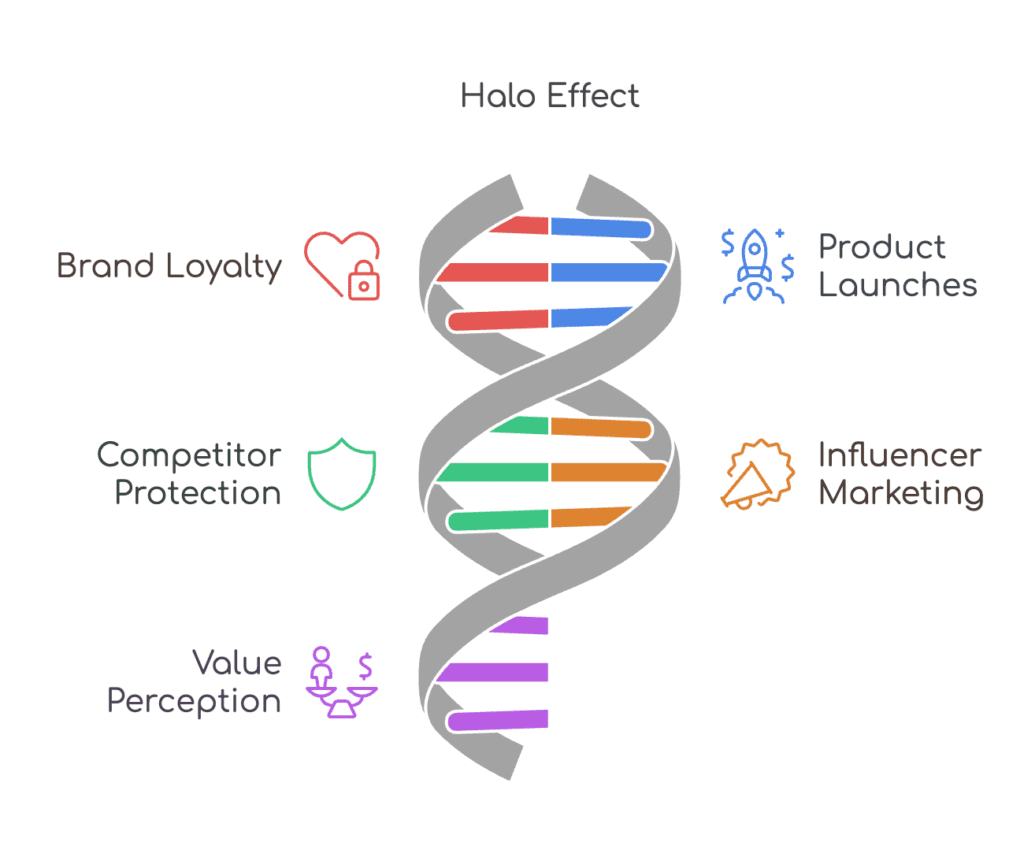
The brand halo effect allows one strong impression to influence how people judge other products, services, and qualities associated with the same company. It can begin with a flagship product, a memorable advertisement, attractive packaging, helpful customer service, an admired founder, or a trusted spokesperson.
The effect can improve product evaluations, reduce perceived risk, support premium pricing, and encourage customers to explore more of a brand’s portfolio. It can also influence loyalty. A customer who trusts one part of a brand may become more willing to buy from it again, recommend it, or forgive a minor mistake.
Yet a halo is not a substitute for quality. It creates an expectation. The product or experience must still confirm that expectation.
This distinction matters. Many discussions of the halo effect in marketing treat it as a simple persuasion tactic. They suggest that a beautiful website, celebrity endorsement, or popular product can make an entire company appear better.
That is only part of the story.
The halo effect in branding operates across several connected levels. It can shape product judgments, corporate reputation, portfolio sales, brand extensions, customer retention, and advertising attribution. It can also reverse. One poor experience can cast doubt over unrelated products and weaken years of accumulated trust.
To use the effect responsibly, marketers need to understand where it comes from, how it influences decisions, when it supports loyalty, and how to measure whether a genuine halo exists.
What Is the Brand Halo Effect in Marketing and Branding?
The brand halo effect is a psychological tendency in which a positive impression of one brand attribute influences judgments about other attributes.
A customer may decide that a product is reliable because its packaging looks premium. They may assume a new service will be easy to use because the company’s existing application is intuitive. They may trust an unfamiliar product because it carries the name of a company they already admire.
In each case, the customer is extending a known impression into an area where direct evidence is limited.
A Simple Brand Halo Effect Definition
In plain language, a brand halo occurs when success in one area makes the rest of the brand look better.
The starting point may be tangible. A product may be durable, fast, attractive, or easy to use. It may also be symbolic. A company may be associated with expertise, environmental responsibility, luxury, creativity, safety, or excellent service.
Once that association becomes strong, customers may use it as a shortcut when evaluating other offerings.
This is why a company known for exceptional engineering may receive the benefit of the doubt when entering a related product category. Customers assume that the standards behind the established product will carry over to the new one.
The assumption may be accurate. It may also be wrong.
That uncertainty is what makes the halo effect a cognitive bias rather than a direct assessment of product performance.
From Thorndike’s Halo Effect to Modern Consumer Behavior
The term “halo effect” is commonly traced to psychologist Edward L. Thorndike’s 1920 work on evaluation errors. Thorndike observed that an overall impression of a person could influence ratings of individual characteristics. Someone seen positively in one respect was more likely to receive positive judgments in other areas, even when the traits should have been assessed separately.
Marketing applies the same principle to companies, products, services, and public figures.
A strong overall impression can affect how customers rate specific qualities such as reliability, value, ethics, usability, or performance. A weak overall impression can lower those ratings.
This makes the halo effect a powerful cognitive bias in marketing. It helps people make fast decisions, but it can also prevent them from evaluating each attribute independently.
A Simple Marketing Example
Imagine a company that becomes known for producing a highly reliable fitness watch.
Customers appreciate its accurate tracking, long battery life, and clear interface. Over time, the company launches wireless headphones.
The headphones belong to a different product category. Yet existing customers may expect them to be reliable, well designed, and easy to use before reading a single review.
The watch has created a positive expectation around the company. That expectation has transferred to the headphones.
The new product still needs to perform. If it does, the halo becomes stronger. If it disappoints, the customer may question both the headphones and the broader brand promise.
How the Halo Effect Works as a Cognitive Bias in Marketing
Consumers rarely evaluate every available fact before making a decision.
Most buying situations involve limited time, incomplete information, competing messages, and uncertainty about future performance. Customers use mental shortcuts to reduce that complexity.
The halo effect is one of those shortcuts.
It allows a familiar signal to influence a wider judgment. That signal may be useful, but it is not always reliable.
First Impression Bias and Fast Brand Judgments
A customer may encounter a brand for the first time through a search result, advertisement, product package, store display, review, social post, or recommendation.
That first encounter can create first impression bias. The customer begins forming a general view before exploring the company in depth.
Several details can shape this view:
- The clarity and professionalism of the design
- The confidence and relevance of the message
- The quality of the product photography
- The credibility of the claims
- The speed and usability of the website
- The tone of customer reviews
- The reputation of the person recommending the product
These signals influence whether the brand feels trustworthy, premium, confusing, outdated, approachable, or risky.
A positive first impression does not guarantee a sale. It changes the starting point of the evaluation. The customer becomes more willing to continue, while a poor impression creates resistance that later evidence must overcome.
Positive Brand Associations and Affect Transfer
Brands become connected with ideas and emotions.
A sports brand might represent ambition. A financial service might represent security. A technology company might represent simplicity. A hotel might represent calm, privacy, or status.
These positive brand associations can spread between connected products and experiences.
This process is sometimes described as affect transfer. Positive feelings attached to one object influence feelings toward another object that appears related to it.
The customer does not always think through the connection consciously. They may simply feel more comfortable with the second product.
This emotional familiarity can be especially valuable when competing products have similar features. Customers often struggle to identify meaningful technical differences. The brand association becomes a deciding cue.
The Spillover Effect Under Uncertainty
The spillover effect becomes more influential when customers lack direct information.
Consider a buyer comparing two unfamiliar software platforms. Both promise similar features. One is produced by a company whose existing tools the buyer already uses and trusts. The other comes from a company they have never encountered.
The trusted company begins with an advantage. Its past performance reduces uncertainty around the new purchase.
The same pattern appears in consumer goods, banking, hospitality, professional services, and retail. When product quality cannot be verified before purchase, the brand helps customers estimate what the experience will be like.
The halo tends to weaken when buyers have strong independent evidence. Blind product tests, detailed technical comparisons, extensive trials, and direct experience can challenge assumptions created by the brand name.
Product, Portfolio, Corporate, and Advertising Halo Effects
“Brand halo” does not describe a single marketing outcome.
The term is used for several related effects. Confusing them can lead to weak strategy and inaccurate measurement.
A psychological halo concerns judgment. A portfolio halo concerns how one product affects other products. A corporate halo concerns how company-level beliefs influence individual offerings. An advertising halo may refer to cross-product conversions attributed to a campaign.
The effects may overlap, but they should not be treated as identical.
Product-Level Halo Effects
A product-level halo occurs when one visible attribute shapes the customer’s view of the whole product.
Attractive packaging may make food seem more premium. A clean user interface may make software appear more capable. A high price may signal superior quality. A sustainability claim may improve assumptions about the company’s wider ethics.
These conclusions can form before the customer has enough evidence to verify them.
The product-level halo can also work within a review. A customer who loves a product’s appearance may rate its usability, durability, and overall value more generously. A customer frustrated by one feature may judge the rest of the experience more harshly.
This matters in research. Attribute ratings can reflect an overall impression rather than independent evaluations. Brand-equity researchers have examined halo as a systematic component of brand judgments, not merely random survey error.
Portfolio and Corporate Halo Effects
A portfolio halo occurs when one successful product improves interest in other products from the same brand.
The customer may enter through a well-known product and later explore accessories, services, premium versions, or products in adjacent categories. The leading product becomes an entry point to the wider portfolio.
A corporate halo works at a broader level. Beliefs about the company influence perceptions of its products.
A company known for engineering competence may receive higher expectations for reliability. A company known for responsive service may gain trust when launching a subscription. A business with a strong social-impact reputation may be judged more favorably when entering a new market.
Research involving consumers in Argentina, China, Spain, and the United States found that halo effects varied across brands and markets. The effect was more pervasive for perceptions of product quality than for corporate social responsibility, and it was strongly related to brand recommendations.
Advertising and Channel Halo Effects
An advertising halo occurs when promotion for one product influences interest or sales for other products from the same brand.
A customer may click an advertisement for running shoes, browse the brand’s store, and purchase a jacket. The campaign did not produce a sale for the advertised product, but it contributed to a wider brand conversion.
Some advertising platforms use “brand halo” as a specific attribution category. Amazon Ads, for example, distinguishes promoted-product conversions from conversions involving other products belonging to the same brand. Brand-halo metrics exclude the promoted product and measure broader catalog activity associated with the campaign.
That definition is useful for campaign analysis. It should not be confused with the psychological halo effect.
A cross-product sale does not prove that a customer transferred perceptions of quality or trust. They may have bought the second product because it was cheaper, better stocked, more relevant, or prominently recommended.
Marketers need both behavioral and perceptual evidence before claiming that a campaign created a true brand halo.
| Type of halo | Starting signal | What it can influence | Useful evidence | Main risk |
|---|---|---|---|---|
| Product halo | One visible feature or experience | Evaluation of the entire product | Attribute ratings, blind tests, usability research | Customers overgeneralize from a superficial cue |
| Portfolio halo | A successful product | Interest in other products from the same brand | Cross-category purchasing, adoption paths, portfolio revenue | Excessive dependence on one product |
| Corporate halo | Company reputation or values | Trust in products, policies, and future actions | Reputation tracking, trust scores, recommendation | A corporate crisis spreads across the portfolio |
| Endorser halo | A celebrity, creator, expert, or partner | Brand attitude and purchase expectations | Brand-lift research, recall, sentiment | Poor fit or reputational controversy |
| Experience halo | Website, service, delivery, or support | Overall confidence in the company | Satisfaction, conversion, retention, interviews | One weak touchpoint damages unrelated judgments |
| Advertising halo | A campaign for a selected product | Activity involving other brand products | Holdout testing, attributed halo sales, matched markets | Cross-product sales are mistaken for psychological influence |
How Brand Halo Shapes Consumer Perception and Purchase Decisions
A halo does not force people to buy. It changes the way they interpret information.
Customers who already view a brand positively may process new claims more generously. They may notice supporting evidence more readily, tolerate small uncertainties, and feel less need to investigate every alternative.
Customers with a negative impression often do the opposite. They question the same claims, focus on risks, and look for reasons to reject the offer.
Perceived Quality and Perceived Value
Consumer perception is not the same as objective performance.
Customers assess quality through a mixture of direct evidence and indirect cues. Materials, design, price, packaging, reviews, reputation, origin, warranties, and retail environment all contribute to the judgment.
A strong halo can increase perceived quality before use. The customer expects the product to be better because it comes from a respected company or resembles other products they trust.
It can also raise perceived value.
Value is not determined by price alone. It reflects the expected benefits relative to the customer’s costs, effort, and risk. A trusted brand may appear to offer better value at a higher price because the customer expects reliability, support, convenience, or status.
This helps explain why some customers pay premiums for familiar brands even when lower-priced alternatives offer similar specifications. The buyer is not purchasing features alone. They are purchasing confidence in the likely outcome.
Purchase Intention and Perceived Risk
Purchase intention often increases when uncertainty falls.
A new product normally presents several questions. Will it work? Will it last? Will it integrate with existing products? Will customer support help if something goes wrong? Will returning it be difficult?
A trusted brand provides partial answers before the customer investigates the details.
This does not remove risk. It changes the customer’s estimate of risk.
The effect is especially useful for brand extensions, subscriptions, expensive purchases, and products that are difficult to evaluate before use.
A company can benefit from this trust only while its actions support the expectation. Repeated disappointments teach customers that the brand name is no longer a dependable signal.
When the Halo Is Strongest or Weakest
Halo strength is not constant.
It often becomes stronger when:
- The customer has limited product knowledge
- The product cannot be tested before purchase
- The decision is complex or time-sensitive
- The customer already identifies with the company
- Competing products appear similar
- The brand association is relevant to the new offer
- The original positive experience was memorable
The effect may weaken when customers possess strong category expertise, have access to independent evidence, see little connection between the products, or encounter information that contradicts the brand promise.
Cultural and market differences also matter. Cross-national research has shown that halo responses can vary between brands and countries. Marketers should not assume that a reputation built in one market will transfer with equal strength elsewhere.
Brand Halo vs Brand Awareness, Image, Reputation, Equity, and Loyalty
Several branding concepts sit close to the halo effect. They are related, but they answer different questions.
Clear definitions help marketing teams avoid measuring the wrong outcome.
Brand Awareness, Brand Image, and Brand Perception
Brand awareness concerns whether customers recognize or remember a brand.
A company can have high awareness without a positive halo. People may know the name but associate it with poor service, high prices, or past controversy.
Brand image is the network of ideas, qualities, emotions, symbols, and experiences linked with the brand.
Brand perception describes how customers currently interpret those signals. Perception may differ across audiences. Existing customers, employees, investors, and first-time buyers can hold very different views of the same company.
The halo effect influences perception by allowing one prominent association to affect other judgments.
Awareness makes the brand mentally available. Image gives it meaning. Perception reflects how that meaning is interpreted. Halo describes the transfer of an impression across attributes or offerings.
Brand Reputation and Brand Equity
Brand reputation develops through accumulated performance, public behavior, communication, and stakeholder experience.
It is broader and more durable than a single campaign impression. A reputation for quality can support a halo, while a reputation for unreliability can create negative spillover.
Brand equity refers to the added value associated with the brand name. It may appear in higher consideration, stronger loyalty, price premiums, easier product launches, better distribution, or greater customer lifetime value.
The halo effect can contribute to brand equity because positive associations make customers more willing to choose the brand. It can also complicate brand-equity research. Respondents may rate every product attribute positively because of their overall opinion, even when they lack specific evidence.
This is why halo should be treated as both a commercial advantage and a potential measurement bias.
Brand Halo and Brand Loyalty
Brand loyalty involves a continuing preference or commitment toward a brand.
A halo can support loyalty, but the concepts are not interchangeable.
The halo effect shapes expectations and evaluations. Loyalty is demonstrated through repeated choice, resistance to alternatives, advocacy, emotional attachment, or commitment over time.
A customer may view a brand positively without buying it repeatedly. They may admire the company but prefer a competitor’s price, availability, or features.
A customer may also repurchase without a strong emotional bond. Convenience, habit, contracts, ecosystem lock-in, or switching costs can create repeated behavior.
A durable loyalty strategy needs more than favorable perception. It needs reliable delivery.
How Brand Trust Becomes Brand Loyalty and Customer Retention
A brand halo can open the door to loyalty. It cannot carry the relationship by itself.
The path from positive impression to long-term commitment contains several stages. Each stage can strengthen or break the relationship.
The Halo-to-Loyalty Chain
The process usually begins with a positive signal.
The customer sees evidence of quality, competence, popularity, values, or service. That evidence shapes expectations. Higher expectations reduce perceived risk and make trial more likely.
The customer then experiences the product.
If the experience confirms the expectation, brand trust grows. Trust means the customer believes the company is likely to deliver again.
Repeated delivery turns trust into preference. Preference can lead to repeat purchase, cross-category buying, recommendation, and resistance to competitors.
The sequence can be expressed as:
Positive signal → favorable expectation → lower perceived risk → initial trial → confirmed satisfaction → trust → repeat purchase → advocacy
The critical point sits in the middle. The halo may generate trial, but product and service performance determine whether the relationship continues.
When the experience falls short, the original halo can make disappointment worse. Customers feel that the brand has violated an expectation it helped create.
Repeat Purchase, Customer Retention, and Cross-Buying
Customer retention is stronger evidence of value than a single conversion.
A customer acquired through a successful campaign may never return. A retained customer continues to find the offer useful, reliable, or difficult to replace.
To understand whether a halo supports retention, marketers should examine customer behavior over time.
They can compare customers who entered through a flagship product with those who entered through other products. They can track how quickly each group makes a second purchase, which categories they explore, how long they remain active, and how their lifetime value develops.
Cross-buying is especially important.
A genuine portfolio halo should make customers more willing to purchase beyond the product that first attracted them. If customers love the hero product but ignore everything else, the company has product success without strong portfolio transfer.
Advocacy, Forgiveness, and Competitive Resilience
Loyal customers often become advocates, but loyalty does not produce every form of word of mouth equally.
Research has found a strong relationship between brand loyalty and offline word of mouth, while the relationship with online word of mouth can depend more heavily on self-brand connection and digital behavior.
A strong relationship may also create limited forgiveness.
Customers sometimes give a trusted brand more time to explain a mistake. They may interpret an isolated failure as an exception rather than proof that the entire company has declined.
That protection has limits.
Forgiveness is more likely when the company has a long record of good performance, responds quickly, accepts responsibility, and fixes the underlying problem. It weakens when failures repeat or the company appears dismissive.
A positive halo creates reputational credit. It should not be treated as permission to lower standards.
Hero Products and Flagship Products as Brand-Halo Engines
A hero product is the product most capable of attracting attention and demonstrating what a brand stands for.
It may be the bestseller, but sales volume alone does not make a product a hero. A hero product should express the company’s most important strength in a memorable way.
A flagship product plays a similar strategic role. It leads the portfolio, attracts media attention, or defines expectations for the wider company.
How to Identify a Genuine Hero Product
A strong hero product usually combines performance with symbolic value.
It solves an important problem. Customers remember it. Reviews are strong. The product is easy to demonstrate. Its benefits are relevant to the company’s future strategy.
A product can sell well without creating a halo. A low-priced commodity may generate volume but communicate little about the brand.
The best halo product gives customers a reason to believe something meaningful about the company.
For example, a project-management platform might use an exceptionally simple onboarding experience as proof of its commitment to usability. A skincare company might become known for one well-supported formula that demonstrates scientific credibility. A restaurant might build its reputation around one signature dish that represents quality and consistency.
The common factor is not fame. It is concentrated proof.
Focused Marketing Versus Equal Portfolio Support
Many companies divide attention evenly across too many products.
This can weaken memory. Customers struggle to understand what the brand is best known for.
Concentrating communication around one standout offer can create a clearer mental position. Once the product earns trust, the company can introduce related offers through a deliberate progression.
This does not mean ignoring the rest of the portfolio. The role of the flagship is to attract attention and establish credibility. Supporting products must then reinforce the same promise.
Focused marketing works poorly when the hero product has little connection to the company’s strategic direction. It can also fail when the leading product attracts an audience that has no reason to consider the wider range.
When a Hero Product Becomes a Liability
A strong flagship can create dependence.
Customers may know the product but not the company. They may reject changes to it. Other products may appear secondary or less authentic. The business may continue investing in the flagship after the category begins to decline.
Expectation inflation is another risk. Every new launch gets compared with the company’s greatest success. A good product may appear disappointing simply because the standard is unusually high.
Companies should plan for the next source of credibility before the existing flagship loses relevance. The goal is not to abandon the hero product. It is to transfer its strongest associations into a broader, more resilient brand promise.
Brand Extensions, Category Fit, and Brand Dilution
A brand extension uses an established brand name to enter a new product category or offer a meaningfully different product.
Extensions can reduce launch friction. Customers already recognize the name and carry expectations from the parent brand.
The same advantage creates risk. A poor extension can damage more than the new product.
How Positive Associations Transfer to a Brand Extension
A strong parent brand gives an extension a ready-made set of associations.
Customers may expect the new product to share the company’s quality, design, expertise, service, values, or status.
This can increase awareness and trial while reducing the cost of explaining who the company is.
Retailers and partners may also view the product as less risky because the parent brand already has demand and credibility.
The transfer works best when the extension uses a capability customers already believe the company possesses.
A trusted audio brand launching headphones feels understandable. A company known for secure payments launching fraud-prevention software also has a clear logic.
Category Fit and Consumer Identification
Category fit describes how naturally the extension connects with the parent brand’s products, capabilities, image, or customer needs.
High-fit extensions are easier to understand. Customers can see why the company is qualified to make the product.
Low-fit extensions require more explanation. The customer must be persuaded that the company has relevant competence or a credible reason to enter the category.
Research on brand extensions has found that consumer-company identification can change the importance of fit. Consumers who strongly identify with a company may show similar purchase intentions across high-fit and low-fit extensions, while weakly identified consumers tend to respond more favorably when fit is high.
This does not mean loyal audiences will accept anything. Strong identification gives a brand more room to introduce an unexpected offer. The product still needs a convincing story and credible performance.
Line Extension Failure, Cannibalization, and Brand Dilution
Brand dilution occurs when new products weaken the meaning, distinctiveness, or credibility of the parent brand.
Dilution can result from poor quality, excessive variants, inconsistent pricing, weak category fit, or confused positioning.
A premium brand may weaken its status by launching too many low-cost products. A specialist brand may lose credibility by entering unrelated categories without proof of expertise. A company known for simplicity may undermine its promise by creating an overly complex range.
Cannibalization is different.
A new product cannibalizes when it takes sales from another company product. This may be acceptable if it improves margins, retains customers, or protects the brand from competitors.
Dilution concerns meaning. Cannibalization concerns where revenue moves.
A successful extension strategy measures both.
Customer Experience, UX, Design, Packaging, and Service Halos
Customer experience includes every interaction a person has with the brand.
Advertising shapes expectations. The website affects confidence. Packaging influences quality judgments. Delivery signals reliability. Support determines how the company behaves when something goes wrong.
Any of these touchpoints can become the source of a halo.
Visual Design and Packaging as Quality Signals
Customers use design as evidence.
Clear hierarchy suggests competence. Consistent typography suggests care. Strong product photography lowers uncertainty. Quality materials can support premium positioning. Accessible instructions signal respect for the customer.
Design can create a halo because customers assume that visible attention to detail reflects invisible attention to detail.
That assumption may be reasonable. A company that invests in clear packaging may also have disciplined product processes.
It may also be misleading. Attractive presentation cannot prove durability, safety, or performance.
The strongest design halo is supported by substance. Packaging should make real value easier to understand rather than distract from weak value.
Website UX and Digital Brand Perception
A website is often treated as a sales channel. Customers treat it as evidence about the company.
A slow, confusing, or broken website can make the organization appear unreliable. A clear and responsive experience can increase confidence beyond the interface itself.
Nielsen Norman Group has noted that users can generalize from an experience with one part of a website to the organization and its products. A positive first impression can influence later judgments, while a negative impression can spread through the rest of the experience.
This matters for companies that sell offline as well as online.
A customer researching a medical practice, construction company, university, or hotel may use the website to judge expertise and professionalism before making contact.
The interface does not need to be visually extravagant. It needs to be fast, clear, credible, and appropriate for the decision.
Customer Service, Delivery, and Post-Purchase Experience
Many halos are created after the sale.
Fast delivery can reinforce reliability. Thoughtful onboarding can confirm expertise. A simple return process can reduce future purchase risk. A helpful support interaction can improve the customer’s view of the entire company.
Service recovery is especially powerful.
When something goes wrong, customers learn how the company behaves under pressure. A fair and efficient response may create more trust than a problem-free but forgettable transaction.
The opposite is also true. One dismissive interaction can make the customer question the company’s values, products, and future promises.
Celebrity Endorsement, Influencer Marketing, Sponsorship, and Social Proof
Brands often borrow credibility from people, institutions, events, and communities.
A celebrity endorsement transfers attention and associations from a public figure to a product. Influencer marketing uses a similar mechanism, often with stronger audience intimacy and category relevance.
The borrowed halo can create rapid awareness. It also introduces a reputational dependency the company does not fully control.
How Celebrity and Influencer Halos Transfer
An admired person may represent success, expertise, beauty, humor, discipline, taste, or social status.
When that person endorses a brand, some of those qualities may become connected with the product.
The strength of the transfer depends on how the audience sees the endorser.
A famous athlete may be credible for training equipment because performance expertise feels relevant. A specialist creator may influence a smaller audience but possess deeper trust within the category.
Popularity alone is not enough. The endorser needs to contribute meaning that helps the customer understand or trust the offer.
Endorser-Brand Fit and the Vampire Effect
Endorser-brand fit concerns whether the person’s identity, expertise, audience, and values match the product.
Weak fit makes the relationship look transactional. The audience remembers the celebrity but learns little about the brand.
This creates the vampire effect. The endorser attracts attention while draining attention away from the product.
Marketers should test more than advertisement liking. They need to measure brand recall, message recall, product understanding, credibility, and purchase response.
The strongest partnership makes the product central to the story. The audience should understand why this person chose this brand and why that choice matters.
Association Risk and Contractual Safeguards
External partners can generate negative spillover.
A controversy may change the qualities associated with the endorser. Customers then reconsider the brand’s judgment, values, or motives.
Research on diminishing celebrity halos highlights the role of consumer attribution. Reactions depend partly on whether audiences see the negative event as intentional, controllable, repeated, or connected with the individual’s character. Social-media amplification and cultural change can accelerate the damage.
Brands should evaluate reputational risk before signing a partner. Contracts should address conduct, disclosure, content approval, termination rights, and crisis procedures.
No contract can remove the public impact of a poor association. Strategic fit and ongoing monitoring remain necessary.
Brand Consistency, Positioning, and Distinctive Assets
Brand consistency helps customers connect separate experiences to the same promise.
Consistency does not mean repeating identical words and designs everywhere. It means that the brand remains recognizable and believable across channels.
A company cannot build a strong halo if every product communicates a different standard.
Building a Clear Messaging Hierarchy
A strong brand needs a leading idea.
That idea should answer a simple question: what should customers expect from this company that matters to them?
Supporting messages should provide reasons to believe the promise. Product features, customer evidence, expert credentials, service standards, and company behavior should point in the same direction.
Without a hierarchy, brands collect disconnected claims.
They describe themselves as affordable, premium, friendly, advanced, sustainable, exclusive, and suitable for everyone. The audience remembers none of it.
A halo needs focus. One association should lead, while other messages add proof and relevance.
Consistency Across Channels Without Repetition
The same brand can communicate differently on a product page, retail package, social video, support email, and investor presentation.
The format changes. The underlying meaning should not.
A brand known for clarity should not produce confusing instructions. A company positioned around accessibility should not create an inaccessible website. A premium service should not deliver careless support.
Distinctive assets help connect these experiences. Logos, colors, shapes, characters, sounds, language patterns, and design systems make the brand easier to recognize.
Recognition supports the halo because customers can only transfer an impression when they identify the relationship between the experiences.
Operational Proof Behind the Brand Promise
Communication can create an expectation. Operations decide whether it survives.
A company that promises speed needs efficient processes. A company that promises safety needs rigorous controls. A company that promises personal service needs trained and empowered employees.
This is where many halo strategies fail.
Marketing creates a polished image, but the customer encounters poor delivery, unclear policies, or inconsistent quality. The gap between promise and performance becomes evidence against the brand.
The strongest halo grows from operational truth. Marketing makes that truth visible.
Brand Halo Effect Examples, Case Studies, and Lessons
Famous brands are useful for explaining halo effects, but examples should not become myths.
Sales growth can have many causes. Distribution, pricing, product quality, media spending, market conditions, and category growth may all contribute.
A strong case analysis identifies the likely mechanism rather than assuming that every successful launch resulted from a halo.
Apple and Ecosystem-Based Halo Effects
Apple is frequently used as a portfolio-halo example because successful products have introduced customers to a wider ecosystem.
A customer may begin with one device, learn the interface, create an account, purchase digital content, and later find other products easier to adopt.
The halo is not created by brand fame alone. It is supported by recognizable design, connected services, retail presence, and consistency across products.
The lesson is not that every company should copy Apple’s aesthetics or create an ecosystem.
The useful lesson is that a flagship product can become an entry point when the wider portfolio preserves the qualities customers valued in the first experience.
Retail, CPG, Banking, Automotive, and Service Examples
Retailers often build halos around private-label products that exceed expectations. Once shoppers trust one product, they may become more willing to try other products carrying the same label.
Consumer packaged goods companies use familiar master brands to reduce uncertainty around new flavors, formats, and adjacent categories.
Automotive companies sometimes create high-performance or technologically advanced models that influence perceptions of the rest of the range. Many customers never buy the flagship vehicle, but they connect its engineering or design with more accessible models.
Banks and insurers can create product-level advertising that affects broader corporate perception. A documented banking case described cross-journey analysis used to understand how product advertising influenced wider brand equity and supported budget reallocation.
Service companies often build a halo around one signature experience. A hotel may become known for exceptional check-in. A consultancy may build authority through one influential research report. A software company may use a valuable free tool to demonstrate expertise.
Small-Business and Personal-Brand Examples
A halo does not require a global advertising budget.
A local bakery can become known for one signature product. That product gives new customers a low-risk reason to visit. A consistently good experience then encourages them to try the wider menu.
A professional service firm can create a halo through a highly useful guide, workshop, assessment, or consultation. The resource gives potential clients evidence of expertise before they purchase the full service.
A personal brand can benefit from a similar effect. One strong article, presentation, case study, or project can shape how people judge the creator’s broader abilities.
Small companies should concentrate on credible proof rather than superficial polish. A narrow area of exceptional performance can create a stronger halo than broad claims of of exceptional performance can create a stronger halo than broad claims of excellence.
The Horn Effect, Negative Halo, and Brand-Reputation Crises
The horn effect is the negative counterpart of the halo effect.
One unfavorable trait or experience influences judgments about other parts of the brand.
A failed delivery may make the company seem disorganized. A billing problem may create doubts about honesty. A security incident may affect confidence in unrelated services. A public controversy may change how customers interpret previous actions.
Negative impressions can spread quickly because they raise questions about risk.
Common Triggers of a Negative Halo
Negative halos often begin with a visible failure that appears to reveal something deeper.
A defective product may be treated as evidence of weak quality control. A dismissive response may be treated as evidence that the company does not care about customers. Misleading environmental claims may create doubts about every company statement.
Common triggers include product recalls, data breaches, hidden fees, repeated outages, poor returns, offensive campaigns, executive misconduct, creator controversies, and inconsistent service.
The severity of the horn effect depends on the meaning customers assign to the event.
An isolated shipping delay may remain a small operational problem. A delay followed by dishonest communication may become a trust problem.
When Prior Reputation Protects the Brand
A strong reputation can act as a temporary buffer.
Customers may interpret one failure as unusual because it conflicts with years of positive experience.
This protection is strongest when the company responds in a way that matches its established values. A trusted brand that communicates clearly, accepts responsibility, and repairs the problem reinforces the belief that the incident was an exception.
Silence or denial can reverse that advantage.
Customers may conclude that the previous reputation was undeserved. The same halo that once protected the company then increases the sense of betrayal.
A Negative-Halo Recovery Framework
Recovery should begin with the cause of the problem, not the appearance of the problem.
The company must identify what happened, who was affected, and which brand associations are now at risk. It should correct the operational failure, communicate what has changed, and provide fair remedies.
A practical recovery process includes:
- Confirm the facts and stop the ongoing harm
- Identify the audiences, products, and associations affected
- Accept responsibility where responsibility is justified
- Repair the product, process, policy, or partnership
- Compensate customers fairly
- Communicate specific corrective actions
- Track trust, sentiment, retention, and complaint patterns
- Rebuild through repeated evidence rather than a single campaign
The recovery message should be proportionate. A minor mistake does not need theatrical language. A serious failure does not need vague reassurance.
Trust returns when customers see proof that the company understood the problem and changed its behavior.
How to Build a Positive Brand Halo Step by Step
A brand cannot order customers to form a halo. It can create the conditions that make positive transfer more likely.
The work begins with a real strength.
Audit Existing Perceptions and Halo Sources
Start by identifying what currently shapes the brand’s overall image.
Ask customers what first comes to mind when they hear the name. Study reviews, support conversations, search queries, sales paths, and social discussions. Compare the language used by loyal customers with the language used by people who stopped buying.
Look for concentration.
One product, feature, employee interaction, policy, founder, or campaign may be influencing the entire brand more than the marketing team realizes.
The audit should also identify negative signals. A positive campaign cannot compensate indefinitely for a consistently poor checkout, unreliable delivery, or confusing product range.
Design a Signature Product or Experience
Choose a source of proof that matters to the target customer and reflects a capability the business can maintain.
The signature experience might be a product, but it could also be fast onboarding, transparent pricing, expert guidance, a strong guarantee, or exceptional problem resolution.
Make the experience distinctive enough to remember and consistent enough to trust.
Avoid building the halo around a feature competitors can copy easily. Durable halos usually come from systems, culture, expertise, or accumulated customer evidence.
Reinforce and Extend the Halo Carefully
Once the signature experience is working, connect it with the wider brand.
Show how the same standards appear in other products. Use customer stories that demonstrate transfer. Make cross-selling relevant rather than aggressive. Introduce extensions that preserve the brand’s central promise.
Expansion should be tested.
A halo that appears strong among existing loyal customers may not influence new customers. A positive perception in one market may not transfer to another. A high-fit product may succeed while a distant extension creates confusion.
The brand should scale based on evidence, not confidence alone.
Brand Halo Measurement, Metrics, and Research Design
Brand halo measurement is difficult because several forces move at the same time.
Advertising may increase awareness. Discounts may raise sales. Distribution may improve. Existing customers may be more likely to see the campaign. Seasonal demand may lift the entire category.
A simple increase in portfolio revenue does not prove a halo.
The measurement design needs to separate perception, behavior, and incrementality.
Measuring Perception Without Reproducing Survey Bias
Surveys can reveal a halo and accidentally create one.
If respondents first rate their overall liking of a brand and then rate several attributes, the overall judgment may influence every later response.
Researchers can reduce this problem by randomizing attribute order, separating overall evaluations from specific ratings, and including behavioral or indirect measures.
Blind or de-branded comparisons are useful.
If customers rate a product highly when the brand is visible but not when it is hidden, the difference may indicate the influence of brand meaning. It does not automatically prove deception. The visible brand can provide legitimate information about service, warranties, or reliability. The result shows that the name changes the evaluation.
Segment analysis is also critical. Existing customers may display a strong halo, while non-customers remain unconvinced.
Brand-Halo KPI Dashboard
A complete dashboard should separate leading indicators from business outcomes.
Perceptual metrics show what customers believe. Behavioral metrics show what they do. Financial metrics show the commercial value associated with that behavior.
| Measurement layer | Recommended metrics | What the metrics help reveal | Important limitation |
|---|---|---|---|
| Awareness | Unaided awareness, aided awareness, branded search, share of search | Whether more people recognize or recall the brand | Awareness can rise without positive perception |
| Perception | Favorability, quality ratings, value ratings, trust, attribute associations | Whether the overall image and specific judgments are improving | Ratings may contain halo bias |
| Consideration | Purchase intention, preference, trial intent, shortlist inclusion | Whether positive perception is moving customers toward action | Intent does not always become behavior |
| Acquisition | Conversion rate, new-customer rate, cost per acquisition | Whether the brand attracts buyers efficiently | Promotions and distribution may drive the result |
| Portfolio behavior | Cross-category penetration, product adoption sequence, non-promoted sales | Whether customers explore beyond the entry product | Cross-buying may result from merchandising rather than halo |
| Loyalty | Repeat-purchase rate, retention, churn, recommendation, share of wallet | Whether trust survives after direct experience | Repeat behavior can reflect habit or switching costs |
| Financial value | Price premium, margin, customer lifetime value, incremental portfolio revenue | Whether the halo contributes to durable economic value | Causal attribution requires a control or counterfactual |
Experiments, Attribution, and Portfolio-Lift Analysis
The strongest measurement approach compares what happened with what would probably have happened without the marketing activity.
Controlled audience holdouts can compare exposed and unexposed customers. Geographic tests can compare similar regions. Matched-market analysis can create a benchmark when randomization is impossible.
Pre-and-post comparisons are weaker on their own because many outside factors may change during the test.
For ecommerce brands, marketers can examine whether customers exposed to a campaign buy non-promoted products at a higher rate than comparable customers who were not exposed.
A practical portfolio-halo estimate is:
Incremental halo revenue = non-promoted product revenue in the exposed group minus expected non-promoted product revenue based on the control group
The expected value should account for differences in customer history, price, promotion, availability, seasonality, and channel exposure.
Platform attribution can provide useful directional evidence. Amazon Ads reports brand-halo activity involving products from the same brand while separating it from promoted-product activity. The platform also states that a conversion is a promoted and halo categories. citeturn635925search15turn635925search18
That reporting still answers an attribution question, not a full causal question. Holdout testing provides stronger evidence of incrementality.
Brand Halo Strategies by Industry and Business Model
Halo strategy changes with the buying process.
A grocery purchase may be low cost and frequent. Enterprise software may involve several decision-makers and months of evaluation. Luxury goods may depend heavily on symbolism. Professional services may be difficult to judge before delivery.
The source of credible transfer must fit the category.
Ecommerce, Retail, Marketplaces, and CPG
Ecommerce brands can build a halo around a hero SKU, review profile, delivery promise, or returns experience.
The product page should make the wider brand easy to explore without distracting customers from the initial purchase. Bundles and recommendations should follow genuine use cases.
Retailers can study basket data to identify product pairs and adoption paths. They should distinguish between cross-buying caused by brand trust and cross-buying caused by discounting or placement.
Consumer packaged goods brands often use familiar names to launch variants and adjacent products. The risk is excessive expansion. Too many weak variations can reduce shelf clarity and weaken the meaning of the master brand.
SaaS, B2B, and Professional Services
B2B halos often begin with proof of competence.
A free tool, benchmark report, successful implementation, technical certification, or expert-led consultation can influence how buyers judge the wider company.
Thought leadership creates a halo only when the expertise connects with the service. High traffic alone does not prove buying relevance.
In SaaS, one highly valued feature may attract customers. The company must then demonstrate that security, support, integrations, onboarding, and reliability meet the same standard.
Professional services firms should avoid depending entirely on one founder or visible expert. The personal halo needs to transfer into processes, team capability, and client outcomes.
Luxury, Automotive, Hospitality, and Experience Brands
Luxury brands depend heavily on symbolic transfer.
Heritage, craftsmanship, scarcity, retail environment, spokespersons, and cultural associations influence how products are judged. A lower-priced entry product may give new customers access to the brand, but excessive accessibility can weaken exclusivity.
Automotive brands may use a technologically advanced or high-performance model to shape expectations for the wider range.
Hospitality brands create halos through sensory and service details. The arrival experience, room design, staff behavior, cleanliness, and problem resolution all influence the guest’s overall judgment.
In experience categories, employees often carry the brand promise more directly than advertising.
Ethical Use of the Halo Effect and Bias Control
The halo effect is part of normal human judgment. Using strong evidence and coherent branding is not inherently unethical.
The ethical problem begins when a company encourages customers to infer qualities that it knows are unsupported.
Responsible Persuasion Versus Misleading Inference
A premium design can communicate care. It should not be used to disguise unsafe materials or weak performance.
An expert spokesperson can explain a product. Their authority should not be used to support claims outside their expertise.
Environmental imagery can express a legitimate commitment. It should not imply sustainability that the company cannot demonstrate.
Responsible halo strategy brings real strengths into focus. It does not manufacture an attractive impression to replace evidence.
Claims involving health, safety, finance, environmental impact, and professional competence need particular care because customers may suffer serious harm when they rely on false assumptions.
Inclusive Design and Representation
Marketers should consider which qualities they present as signals of competence, trust, or aspiration.
Attractiveness-based halos can reinforce narrow standards. Expensive visual cues can make credible low-budget businesses appear less trustworthy than polished companies with weaker practices.
Inclusive marketing should use diverse forms of expertise and representation. Accessibility should be treated as part of quality rather than an optional feature.
The goal is not to remove all emotional meaning from branding. It is to avoid teaching audiences that credibility belongs to one appearance, accent, age, background, or lifestyle.
Preventing Halo Bias Inside the Company
Marketing teams are vulnerable to halo effects too.
A proposal from a famous agency may receive less scrutiny. An idea supported by a senior executive may be rated more highly. A campaign that looks beautiful may be assumed to be strategically strong.
Companies can reduce internal bias through blind concept tests, standardized evaluation criteria, independent review, and pre-agreed success metrics.
Product tests should separate brand identity from performance where possible.
A strong brand should be willing to discover when the name is doing more work than the product.
A 90-Day Brand Halo Audit and Improvement Plan
A 90-day program cannot create a lasting reputation from nothing. It can identify the strongest existing signal, correct obvious problems, and establish a better measurement system.
Days 1–30: Diagnose Current Halo and Horn Signals
Begin with evidence.
Map the main customer journeys. Identify where people first encounter the brand, what convinces them to buy, and where trust weakens.
Review brand research, search behavior, reviews, customer-service records, return reasons, retention data, and cross-category purchasing.
Interview customers who love the brand and customers who left. Ask them what one experience most influenced their overall view.
Establish baseline measures for awareness, quality, value, trust, purchase intention, retention, and portfolio behavior.
Days 31–60: Improve the Signature Experience
Choose the experience with the greatest ability to influence wider perception.
Correct the strongest negative signal first. A campaign should not send more customers into a broken checkout or unreliable service process.
Clarify the brand promise. Improve the product, onboarding, packaging, website, or support interaction that provides the best proof of that promise.
Create consistent evidence across key channels. The message, design, product page, and employee behavior should support the same expectation.
Test the new experience with customers before expanding it.
Days 61–90: Test Transfer and Measure Incrementality
Run a controlled campaign around the signature product or experience.
Measure its effect on the promoted offer and the wider portfolio. Compare exposed customers with an appropriate control group.
Track whether people explore related categories, whether trust rises, and whether the effect differs between new and existing customers.
Test one high-fit extension or cross-sell rather than promoting the entire portfolio.
At the end of the period, document which association transferred, which audience responded, and which business outcome changed.
Scale only the parts supported by evidence.
Frequently Asked Questions About the Brand Halo Effect
What is the brand halo effect in one sentence?
The brand halo effect occurs when a positive impression of one product, experience, person, or brand attribute improves how customers judge other qualities and offerings associated with the same brand.
Is the halo effect the same as brand equity?
No.
The halo effect is a judgment process in which one impression influences other evaluations. Brand equity is the wider value created by the brand name, including awareness, preference, loyalty, pricing power, and commercial advantage.
A positive halo can contribute to brand equity. It can also distort the surveys used to measure it.
How does the halo effect influence brand loyalty?
A positive halo can increase trust and reduce the risk customers feel when trying a product.
If the experience confirms those expectations, customers become more likely to purchase again, explore other products, and recommend the company.
The halo supports the beginning of loyalty. Consistent performance sustains it.
Does a brand halo guarantee customer retention?
No.
A strong reputation may attract customers and encourage initial trial. Retention depends on whether the product continues to solve the customer’s problem at an acceptable price and level of effort.
Competitors, changing needs, poor service, and product decline can overcome a positive halo.
Can a small business create a brand halo?
Yes.
A small business can build a halo around one signature product, exceptional service standard, specialist resource, strong guarantee, or memorable customer experience.
The advantage comes from concentrated proof, not company size.
What is the difference between the halo effect and the horn effect?
The halo effect spreads a favorable impression. The horn effect spreads an unfavorable impression.
A positive product experience may improve confidence in the company’s other products. A serious service failure may create doubts about the entire company.
How can marketers measure a brand halo?
Marketers should combine perception research with behavioral data.
They can measure quality perceptions, trust, consideration, cross-category purchasing, retention, recommendation, and non-promoted portfolio sales.
Controlled experiments, audience holdouts, matched markets, and blind product tests help separate halo effects from seasonality, promotions, and existing demand.
Can good website design create a halo effect?
Yes.
A clear, responsive, credible website can improve the customer’s overall impression of a company. Users may interpret a well-designed experience as evidence of profes. Poor usability can create the opposite response. citeturn106847search1
Design works best when the wider operation supports the impression it creates.
Can a celebrity endorsement damage a brand?
Yes.
A poorly matched celebrity may distract from the product or make the promotion look inauthentic. A later controversy can also transfer negative associations to the company.
Brands should evaluate audience fit, values, expertise, conduct risk, and crisis procedures before entering the partnership.
What is the biggest mistake brands make with the halo effect?
The biggest mistake is assuming that positive perception can replace product performance.
A halo creates expectations. When the company repeatedly fails to meet them, the same effect can reverse and damage the wider portfolio.
Building a Halo That Deserves to Last
The brand halo effect is powerful because customers do not evaluate every product, feature, and claim in isolation.
They carry past experiences forward. They use design, reputation, social proof, service, and familiar names to estimate what an unfamiliar offer will be like.
That transfer can increase consideration, lower perceived risk, support brand extensions, and strengthen loyalty. It can also hide weak products, distort research, and spread negative impressions across a portfolio.
The difference lies in what supports the halo.
A fragile halo is created by attention without evidence. It depends on attractive presentation, borrowed fame, or one unusually successful campaign.
A durable halo is earned through a clear promise, concentrated proof, consistent delivery, and responsible expansion.
The strongest brands do not ask customers to believe that every product is excellent because one product succeeded.
They build systems that make the customer’s expectation increasingly likely to be true.